Showing posts with label Book Review. Show all posts

Friday, May 30, 2014

"In Praise of Shadows" by Jun'ichiro Tanizaki


An essay on aesthetics by the Japanese novelist, this book explores architecture, jade, food, and even toilets, combining an acute sense of the use of space in buildings. The book also includes descriptions of laquerware under candlelight and women in the darkness of the house of pleasure.
-Goodreads

I'm just starting to come to terms with my interest in Eastern culture, especially compared to the West. When I think about it, it's been a part of my life for a very long time: growing up, our closest family friends were Japanese, and we would often receive presents from Japan; fans, boxes, rice seasonings, paper.These objects had a certain air of mystery and ...."differentness" about them. The colors, the textures: I knew what the objects were, but at the same time they weren't quite the same as the ones I was used to. And with a brother eight years older, going through a socially tragic anime phase, I was exposed to Japanese media very early on as well. For a long time all I thought of it as was different, but in recent years I've started to dig deeper- what makes it different? What are the fundamentals of Eastern culture as opposed to those of Western that put them at odds? What are the contrasts in the philosophies, the storytelling? 

I think the answers can be found in media as basic as music videos and tv shows- if there are ideas at the core of a society, they'll manifest in whatever that society creates. So while visual kei band videos have made me question gender stereotypes, and animes have made me wonder about the roots of Eastern mythology as compared to Western, I've also started to branch into literature for answers to my questions. It was completely by coincidence that I found In Praise of Shadows just as my interest in these subjects was starting to blossom. I was organizing my bookshelves (they were just built and I was putting all my books on them) and I came to a bunch that were my brother's. They were mainly graphic novels from his college courses, so I assumed Tanizaki's book to be as well. But when I opened it up I didn't see pictures, so I read the back to find out what it was about. Turns out, an essay on Japanese aesthetic and sense of beauty and the effects of Westernization on the Japanese way of life. I almost cried. 

In Praise of Shadows is an essay in some regards: in others, the ramblings of a man disenchanted with the bright lights of the West. He begins by describing his struggles in building a traditional Japanese house for himself, trying to reconcile his desire for the traditional Japanese looks and fixtures with the necessities of the modern, westernized world. In a sense, trying to exclude Western presence from a house is trying to create an illusion; it will be there, but the struggle is in making it appear to not be. From this point he continues to talk about light through paper, toilets, jade, feminine beauty, the Noh theater, and other seemingly random aspects of Japanese culture. And for this reason many critics have said of the essay that it is disjointed, not structured well. But what Tanizaki wishes to do is to provide a range of examples of the way the modern world has changed aspects of the Japanese society, aspects that range from theatre to toilets, that even the most commonplace things are not as they once were. At the end of the book there is also a note about how Japanese writing style is much more train of consciousness, less structured and contrived than Western writing.

My interest in Westernization in the East is a bit masochistic, considering that whenever I think about it it makes me infinitely sad. I shared Tanizaki's lament while reading his book: Japan, untouched by the West, is a thing of the past. A nation must keep moving forward, must keep up with the rest of the world, and therefore must change. He concedes that the products of the West do make life easier, that at the end of the day living without the modern conveniences wouldn't necessarily be preferable. Yet he also argues that if Japan were left alone and given time, it would have created the same sort of modern inventions, yet tailored to the Eastern tastes, which I find to be a very interesting idea. It's not the innovation that's bad, it's that Japan has to adapt to the innovation of the West rather than their own. But this feeling of regret over the loss of culture is what intrigues me so much about Japan; I think that even today, the sadness Tanizaki speaks of is still very strongly felt, even as the bright lights of the Western world are celebrated. It is in the shadows that Japanese culture has grown and lives, and now all of those shadows are perishing in the illumination of the modern world.

This essay provided a good bit of insight into the feelings of nostalgia felt by so many Japanese people; I came away understanding so much more of the sentiments about Westernization felt in the East. But it really felt like a kick to the stomach when I looked the book up and realized it was written in the 1930s. Almost a century ago. I had been reading the whole book assuming it was written in the present, seeing as all of the author's comments are still entirely relevant. But almost a century ago. Think how much has changed since then, how further the country has become less of its past self. How sad Tanizaki would be if he were still alive today. 

The book is only forty pages, and if you're interested in Japanese culture it really explains so much, especially about the subtleties that wouldn't really come up otherwise. In his descriptions of Japanese aesthetics or customs, I thought of a lot of anime that I had seen and suddenly understood how it reflected what the author was talking about: the way light in rooms was depicted, the values that were subtly present. I would recommend it 110%- I feel that this text will become a touchstone for me in my future explorations on the subject.

5/5 stars- going on my favorites shelf.

Sunday, April 6, 2014

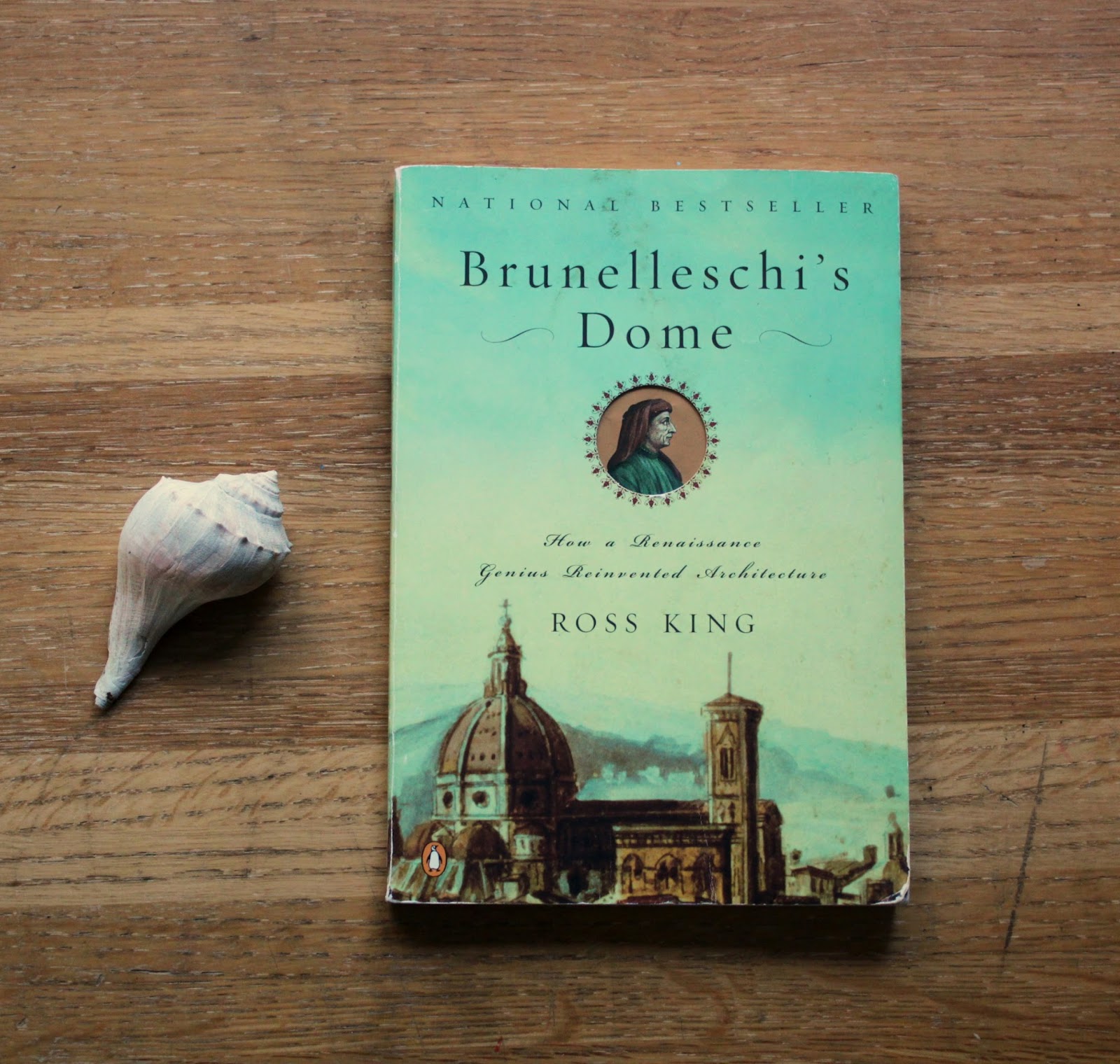
"Brunelleschi's Dome" by Ross King Review


"By all accounts, Filippo Brunelleschi, goldsmith and clockmaker, was an unkempt, cantankerous, and suspicious man-even by the generous standards according to which artists were judged in fifteenth-century Florence. He also designed and erected a dome over the cathedral of Santa Maria del Fiore-a feat of architectural daring that we continue to marvel at today-thus securing himself a place among the most formidable geniuses of the Renaissance. At first denounced as a madman, Brunelleschi literally reinvented the field of architecture amid plagues, wars, and political feuds to raise seventy million pounds of metal, wood, and marble hundreds of feet in the air. Ross King's captivating narrative brings to life the personalities and intrigue surrounding the twenty-eight-year-long construction of the dome, opening a window onto Florentine life during one of history's most fascinating eras."
-Goodreads summary

Ross King tells the story of the Duomo di Santa Maria Del Fiore and Brunelleschi as just that: a story. Which is why this book was so much fun to read. It really speaks to Ross King's skill as a writer that he can make concepts like dome fortifications and pulley systems interesting to read, and that he presents his information in a both entertaining and educational way. Not too many history books I've come across have focused on such a specific topic as this one did,and yet what seemed at first glance as a pretty isolated idea ended up connecting to many things in the end, and enriched my knowledge of Italian history and culture across the board. The way King wrote about Brunelleschi presented him as a character, and not just a historical figure. I found myself giggling whilst reading the accounts of Brunelleschi exchanging insulting sonnets with his enemies and playing cruel mind tricks on them. I wish people still messed with each other like that instead of tweeting and ask.fm posts. Feuds would be much more amusing.

Brunelleschi's Dome is a short and informational read, and by no means did I have to force myself to get through it. If you're interested in Renaissance/ Middle Ages Italy and architecture, definitely pick this book up!

Monday, March 24, 2014

"Button Man" by Paul Lyons


It's the hot summer of 1988, Michael Dukakis leads the elder George Bush in the polls, and while the over-arching events of the political conventions are in progress, Hawk and the rest of the "button gang" sell their buttons first to Democrats in Atlanta, then Republicans in New Orleans. They sell, as always, to either side of any persuasion, offering a unique underview of the American political process, amoral hucksterism, and a kind of grubby capitalism. Hawk is a gambler-canny, streetwise, full of hungers and debt, beset by loan sharks and his girlfriend's Ginsu-wielding ex-husband. His story explores trust-and trust betrayed; the ethics of the street-and ethics compromised. His story is that of an edgy outsider's strategies for survival, solvency, and love.

The adjective most often used to describe this book is "gritty". There's definitely a sense of reality about it, peeking into a life lived on the streets and at people most of us wouldn't want to associate with. But this perspective is what makes the book so interesting. The book follows the story of someone that I've seen many times, yet never actually seen. That is, I'd never considered these street vendors to have lives as intricate as my own; they simply existed as part of the scenery. Paul Lyons did a very good job of telling about a time in Hawk's life, making you understand who Hawk was and how he felt about things with very few words and suggestions rather than statements. The other characters in the story came and went without much, or any, exposition, only there when they interacted with Hawk, only developed when they were very important to Hawk. For all that the book was described as "gritty", there wasn't any gratuitous violence, drugs, or other such sinnery, which I appreciated- it kept the book feeling real. The dialogue was fast, natural and witty- I found myself actually laughing out loud at times. The one thing that was a  bit confusing about the writing was how easily it flipped between present and past- the present was written present tense, the past in past tense, and although this sounds pretty straightforward, in actually reading it takes a second to register the switch. This made the narrative nicely fluid, though. Hawk recalled memories the way you would really do it, swishing in and out without much announcement.

The real aim of the book was to talk about politics, especially the politics of 1988. I wish I had gone into the book with a little more priming on the important political figures and events of that time, as a lot went over my head. I got the gist, though, and I found myself to enjoy the manner in which Lyons wrote about politics and it's relation to economy and capitalism. Much of what he wanted to say was said through amusing ironies, the most obvious of which is that Hawk sells buttons to both political parties, smashing the other, as long as he can make a profit. He sells at the democratic convention then packs up and heads right over to the Republican convention.

The book was a short read, and very easy to get through- it's not the type of book that needs to be carefully analyzed. I ended up enjoying it immensely, which says a lot considering I've never been interested in any sorts of politics or political books. If you like politics, 1988, New York City, interesting perspectives, irony, and humor, go for this book! It doesn't seem to be very popular (it had exactly one review on goodreads) but I think that's simply due to the fact it hasn't been discovered, not that it's not well-written.

Wednesday, February 19, 2014

Little Failure by Gary Shteyngart


BOOK REVIEW! I haven't done one in awhile, sorry about that.

I really only got Little Failure because it was hyped so much- I'd seen it multiple times on Flavorwire and I had watched the trailer on Youtube.  Of course I expected it to be hilarious and entertaining, but what I really didn't expect was the depth of emotion that was expressed between the bouts of humor.

Gary Shteyngart moved from Soviet Russia to America when he was seven. In his book, he traces the immigrant experience, from having nothing to slowly moving upwards in society, the guilt at having money and luxuries when others don't, but the constant desire for more. 

I really like Shteyngart's writing. It's not beautiful, but it's accessible, and the way he fuses humor and dark truth really drives the story home. I find that I enjoy very few autobiographies; after a few chapters I find myself simply not caring about the author anymore. And if Shteyngart didn't write with so much humor, I might have become disinterested. But he kept me hooked with his sarcasm and self-deprecation enough that I was able to get through, and enjoy, the more serious and painful sides of his life. I also enjoyed learning about his family, and the character traits he considers to be "Russian". Russia is a country I don't ultimately know much about, especially the people there, so I liked the insight his book provided. It wasn't a groundbreaking read, but it was enjoyable and I would recommend it.

Sunday, February 2, 2014

Speak, Memory by Vladimir Nabokov


'Speak, memory' said Vladimir Nabokov. And immediately there came flooding back to him a host of enchanting recollections - of his comfortable childhood and adolescence, of his rich, liberal-minded father, his beautiful mother, an army of relations and family hangers-on and of grand old houses in St Petersburg and the surrounding countryside in pre-revolutionary Russia. Young love, butterflies, tutors and a multitude of other themes thread together to weave an autobiography which is itself a work of art. 

I received the Everyman's Library edition of this book for Christmas, and started it at the beginning of January. It was an interesting way to approach Nabokov's work, but I think reading his autobiography is a good primer to reading his other stories, like Lolita. He mentions many times how he has written certain experiences and memories of his own into his other novels.

Speak, Memory was written incredibly beautifully, with some ideas and lines that just begged to be highlighted. However, it was a bit dense, which is why it took me so long to get through. The first chapter, speaking about his memory of being a person, an entity separate from others, was a vivid and thought-provoking lead-in to the book, but I have to say after that there were some parts I was quite bored with. There was a whole chapter just listing the names and connections between his ancestors, which I forced myself to read more as a test of will than anything else. From Nabokov I got the sense that he knew he was a very good writer, and he knew that he had a privileged background, and so had no shame in self-indulging quite a bit in his autobiography. I mean, autobiographies by definition are somewhat self-indulgent, but at certain points in this I literally had to keep myself from asking aloud, "WHO CARES??". The middle chapters of the book are sort of a dull blur in my memory, but I think the last chapter served as a bit of redemption- in it I found the sentiment and thought-based writing I had been craving for the last hundred or so pages. In my opinion, Nabokov fixated far too much on his childhood. At a certain point I just wanted his story to move along. The one thing that really stood out for me about his writing, however, was his descriptions of light. The way Nabokov described light in his story, from the lurid gleam after a rainstorm to the view of a small town from a passing train in the night, it was like he was taking the images right out of his mind and putting them into mine. 

Although I was sometimes bored with it, and for a memoir found it to be a little too impersonal, I can understand why Speak, Memory is considered one of the best autobiographies of the twentieth century. The experience of growing up as a privileged child in Russia and then being exiled makes quite an interesting story, and some of Nabokov's views really struck me, especially about what life is. (A bright gap between two infinities of darkness, a spiral in a glass ball). To read any of Nabokov's work, I think it would be pretty important to read his autobiography, because his life strongly affected his writing, as with most authors.

Sunday, December 29, 2013

The Fault in Our Stars by John Green

The Fault in Our Stars by John Green was tne No. 1 New York Times bestselling book this year. A huge number of people I know have read it, and loved it, which is why I was a bit wary about it- these are people that don't like reading recreationally, yet here they are raving about a book. How good could it possibly be?
The main character of the book is Hazel, and she has lung cancer. She's sixteen and has been out of school for three years, but she takes community college classes and reads a lot. She opens the story by telling us her mother decided she was depressed, " presumably because I rarely left the house, spent quite a lot of time in bed, read the same book over and over, ate infrequently, and devoted quite a bit of my abundant free time to thinking about death."(page one, TFIOS) To get her out of the house, her mother sends Hazel to cancer kids support group. Here she meets Augustus Waters, and the rest of the book is dedicated to their love story and their fight against cancer, with a spontaneous trip to Amsterdam thrown in.
Considering the cult following this book has, I'm not sure I dare say this, but... I didn't really enjoy this book. I suppose I should be expecting a crowd of angry pitchfork and torch-wielding youths at my door any minute now. The thing is, I can understand why people would like this book-it's clearly marketed towards teenagers, and it has all the emotion and romance and angst any adolescent would want. But here's the thing about me; when something is so obviously supposed to be sad, I can't really get absorbed in it and connect to it because I know what it's trying to do. That's probably a pretty big reason I couldn't enjoy this book.
John Green banks too heavily on the cancer and death factors of his book to get the reader to connect and become invested. To me, it just seemed like an easy way out of actually building a meaningful plot. I mean, everyone makes such a big deal about TFIOS not being a "cancer book",about it being about these characters, but can I ask: if you were to take the cancer aspect out of this book, and were left simply with the characters and ideas, would you care about either? I wouldn't, because I don't think either were particularly well-written or explored well. I mean, I didn't like Hazel, or connect to her. She didn't really have any interesting thoughts, and her whole clever and witty persona started to wear on me after  awhile. AND ALL THE CHARACTERS TALK THE EXACT SAME WAY. From Hazel to Augustus to the parents to the novelist Van Houten-they all sound like John Green. And as for any kind of subtext or ideas, what were they really? Every little metaphor or symbol was straight-out explained by the characters in the book-there was nothing left for the reader to think about or interpret on their own. So if these aspects aren't quality, all we are left with is the cancer aspect, which leads me to believe the whole book was a "cancer perk" , an idea Green talks about in the book. Cancer perks are special things cancer kids get because they have cancer. The acclaim this book received was a special thing it got because it had cancer. What really annoyed me was that the cancer didn't mean anything. When a character in a book is physically ill, we as readers are trained to look for the sickness to symbolize some other problem that is perhaps mental, or of the heart. Physical sickness is never just physical.... Except in this book.
Another aspect of Green's story that kept me from enjoying it was how formulated it was for it's audience. Like I said before, Hazel's attitude is so obviously supposed to mirror that of the average teenage girl. But by trying so hard to do this it really just makes her boring. And the number of slapped-in pithy quotable lines really got to me. Just these moments of pseudo-deep thought that felt like they were drafted separate from the book and inserted wherever the author saw fit. On top of that, the number of references to authors and philosophers really held up the story. I think of F. Scott Fitzgerald when I'm saying this, and he's good to compare to. The man was obviously very well educated, and as an effect of this tended to allude to many authors, philosophers, classical works, but they flowed as a part of the story; they enhanced the text if you understood the reference, if you didn't you just skipped over them. However, John Green puts all these names and such into the story in such a pretentious and contrived manner, and then assumes the reader doesn't know what he is talking about so sets the story aside to explain them. It really did start to drive me insane.
Overall, I didn't consider TFIOS to be a particularly well-written book, and I think part of the reason it has sold so many copies is the propaganda surrounding it. I mean, don't get me wrong, I love John Green as a person, and I watch Vlogbrothers religiously, so I was really let down when I found out what sort of an author he was. He has such a following I bet people feel a sort of duty to read his books. I can understand how people liked it, but this just wasn't the right book for me. I think I would recommend it just for cultural literacy at this point.

Tuesday, December 10, 2013

The Picture of Dorian Gray by Oscar Wilde


Right now I seem to be on a classics stint with my reading, so it was natural I would eventually come to this book. To be honest the only reason I decided to read it was because I really liked the name Dorian Gray. Here's the Goodreads summary:
Written in his distinctively dazzling manner, Oscar Wilde’s story of a fashionable young man who sells his soul for eternal youth and beauty is the author’s most popular work. The tale of Dorian Gray’s moral disintegration caused a scandal when it first appeared in 1890, but though Wilde was attacked for the novel’s corrupting influence, he responded that there is, in fact, “a terrible moral in Dorian Gray.” Just a few years later, the book and the aesthetic/moral dilemma it presented became issues in the trials occasioned by Wilde’s homosexual liaisons, which resulted in his imprisonment. Of Dorian Gray’s relationship to autobiography, Wilde noted in a letter, “Basil Hallward is what I think I am: Lord Henry what the world thinks me: Dorian what I would like to  be in other ages, perhaps.”

I have mixed feelings about Oscar Wilde- in a way I want to hate him, but at the same time I can't. You get the sense from reading his work that he's a very skilled writer, but he's well aware of that fact and so his arrogance leaks into his writing. It reminds me of something Holden Caulfield said in The Catcher In The Rye- I can't remember the exact quote but he says that he doesn't like actors because if they're good they know they're good, and then that detracts from their performance because it gets contrived...it seems the same with Oscar Wilde. Some things are subtle and well written, but most of the time he isn't even trying for subtlety and really just wants to get his points across and make sure the audience appreciates him. Nevertheless, I really did enjoy the book. The plot was really very interesting- the painting that would grow old and bear his sins whilst Dorian Gray would stay forever young and would be able to sin as much as he wanted. There were some parts that were really slow to get through (there's literally like ten pages describing different types of jewels and perfumes and musical instruments, where I was left wondering why) but reading some of the witty and fast-paced conversations between the characters was a lot of fun, and there was a plenitude of good quotes to take away. 
The book started to make a lot more sense after I read up a little bit on Oscar Wilde and the aestheticism movement: valuing beauty above all else. That was definitely the hugest focus of the book, but what's intriguing is that even though Wilde was a member of the movement, he almost seems to be condemning it in his book. The obsession with youth and beauty above all else ends in ruin for Dorian and the people around him, and Wilde portrays the decadence of the upper classes as a sin. The ringleader of all this hedonistic thought and persuasion, Lord Henry, is shown pretty clearly as the Devil himself, and yet I found that he was my favorite character in the book- his pithy observations about society and human nature were charming and clever and he was oddly charismatic despite not really being involved in anything or giving any of himself to the situations... he remained at a distance, simply influencing the other characters in the story, which corresponds pretty strongly with the role of the Devil, I suppose.
*Spoilers*
Although the ending was pretty easy to predict, I liked it a lot- that Dorian Gray still had that part of him that wanted to be good, and in the end he was able to purify his own soul by accepting his sins. 
*Spoilers over*

Although I didn't really connect to this book, and at some moments couldn't help rolling my eyes, there's no doubt it was masterfully written and that it's earned its place as a classic. I would definitely recommend that everyone read this.

Favorite Quotes:

"But beauty, real beauty, ends where an intellectual expression begins. Intellect is in itself a mode of exaggeration, and destroys the harmony of any face. The moment one sits down to think, one becomes all nose, or all forehead, or something horrid. Look at the successful men in any of the learned professions. How perfectly hideous they are! Except, of course, in the Church. But then in the Church they don't think."

"The commonest thing is delightful if only one hides it."

"...there is no doubt that genius lasts longer than beauty."

"And the mind of a thoroughly well-informed man is a dreadful thing. It is like a bric-a-brac shop, all monsters and dust, with everything priced above its proper value."

"Because to influence a person is to give him one's own soul. He does not think his natural thoughts, or burn with natural passions. His virtues are not real to him. His sins, if there are such things as sins, are borrowed. He becomes an echo of someone else's music, an actor of a part that has not been written for him. The aim of life is self-development. To realize one's nature perfectly--that is what each of us is here for. People are afraid of themselves, nowadays. The have forgotten the highest of all duties, the duty that one owes to one's own self. Of course, they are charitable. They feed the hungry and clothe the beggar. But their own souls starve, and are naked. Courage has gone out of our race. Perhaps we never really had it. The terror of society, which is the basis of morals, the terror of God, which is the secret of religion--these are the two things that govern us."

"I can stand brute force, but brute reason is quite unbearable. There is something unfair about its use. It is hitting below the intellect."

"The way of paradoxes is the way of truth. To test reality we must see it on the tight rope."

"I am too fond of reading books to care to write them."

"If one hears bad music, it is one's duty to drown it in conversation."

"Nowadays, people know the price of everything and the value of nothing."

"There are many things that we would throw away if we were not afraid that others might pick them up."

"Good artists exist simply in what they make, and consequently are perfectly uninteresting people in what they are."

"And there was a terrible consumption of nuts going on."

"I love acting. It is so much more real than life."

"There is a luxury in self-reproach. When we blame ourselves, we feel that no one else has a right to blame us."

"I didn't say I liked it, Harry. I said it fascinated me. There is a great difference."

"Each of us has heaven and hell in him, Basil."

"She lacks the indefinable charm of weakness."

"Every effect that one produces gives one an enemy. To be popular one must be a mediocrity."

"Besides, each time that one loves is the only time one has ever loved. Difference of object does not alter singleness of passion. It merely intensifies it."

"The books that the world calls immoral are the books that show the world its own shame."

"I don't think there have been such lilacs since the year I met you."

Sunday, November 24, 2013

This Side of Paradise by F. Scott Fitzgerald


This Side of Paradise was the debut novel of acclaimed American author F. Scott Fitzgerald. The story follows the young Amory Blaine, born into the upper-class and raised by a highly cultured and slightly eccentric mother, Beatrice. From prep school to Princeton to New York City, Amory is in a struggle to find himself, to discover who the "fundamental Amory" truly is. 

I hadn't read any of F. Scott Fitzgerald's works before this, but from this book I got a very strong impression of who Fitzgerald is as a writer, and as a person as well. Amory Blaine seems to be an almost auto-biographical character of the writer himself: his insights and feelings are too intimate and specific to be imagined. 
The beginning of the book, chronicling Amory's elementary and teen years, was quite reminiscent of The Catcher in The Rye, which I also read this year. The idea of a youth, in some ways rebellious, thinking himself different from everyone, sent away to prep school with a stint in New York City- there were many similarities to be seen. However, as I got more into the book the differences started appearing, developing Amory as his own independent character. I got many gasps and shocked expressions when I told my friends that I did not identify with Holden from Salinger's book. However, Amory Blaine was a character I strongly connected with. He was this illusion that he was different, somehow, from everyone else. Better. This led him to being very vain, as he was well aware of, and this trait carried with him throughout the book. Despite this vanity, though, he didn't have too much a sense of who he was, and he was sensitive to other's criticisms. He let many things affect him, and change who he was, and he was in the habit of putting on "poses", acting like who he wanted to be. I admired this about his character, that he was aware of what he was doing quite a bit of the time. I think most people act like who they want to be, or how they feel they should in different contexts, so at the end of the day we seldom, if never, actually act like ourselves.

An aspect of Fitzgerald's writing that appreciate, although much of it went over my head, is how educated his storytelling is. He makes many allusions to writers and philosophers, many of whom I don't recognize, but you can tell he is very well read, and this trait carries over to Amory. At first Amory's reading is introduced as part of a pose- he feels it's cultured to read deep books. And don't so many of us do this, though? Why did I even read this book in the first place? It's because it's a classic, and to a certain degree I feel special, or educated, or better than others by saying that I'm reading Fitzgerald. Of course it's not something that I'm proud of, and so I don't truly acknowledge it, but that's the thing about this book; it acknowledges truths and feelings that we hide from because they're distasteful. Amory acknowledges these things in himself, which is a little ironic considering he feels like he doesn't really know himself for most of the book. But back to his reading career, he soon becomes more and more involved in books and poets, and it stops being for the benefit of his image and becomes simply for himself. He starts writing, and thinking about ideas. This was the point where I really began to see myself in Amory's character. One of my favorite quotes was ," He was proud of the fact that he could never become a mechanical or scientific genius." I mean, that sounds pretty pretentious, right? And yet without letting myself be truly aware of it, that's how I've felt quite a bit of the time. Later Amory says to his friend, "I'm in a superior class. You are, too. We're philosophers." That was the quote that really cemented my love for this book, and for Amory as a character. Fitzgerald pinpoints that superiority that writers and philosophers and thinkers feel, combined with the inadequacy that is inherent in those types of people simultaneously, or, at least for me. 

My favorite part of the novel was book one, where Amory is in prep school, and mainly, Princeton. It's the period where he experiments most with who he is and who he could be, and is surrounded by interesting individuals. The thing I like about Amory is his lack of motivation to achieve. He floats, and he doesn't live to get somewhere, he just lives for living, and he thinks, and he's subject to moods and whims and bursts of interest, all of which he takes in stride. At Princeton he did want to be class president, but when it came down to it, to really having to do something he didn't want to to achieve his goal, he gave it up. His friend told him, "You're a literary genius. It's up to you." to which Amory replied, " I wonder if I could be. I honestly think so sometimes. That sounds like the devil, and I wouldn't say it to anyone except you." It's interesting to consider that Fitzgerald may have been modeling much of this off of himself, that he was writing this book and put that in there because he thought it about what he was writing- he knew it was good but he couldn't say it outright, so he had his character say it for him.

After book one a lot of my interest for the novel waned. I knew from the start that there would be a lot of focus on love in the book because, well, the main character's name was AMORy, but the parts when Amory was in love tended to be my least favorite: they were the parts where I felt most distance from Amory. Maybe Fitzgerald meant for that to happen, because when Amory was in love he wasn't as in touch with himself. There was a part in the book that was written as a play, where Amory was in love with a girl Rosalind, and I liked this technique- it made the lovers seem like actors in a play. This was contrasted with Amory's next love, where everything was written in poetry and beautiful descriptions, like some kind of eloquent dream. Although I wasn't really as interested in the ideas of love in the book as in some other things, I did like how Amory tended to not be in love with actual people, but rather what he projected of himself onto them. This supported his persona of vanity and egotism. And I really do admire Fitzgerald's representation of the women in the story. There was not one weak woman character- they all were interesting and knew what they wanted, didn't fold to love like women in stories so often do. Fitzgerald saw the unfairness of womens' situations during the time, but instead of simply protest it, he made his women take advantage of it. No, they didn't like that they had to get married, but they didn't simply rebel and say they were in love. They understood love, but they saw the importance of marriage and money for them, and put themselves first above everything. 
Fitzgerald expresses a lot of views on class and money, greed, social systems, but personally I'm not so interested in those things, which was one of the only downsides to me. 

The writing style in the book was so beautiful- the F. Scott has a way with words where he can describe things in fresh new ways, clever ways, that show them in a light you had never seen them in before. I liked how much poetry was in the book- it was beautiful and added to the feel of the story. A complaint would be how much he jumps around- from place to place and time to time without so much transition or context, so that sometimes I got a little lost. But overall it was a very good book, and I can't wait to read more Fitzgerald's works. 

Some of my favorite quotes:

"They slipped briskly into an intimacy from which they never recovered."

"The great tapestries of trees had darkened to ghosts back at the last edge of twilight. The early moon had drenched the arches with pale blue, and, weaving over the night, in and out of the gossamer rifts of the moon, swept a song, a song with more than a hint of sadness, infinitely transient, infinitely regretful."

"'I was born one,' Amory murmured. 'I'm a cynical idealist." He paused and wondered if that meant anything."

"'I'll never be a poet,' said Amory as he finished. ' I'm not enough of a sensualist really; there are only a few obvious things that I notice as primarily beautiful: women, spring evenings, music at night, the sea; I don't catch the subtle things like 'silver snarling trumpets' . I may turn out an intellectual, but I'll never write anything but mediocre poetry.'"

"You'd sniffled through an era's must,
Filling your nostrils up with dust,
And then, arising from your knees,
Published, in one gigantic sneeze..."

"People unconsciously admit it,' said Amory. 'You'll notice a blonde person is expected to talk. If a blonde girl doesn't talk we call her a doll. If a light haired man is silent he's considered stupid. Yet the world is full of 'dark silent men' and 'languorous brunettes' who haven't a brain in their heads, but somehow are never accused of the dearth."

"And he must have remarked patronizingly how different he was from Eve, forgetting how different she was from him..."

"His judgement walked off to prison with the unconfined imp, imagination, dancing in mocking glee beside him."

"If we could only learn to look on evil as evil, whether it's clothed in filth or monotony or magnificence."

"SHE: You're not sentimental?
HE: No, I'm a romantic- a sentimental person thinks things will last- a romantic person hopes against hope that they won't."

"He wanted people to like his mind again- after awhile it might be such a nice place in which to live."

"'Then you don't think there will be any more permanent world heroes?'
'Yes-in history- not in life"

"The man in the street heard the conclusions of dead genius through someone else's clever paradoxes and didactic epigrams."

"'I know myself,' he cried, 'but that is all.''" 

Sunday, September 15, 2013

The Catcher In The Rye by J.D. Salinger


It was an odd coincidence that I happened to read this book right before the huge storm of publicity about J.D. Salinger's comeback; the movie, the book, the new writing. But I'm glad I did, because having tasted his work I can look forward to the big reveal in 2015 even more. Previously all I had read of his was was A Perfect Day for Bananafish, which was an incredible read that really stuck with me, and the The Catcher In The Rye was the same.

The story is narrated by one Holden Caulfield, telling us, the anonymous audience, of the events of a few winter days a year ago. Considering that all the new advertisement of Salinger will draw many people to the book, I probably should try not to spoil it for the newcomers, so I'll be vague, but the story begins at Pencey Prep, the fourth high-end prep school Holden has attended. The previous three he had been expelled from. The problem with Holden is that he doesn't try, it's not that he's not smart. He's apathetic to the whole education system, and he's kind of a class clown as well. He likes to mess with people. 
You find out that Holden's been kicked out of Pencey, too, and he decides to skip out early and take a train up to his hometown of New York City. He can't go home until his parents get the expulsion letter, though, so he has to kick around for a couple days. 

The book wasn't action-packed by any means- it's hard to give a clear plot-line because there aren't many points on it. The focus of the book was really to understand Holden's character, how he saw things. Holden is sort of the epitome of the angsty teen-- nothing is really wrong with his life, and yet he sees everything as bothersome and fake, and you realize once you get to know him that behind the facade of carefree goofiness, he's actually depressed. I'm sure that if he told people in his life how he really felt, they would respond with the age-old expression "others have it worse". Maybe he has told people, and maybe they have said that, and maybe that's why he seems to lie to himself as well. I really admire Salinger for portraying Holden like this, because it's something a lot of teenagers can connect to, but that adults seem to write off a lot of the time. There are a lot of teenagers that are having a really difficult time, that are sad for maybe no tangible reason, but sad nevertheless because of things inside them, and yet no one tries to help. No one tries to help because they're a teenager, it's a passing thing, it's just hormones or angst, and really they're being dumb, or selfish, or immature, because look around, there's people that have it worse. And when people tell you what you feel is irrelevant, you tell yourself that, too...so you keep all of this sadness bottled inside, where it multiplies and drags you down even farther. 

I admired Holden for his honesty. He was very clear about what he thought of people, and he saw right through social conventions, people's actions and personalities. His character is known for calling everyone "goddamn phonies", because everyone acts differently depending on the context, and he saw how everyone presented a different version of themselves to be palatable to the audience. But he didn't hate people. He saw them for what they were, so while he may hate an aspect of their personality, he could also like an aspect as well, and he was fine with that. I think this point of view extended to himself as well. He knew what he was, and he would call himself out very plainly on it-- he'd say he was "yellow", too yellow for war, he would just go to the front lines and get shot up right away if he went, because he wouldn't be able to stand the fear. This is really amazing for a teenage guy to say, because most would probably dream themselves war heroes. He's so perceptive, but he doesn't really have anyone to talk to about what he sees. I guess I connected to this because I find, as a teenager, this amazing moment in time where, really, I'm on the mental level of an adult, I can understand things like an adult, but I haven't yet succumbed to the social constrictions of being an adult. I'm not ruled by the sensibilities and responsibilities, and my thinking hasn't yet been shaped into the mold of adulthood. It's like when you're little, and you ask those silly questions, or make those silly remarks, and everyone laughs because you don't yet have the common knowledge that would answer those questions for you. But then you look back on something you said, or on something a child has said, and realize how penetrating it is. Maybe you don't get what I'm saying, I'm sort of on a tangent, but... children see things more clearly than adults because those things aren't wrapped up in complications or biases yet. So teenagers are at a point in time where they see things that way, but can actually consider them with the mind of an adult, and so for me, I think that it's such a precious time, and you should be aware of how you think because it's too easy for society to put blinders on you.

This sort of leads into another theme of the book, which was childhood/innocence vs. adulthood and the loss of innocence. Holden sees things as a child would see them, but considers them as an adult would consider them, which is why I think he's so pained. He sees truths that most adults have taught their brains not to see, because it would be too painful otherwise, but Holden takes in these truths and really empathizes. He gets into a cab and feels bad because he thinks all about the cab driver's life, and then all about his, and sees such a huge difference there. He feels the embarrassment of a kid that has cheaper suitcases than him, so he hides his. For this reason I think he wants to protect the innocence in others, although there is another explanation I won't spoil for people who haven't read the book. He wants to be The Catcher in The Rye, catching kids before they fall over the cliff...catching them before they fall into adulthood. This is what he says when his little sister Pheobe asks him what he wants to be when he grows up. I can relate to this train of thought, because I myself have been on it recently. If you asked me what I wanted to be when I grew up, profession-wise, I don't think I could give you a straight answer, but I know that I want to write, to travel, to experience, to make art, to be content and happy, and enrich people's lives in some way. Yet society pressures us into a career path, deciding how we'll earn our keep, and I really don't think this is how teenagers should think about their futures. Each person should make their own path, not follow one that's already been tamped down by thousands. 

Phoebe, Holden's little sister, was the one character I truly connected with in the book. I guess it's strange that I didn't resonate with Holden the most, although I do agree with everything he says and thinks. But throughout the book Holden fell on Phoebe as a source of stability and happiness in his heart, even though she only really showed up in the last few chapters. He wanted to protect her so bad, he wanted to be there for her, because she was the embodiment of the innocence he had lost. She was still young, and there was hope for her, and he wanted to shield her against the pain and sadness of growing up but simultaneously being a child. She was the one that really led him off the path he was on, one of self-destruction, and made him confront his life. She was the goodness in him, and whatever he did, he wanted to hang onto her. It was truly touching, and it was my favorite aspect of the book. 

I can see why this book is lauded as one of the American greats, and J. D. Salinger as one of the best American authors. I don't want to be stereotypical and say that he truly portrayed teenage alienation, because literally everyone who had ever read this book has declared that, but he got inside the head of a teenager so perfectly. The way Salinger writes is not overwrought with emotion- he leaves that to you. He says things so simply, makes observations and presents ideas, and he counts on you understanding them enough to fill into the story your own feelings and interpretations. Maybe that is why teenagers think Holden Caulfield is so much like them; Salinger created Holden as a strong character who could stand on his own, but that was malleable enough for every person reading this book to make him their own, and supply their own feelings and connections to bring his story to life. In that way, Salinger is a very humble author. He's not so pompous as to make a story completely his own- to say, I created this, you can appreciate, but it's mine and not for you to personalize. He simply presents his story, but leaves the job of making it whole to the reader. I'm not really sure if it was good or bad for my appreciation of the book that I felt distance from it: I could understand better what Salinger was trying to portray, but I couldn't experience it as well. Overall though, it was an amazing book, and it lived up to it's acclaim. 5/5 stars.

FAVORITE QUOTES

"That's just the trouble with all you morons. You never want to discuss anything. That's the way you can always tell a moron. They never want to discuss anything intell--"
--page 44-45

"One of my troubles is, I never care too much when i lose something- it used to drive my mother crazy when i was a kid. Some guys spend days looking for something they lost. I never seem to have anything that if I lost it I'd care too much."
--page 89

"When in hell are you going to grow up?"
--page 146

Sorry that my post went on for so long, I guess I got a little carried away. Here's a sketch of Holden I did to make up for it ;)

Tuesday, September 3, 2013

Girl In Hyacinth Blue by Susan Vreeland


"A professor invites a colleague from the art department to his home to see a painting that he has kept secret for decades. The professor swears it is a Vermeer--why has he hidden the important work for so long? The reasons unfold in a series of stories that trace ownership of the painting back to World War 2 and Amsterdam, and still further back to the moment of the work's inspiration. As the painting moves through each owner's hands, what was long hidden quietly surfaces, illuminating poignant moments in human lives. Vreeland's characters remind us, through their love of the mysterious painting, how beauty transforms and why we reach for it, what lasts, and what in our lives is singular and unforgettable."

A couple months ago, before I had ever heard of this book, I had an idea for a movie. That happens every so often, me getting ideas for things, but this one I liked in particular. I thought how interesting it would be to have a movie following the life of the main character, but only through the eyes of those she encounters. Would you ever know who she truly was, or would you only see what others wanted her to be?

So it was sort of serendipity that I picked this book up, because I didn't even realize until about halfway through it that it was almost exactly what my idea had been, and executed so beautifully. It just made me connect to it all the better. 

The main character in Girl In Hyacinth Blue  is the painting of the girl in hyacinth blue itself- something that sucked me in right away. Each chapter shows the painting in the hands of a different owner, and provides insight into how the owner connects to the painting. I loved that each chapter was strong enough to stand on it's own; the chapters had originally been published different places as short stories, which meant they didn't necessarily have to connect to each other, but the connections made the themes that much clearer. When you finished a chapter, you said goodbye to the characters in it, but Susan Vreeland did an amazing job at relating you to the characters and their story in the little time you had with them. 

The book was a sort of commentary on how art affects people. It draws out truths about ourselves that even we don't know, and this is what Susan Vreeland explores. The painting is at once the same and different in every chapter, because the characters see it through their own biased lens. If a character wants to escape, the girl in the painting may be looking out the window with longing. If a character wants to be rich, the girl may not be sewing because she doesn't have to. By this means you end up learning so much more about the characters than if you had simply experienced them the way they show themselves to the outside world.

Susan Vreeland's writing style is also incredibly gorgeous. Her descriptions are rich with detail, and the way she presents people, drawing on tiny mannerisms and perceptions, you understand exactly the person she is talking about immediately. I liked her book in part because she's one of those authors that I feel I think similarly to. Those ones where they say something, and you understand them exactly; one phrase can speak volumes. I think different people connect to different authors in this way-- I can read an amazing, classic book, and appreciate it, but not connect to it the way I connect to another book. The reason I bought this book was solely the first sentence. I could tell right then and there that I would understand it completely.

"Cornelius Engelbrecht invented himself."

And that sentence, right there, don't you understand exactly the kind of person being introduced?

The end wrapped up the ideas of the story so well, tracing the painting back to it's conception, when it was first painted by Vermeer. It focuses on how he wants to capture truth, and in this way he has to contemplate for long periods of time before painting. He wants to make things alive. I think Vreeland may have put a little of her own feelings into this chapter; her work is beautiful and and reveals the truths of human nature in a subtle and eloquent way. In the end, I think Vermeer creates something that tells a universal truth, and that lives long after it's creator dies.

The setting being in Holland made the story and culture so much richer, and I also fall for anything professor or art history related (this book had both) so you can understand how elated I was. This is definitely the newest addition to my favorites shelf ( Fahrenheit 451 and The Rebel Angels were getting a little lonely)- the writing was beautiful, the story was contemplative, the characters were vivid. 5/5 stars.

I also need to give a shout-out to the cover designer for the book, because that's what made me pick up the book in the first place, and it's so pretty I refused to mark it up at all. The hyacinth blue on the cover has got to be one of my favorite colors, and the picture window was unique. I love how spaced out the type on the pages is, too. It gives you room to think.

Read if you like:
-Art history
-Vermeer
-Scandinavia
-Short Stories
-World War II

FAVORITE QUOTES--
"If two people love the same thing, she reasoned, then they must love each other, at least a little, even if they never say it."

"People who would be that close to her, she thought, a matter of a few arms lengths, looking, looking, but would never know her."


Monday, July 22, 2013

The Mambo Kings Play Songs of Love by Oscar Hijuelos


"It's 1949. Two young Cuban musicians make their way up from Havana to the grand stage of New York. It is the era of the mambo, and the Castillo brothers, workers by day, become by night stars of the dance halls, where their orchestra plays the lush, sensuous, pulsing music that earns them the title of Mambo Kings. This is their moment of youth-- a golden time that thirty years later will be remembered with nostalgia and deep affection. In The Mambo Kings Play Songs of Love, Oscar Hijuelos has created a rich and enthralling novel about passion and loss and memory and desire."

This book was a vivid portrayal of a certain era in a certain place through a certain man's eyes. Oscar Hijuelos took the idea that in your last moments your life flashes before you to heart, and created a wildly detailed and beautifully illustrated trip down the memory lane of one Cesar Castillo, a Cuban musician living out his days in a New York City pulsing with mambo and life. 
To be honest, this book took me quite awhile to get through. There isn't a driving plot line that makes you want to know what happens next; instead, each chapter presents an intricate vignette of actions, emotions, and thoughts, and the memories don't necessarily come in order. What I realized towards the end of the book, though, is why the scenes weren't shown chronologically. The book really only takes place in a couple hours of Cesar's life, as he's living out his last moments in a room in the Hotel Splendour, with a record player by his side spinning out the music of his youth. So when a song comes on, it's like opening a time capsule: everything this man experienced relating to that song comes rushing back as clearly as if it happened yesterday-- and the songs aren't chronological. It's a feeling I can personally relate to, as I think most people can. 
What I liked a lot about the book was that, even though Cesar is remembering certain things, the author provides you with information that Cesar may not know. So these characters Cesar interacts with, you know their story and their thoughts, and they become a rounded person. In terms of that, I thought there was amazing character development in the story. Something I also found interesting was how no one character would be good or bad, since their intentions were all laid bare to the reader. The author was very blatant about how people used eachother, not necessarily malevolently, but simply because that's what people do. Cesar himself was an interesting man to consider. He drank a lot, he smoked, he was a complete womanizer, and though yet given these  facts you would jump to the conclusion he was a bad man, or maybe emotionally closed off, as the stereotype is, Hijuelos gave him generosity, a love of family and music, redeeming qualities that in the end made him neither a good, nor a bad person-- because in real life, good and bad people don't exist. There are only good and bad qualities, and the balance therein. 
The reason I picked this book up in the first place was that it was about the music scene in the mid- twentieth century, particularly the Cuban music. I love books that work in history and real settings, because you learn so much while reading them, and understand even more because you have context. Reading this book, I learned an amazing amount about New York, mambo, Cuban immigrants, and more, and while I had heard about Fidel Castro in Cuba, this book taught me about the effect it had on Cubans and the different views they had- something I would never learn in history books. I liked how real people and places were worked in- the main characters met the likes of Perez Prado, Paquito di Rivera, and Desi Arnaz, and integrating such real-life names gave the book a sense of reality as well; it was interesting to be listening to the exact songs mentioned while reading about them. 
One of the few things I didn't necessarily enjoy about this book was how graphic it was. It made a point of questioning the difference/ boundary between lust and love, but I feel that it could have made that point with less imagery--I felt like it held up the story sometimes. However, it did round out that theme well in the end, giving no clear answer and leaving you questioning more than ever. 
There was no doubt this book was well- written, and although it wasn't a page-turner I enjoyed my time reading it- Hijuelos is a master of imagery and his sentences are beautiful in their own right, rich in color and emotion. I would recommend this book to music-lovers and history buffs and anyone looking for a little romance.


There was a movie adaptation made of this book in 1992 that I'm looking forward to watching now that I finished the book. Review to come!

Friday, May 10, 2013

The Scarlet Letter by Nathaniel Hawthorne

Finally, finally, finally, I finished this book. I decided to read The Scarlet Letter because I found this adorable edition at T.J.Maxx (Penguin got a famous fashion illustrator to do the cover) and I figured I should read a "classic". As it turns out, I probably should have waited on this book. I'm not sure if it's because I'm too young that I didn't enjoy this book, or if it's just not my cup of tea and never will be, but I struggled to get through it. Nathaniel Hawthorne writes in such a circuitous, over-wrought fashion, and never really makes succinct points that you have as landmarks in the book. And yes, I know that it's also due to his time period that he writes this way, but I would zone out for whole paragraphs, and when i came back he would still be talking about the same exact thing. There was definitely a lot to analyze in this book, and no doubt it was well written, but I don't really want to go back and try to work with it solely because I honestly can't stand the writing. I know that this is a classic, so I feel a little bit like an ignorant high-schooler putting it down like this, but hopefully I can come back to it in later years and enjoy it more.

How To Read Literature Like a Professor- by Thomas C. Foster


Finishing this book felt like saying au revoir to a friend after having had a particularly satisfying discussion with them; to an extent you wish you didn't have to go, but at the same time you feel mentally sated. Thomas Foster really does feel like a friend when you're reading through his book. He speaks straight to you, the reader, and he doesn't take himself too seriously, either. He's a professor yes, but he cedes multiple times throughout the book that being a professor does not mean his word is law, particularly in literature, since it can be interpreted so many ways. Instead, in How To Read Literature Like a Professor, Foster provides a comprehensive guide to approaching works of literature, outlining the checklist of things to consider when reading, and he goes about it all in a patient and entertaining manner.

How To Read Literature Like a Professor, is, basically, an extremely condensed college course in literature. Foster spends a few pages explaining topics ranging from interpretations of the seasons to the appearance of baptism in it's many forms. The first chapter is a nice, soft lead-in to the book, talking about how most trips are quests. I'm pretty sure that he started the book this way because you can immediately put identifying quests to use; they pop up everywhere. The night I started reading this book I watched Django Unchained, and almost immediately I jerked my pointer finger at the tv and shouted "THIS IS A QUEST FOSTER SAYS SO" But soon after Foster delves into less obvious interpretations and themes; one of his next chapters is about vampires in literature, and yet the examples he uses are not pulled from Stephanie Meyer or Anne Rice. Not even Bram Stoker. No, he references "Daisy Miller", about a young woman who is struggling in a romance with someone in a different social system than her, and although this might not sound like an ooky spooky vampire tale, as Foster explains further, you realize the clues are as plain as day- the older man who is sucking the life force from a younger woman, etc. Throughout the chapters, the reader is provided with an array of examples from literature, and the list of sources at the back of the book is a dozen pages long, and it helps to elucidate his points, as well as makes you want to read more than a few titles he mentions.

I've mentally dubbed this "The Reader's Textbook", and like math, or science, it's good to read the textbook before getting into quadratics or conducting an experiment. I promised myself that I wouldn't read any other books until I finished this one, because I feel like there's so much to understand that I didn't even pick up on before reading this. I really wish that I had been introduced to this book earlier; there are so many books that I'm absolutely certain I haven't appreciated to their full potential simply because so much of the subtlety went right over my head. I would say this book is a must-read, and is the newest addition to my list of favorites. But the message it really sends, at the end of the day, is that to be a good reader, as with anything, you have to practice. The more you read, the better a reader you will be.

Tuesday, April 2, 2013

Reading Anti-Theistic Documents and Being Sick.

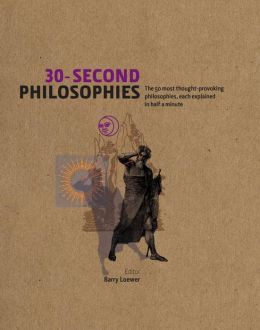
I have had an exceedingly philosophical day. I woke up this morning with a severe head cold and sore throat, and after a half-hearted argument for going to school, I was convinced to go back to sleep. Three hours later I awoke with a strong urge to ponder the universe and all it's mysteries. So I grabbed some mint-chocolate chip ice cream, swathed myself in a forest-green comforter, and proceeded to pour over my collection of religion and philosophy books. I started with 30- Second Philosophies by Barry Loewer.


I would most definitely recommend this book to anyone hungry for some food for thought. The title is slightly misleading, considering that the book is less philosophy and more some of the thoughts that make up philosophies: little tidbits of ideas for you to consider and perhaps decide to pursue further with other books. However, the text is succinct and to the point, with an abundance of examples to elucidate the sometimes abstract points it's making. Each philosophy has a long paragraph explaining the ideas, a "three-second thrash" which summarizes in a sentence what the page is about, and a "three-minute thought" that poses some questions to consider and approaches the philosophy from a critical standpoint. I wasn't in love with the art in the book, but the actual content was good, covering ideas from metaphysics to mathematical paradoxes to the human nature. With philosophical warm-up, I then tackled Sam Harris's book/ long essay Letter To a Christian Nation, which I spent the remainder of my day reading. 


I'd like to start by ascertaining that I consider myself to be agnostic. I don't follow any faith or religion, but I like to consider religions and the idea that there is something more there, and I am a certified philoceraptor. So I approached Sam Harris's book with an open mind, not prepared to scorn it or totally accept it. In Letter To A Christian Nation, Harris writes to his reader, a stereotypical Christian in modern-day America. He spends the book dissecting religion, poking holes in all the arguments put forth on behalf of Christianity in society. Harris has a very defined point of view; he believes that religion has no place in the modern world and that it is time for society to move on from it; worshiping is an antiquated practice. The arguments made in the book were solid, and pointed out the flaws that no one ever really talks about. It was an eye-opener, and I would definitely recommend it to people of all religions as well as atheists.

My only problem with this work, however, was just how certain the author was in his argument. He was very no-nonsense, and very extreme in his view as an atheist. He didn't leave any room for doubt, it was either take it or leave it with his ideas in the book. Every argument made by religion he smacked down with facts and percentages and assertive statements. I loved the book, and I think it's a good jumping-off point to form your own ideas about what he is saying, so I personally agreed with him but would add to his argument that there is always room in people's minds for philosophy and the consideration of ideas; while I believe that religion as it stands now is harmful to society and horribly twisted and corrupt in some cases, I don't think it is necessary to shut down faith. People should always be asking questions, including the question of is there is some kind of spiritual world out there, or some kind of something more. I think in some respects complete atheism is bad in that it's just another way of not thinking about ideas. 

Whether or not you are religious to any extent, I think that reading books like this can only be good for you, because it strengthens your own thoughts and arguments to hear those of other people. This was a short little book, and I read it in a few hours, so I would definitely put it on my must-read list, and I know that I'll be revisiting it in the future.

Sunday, March 10, 2013

Farenheit 451


Farenheit 451--
The temperature at which book paper catches fire, and burns...

This book was exactly what I needed right now. That's what I have to start by saying. I used to be a voracious reader, and here I'm going to have to use a quote from one of the characters in the book--

"I ate them like salad, books were my sandwich for lunch, my tiffin and dinner and midnight munch. I tore out the pages, ate them with salt, doused them with relish, gnawed on the bindings, turned the chapters with my tongue! Books by the dozen, the score, the billion!"
-Fire Chief Beatty

I think that this blog post could very easily regress into a collection of quotes from the book, and I would still get across exactly what I want to say, because it's one of those books. Those books where you understand every sentence, not just in terms of what it's saying, but in terms of what it means, what it means to you, to your life, what it means to the story. The book brings up ideas that just ring so true, the ones that you want to spend forever thinking about and discussing, just to try to understand them better.

But my point was that ever since high school hit, I've changed, and I know I have. I don't read anymore, because I don't have the time to read. Oh yes, I have the time to watch TV shows and movies, to talk with my friends, to go on tumblr, but I simply don't have the time to read. Because it's not the actual reading that takes time; It's the thinking. A book is ideas, so many ideas, all bound up with glue and a cover, and when life is moving so fast, you don't want to think about ideas. You want to have things told to you, definitively. You want to solve for X and come out with a whole number to plug into the equation and have it make sense. But that's not what thinking is, not what reading is. It's trying to figure out what the X is, again and again, when, in reality, the X is nothing. The X is everything.

And this book made me realize that.

In fact,

This book made me feel guilty.

It's funny how this book had the power to do that to me. It took every single argument you could make against reading and sent it up in a mushroom cloud of flames. It told you THERE IS NO EXCUSE. And that's exactly what I needed to hear.

I suppose I should have said about five paragraphs ago what Farenheit 451 is actually about. I guess I'm not writing this as an informative post, or even as a review. I don't feel like it's my place to review a book like this. I just want to get my thoughts down, I need to, because I have so many. But the book, written by Ray Bradbury, takes place in a future, where "Books were for burning, along with the houses in which they were hidden."-back cover. The story follows Guy Montag, a firemen, but not in our sense of the word. Firemen started fires, making midnight runs to burn collections of books that were found in homes. Because it was illegal to own books, illegal to read them. But Guy meets a girl Clarisse, seventeen, and different. She's not like the other people he's surrounded with; she takes time to think, to appreciate the world. To touch, smell, hear, see all the things that others are whizzing by too fast for others to notice. And she introduces Guy to this world. She plants the seed of a different way of thinking. Clarisse disappears from the story soon after, and Guy hears she was hit by a car and died. In the movie version she appears again at the end, in reality not dead, but in the book she never appears again. But it doesn't matter. Clarisse was less of a character, more of a catalyst. She set the cogs turning, set the ball rolling. And so Guy starts wondering why he's burning. What if books should be read? This train of thought leads him to steal a book AND YOU KNOW I DONT EVEN WANT TO TALK ABOUT THE PLOT BECAUSE I DONT FEEL LIKE IT GOOGLE IT.
It was really good though...

But I think what was really...chilling, I suppose, was that this book was written in 1950. That's over half a century ago. And yet, it's like Ray Bradbury could see into the future. I mean, weren't televisions barely invented in that time? Yet it's like he knows what effects they'll have on the future population. People being glued to televisions, thinking of the characters in them like real people, the shows of practically no consistency but somehow riveting people to watch them. He seemed to already understand that books would fall out of favor, how people wouldn't want to think about them. And it's true; not a lot of people my age read anymore. But I wonder, would they if they read Farenheit 451? Would they if they were aware of their condition, aware of the excuses they make to themselves, aware of what the future could turn into? I think that they would.

Search This Blog