Before school this year, I got a notion in my head: I would be a fashion blogger. I'd be one of those cool fashion-y girls that wears dark lipstick and pouts all the time and stomps the halls in Lita boots. Well, the first two things I did anyway...and Lita boots are overrated. But mainly, the reasons were-
1.) It validated my sometimes-self-obsession.
2.) I thought the name I came up with was cool (Style Asylum).
So I tried, and after about .2 posts I'd run out of things to write about. But it seems a waste to not post the pictures anywhere, so let this be a tribute to the deceased Style Asylum. May it rest in peace.
"A professor invites a colleague from the art department to his home to see a painting that he has kept secret for decades. The professor swears it is a Vermeer--why has he hidden the important work for so long? The reasons unfold in a series of stories that trace ownership of the painting back to World War 2 and Amsterdam, and still further back to the moment of the work's inspiration. As the painting moves through each owner's hands, what was long hidden quietly surfaces, illuminating poignant moments in human lives. Vreeland's characters remind us, through their love of the mysterious painting, how beauty transforms and why we reach for it, what lasts, and what in our lives is singular and unforgettable." A couple months ago, before I had ever heard of this book, I had an idea for a movie. That happens every so often, me getting ideas for things, but this one I liked in particular. I thought how interesting it would be to have a movie following the life of the main character, but only through the eyes of those she encounters. Would you ever know who she truly was, or would you only see what others wanted her to be? So it was sort of serendipity that I picked this book up, because I didn't even realize until about halfway through it that it was almost exactly what my idea had been, and executed so beautifully. It just made me connect to it all the better. The main character in Girl In Hyacinth Blue is the painting of the girl in hyacinth blue itself- something that sucked me in right away. Each chapter shows the painting in the hands of a different owner, and provides insight into how the owner connects to the painting. I loved that each chapter was strong enough to stand on it's own; the chapters had originally been published different places as short stories, which meant they didn't necessarily have to connect to each other, but the connections made the themes that much clearer. When you finished a chapter, you said goodbye to the characters in it, but Susan Vreeland did an amazing job at relating you to the characters and their story in the little time you had with them.
The book was a sort of commentary on how art affects people. It draws out truths about ourselves that even we don't know, and this is what Susan Vreeland explores. The painting is at once the same and different in every chapter, because the characters see it through their own biased lens. If a character wants to escape, the girl in the painting may be looking out the window with longing. If a character wants to be rich, the girl may not be sewing because she doesn't have to. By this means you end up learning so much more about the characters than if you had simply experienced them the way they show themselves to the outside world.
Susan Vreeland's writing style is also incredibly gorgeous. Her descriptions are rich with detail, and the way she presents people, drawing on tiny mannerisms and perceptions, you understand exactly the person she is talking about immediately. I liked her book in part because she's one of those authors that I feel I think similarly to. Those ones where they say something, and you understand them exactly; one phrase can speak volumes. I think different people connect to different authors in this way-- I can read an amazing, classic book, and appreciate it, but not connect to it the way I connect to another book. The reason I bought this book was solely the first sentence. I could tell right then and there that I would understand it completely.
"Cornelius Engelbrecht invented himself."
And that sentence, right there, don't you understand exactly the kind of person being introduced?
The end wrapped up the ideas of the story so well, tracing the painting back to it's conception, when it was first painted by Vermeer. It focuses on how he wants to capture truth, and in this way he has to contemplate for long periods of time before painting. He wants to make things alive. I think Vreeland may have put a little of her own feelings into this chapter; her work is beautiful and and reveals the truths of human nature in a subtle and eloquent way. In the end, I think Vermeer creates something that tells a universal truth, and that lives long after it's creator dies.
The setting being in Holland made the story and culture so much richer, and I also fall for anything professor or art history related (this book had both) so you can understand how elated I was. This is definitely the newest addition to my favorites shelf ( Fahrenheit 451 and The Rebel Angels were getting a little lonely)- the writing was beautiful, the story was contemplative, the characters were vivid. 5/5 stars.
I also need to give a shout-out to the cover designer for the book, because that's what made me pick up the book in the first place, and it's so pretty I refused to mark it up at all. The hyacinth blue on the cover has got to be one of my favorite colors, and the picture window was unique. I love how spaced out the type on the pages is, too. It gives you room to think.
Read if you like:
-Art history
-Vermeer
-Scandinavia
-Short Stories
-World War II
FAVORITE QUOTES--
"If two people love the same thing, she reasoned, then they must love each other, at least a little, even if they never say it." "People who would be that close to her, she thought, a matter of a few arms lengths, looking, looking, but would never know her."
My scanner finally came back from the dead! I haven't been able to scan anything for weeks so now I finally get to and post all my failure to the world wide web. I'm pretty excited, too.
This is actually from last year but I don't think I ever posted it. There was an assignment to illustrate a line from Romeo and Juliet so I chose
"Swear not by the moon, th'inconsistent moon, that monthly changes in her circled orb, lest thy love prove likewise variable."
I took a stab at the Mirror's Edge poster, but just using three colors and more of posterized style. My interest kind of petered out after the figure and the logo, so the city and text are sub-par.
I did Cara Delevigne in pencil. Some charcoal from another picture rubbed off on it though, so all the shading is messed up- I'll probably re-do it in the future.
I started reading The Catcher In The Rye last night and felt the need to draw Holden. Except of course I had to make things hard on myself, so I challenged myself to do under ten minutes and with charcoals. This is the outcome... As far as the book, I'll probably review it when I finish (I'm about halfway through, so hopefully in a couple days?). I like it a lot so far... I can read through a pretty good chunk of it in one sitting without feeling like I have to stop and digest, but it's not shallow or anything either, and I like that the narration is so stylized and conversational. It's not my favorite, but it's definitely a good book.
" The Glass Castle is a remarkable memoir of resilience and redemption, and a revelatory look into a family at once deeply dysfunctional and uniquely vibrant. When sober, Jeannette's brilliant and charismatic father captured his children's imagination, teaching them physics, geology, and how to embrace life fearlessly. But when he drank, he was dishonest and destructive. Her mother was a free spirit who abhorred the idea of domesticity and didn't want the responsibility of raising a family.
The Walls children learned to take care of themselves. They fed, clothed, and protected one another, and eventually found their way to New York. Their parents followed them, choosing to be homeless even as their children prospered."
The Glass Castle by Jeannette Walls was the second of two books that I had to read for school. I hadn't read too many memoirs before, so I wasn't too sure how to react to it-- should I be analyzing the text, looking in the story for themes and motifs? After a few chapters I understood that I should just be reading for the story, which wasn't bad. Jeannette Walls talks about her rough upcoming, but constantly through the book I was asking, so what? I didn't see any clear ideas showing through that really encompassed the whole story. Jeannette Walls writes well though, her chapters only one or two pages, almost like articles. You get a really good idea of the weaknesses of her parents, and she displays them as people, not glorifying them through a child's eyes, but not villainizing them because of how they raised her.
I don't think I would really recommend this book-- I found the whole thing kind of sad, and didn't take anything away from it except knowing about a random persons life. 2/5 stars.
I was going through old notebooks today (I only ever write in two pages of each of them) and I found a story called The Border World I had written for a flash-fiction contest. Except it went way over 100 words and needed lots of follow-up.... Anyways, I read it and, kind of like it? So now I'm thinking about continuing with it, because there are a lot of themes and such I'd like to fill out more/ introduce. Tell me what you think!
(Sorry for the funky text, I had to copy and paste and Blogger doesn't like it when I do that )
The shadows cast by the setting sun creeped and crawled across the land, distorting the silhouettes of scattered trees. Slavering waves clawed at the steep cliffs that stood guard against the sea, and the salty moans and howls called up to the girl in the house. She didn't respond to them. Instead she looked into the mug of tea she cupped in her hands, watched as the clear water infused with the brown seeping from the teabag. She looked up as the man called The Poet sat down across from her.
"She had questions, so many, but the first she asked were, "What is this place, why am I here?"
She hadn't heard the poet speak before. His voice was lilting and rythmic as he explained,
"Between where something is, and is,"
He placed each palm up, as if an "is" had come to rest there.
"There lies a place that "isn't",
A place we call the Border World,
A place you've come to visit."
He smiled, as if his quatraine had elucidated everything.
"But poet, that makes no sense! I was in my house and now I'm here, yet you tell me that here isn't anywhere?"
The poet seemed about to speak but paused, tasting the words in his mouth, flavoring and distilling, swirling with meaning and metaphor.
"The Border World, it floats between,
what you see before you and your dreams.
A snow-blank page on which reality resides
Amongst the inky black behind your eyes."
The girl did not comprehend what the poet was saying. She looked out the window to the clamoring waves, and they answered, but she did not understand their language either. Her hands were shaking; the tea she was holding rippled and came near to sloshing over the side of the cup.
Breathing deeply, the girl looked to The Poet and asked, "Why are you here, alone by the sea?"
At this the man looked out toward the afore-mentioned sea, and he seemed to be holding a great sadness in his eyes, if only for a moment. He averted his gaze quickly, getting up to pace the room.
"Before, when I said you had come to visit here, I'm afraid it was the wrong choice of words."
He stopped and shook his head, as if thinking his mistake quite ridiculous.
"Those who find themselves in the Border World,
The lose themselves as well, they change.
You can't go back to who you are,
When you don't even remember your name."
Phantom chills shimmied their way down the girls spine. "But I know my name! Its----"
The Poet met her frightened stare, and his eyes were heavy with the same sadness she had glimpsed there before.
"There's nothing you can do now,
The Border World's decided who you'll be.
But tell me, little girl,"
The Poets thoughts were not in the house, or on the girls answer, for he already knew what it would be. They were out on the edge of the cliffs, looking down at the waves crashing slilently on the rocks of the shore.
"Do you hear the sea?"
The girl did not respond, only shook her head, and sipped her tea.
I read the above article in Boston magazine about creativity and the whole industry behind it; the tips, the articles, the books, all about how to boost your creativity. Beth Altringer, the author, explored multiple sources and tested out their self-help tips for herself: high ceilings, blue walls, ambient sound, beer and coffee regimens.
What Beth found was that really none of these worked; not a surprising finding to me. I'll quote her mom, because I think she said some really true things about creativity- "Don’t worry about finding the perfect paper. Use what you have. Just get started. Don’t beat yourself up. Seek supportive people. Just focus on making a little progress every day. "
I think that what Beth's mom said is in accordance with my philosophy about creativity; it's not something that can be planned or organized, it's a constant state of being. You don't sit down and say, "I'm going to be creative and do some art." Creativity should influence everything you do on a day-to-day basis, it should be like a lens that you see everything through. A tree is an opportunity for photography, drawing, sculpture, writing, symbolism, climbing, activism. It's not just a tree when you're creative.
I also like the idea of not judging yourself. Something I used to do a lot was creative writing, and it was the thing I loved most. If you go back far enough into this blog's archives, you'll find some of my poems and short stories. But something inside me broke around eighth grade-- I couldn't --and didn't want to-- write anymore, and when I did I wasn't pleased with anything I created. It got to the point that I was too afraid to write anything because I was afraid it wouldn't be good. But who's judging? The best things are created for ourselves, not for other people, because we can pour our souls and love into them and not have to be judged; we're freest with ourselves. So I just need to stop judging myself, because if it makes me happy, it's good enough.
At the same time, having creative friends around is such a boost for creativity. I think creativity and creative ideas grow exponentially the more they are bounced around and shared. And endeavoring to do something like art, or a short film, or a story, is a lot less scary when you know there are people that are going to be there for you even if it's a total flop, because they themselves have tried and failed multiple times.
I think that living creatively is something that improves your life so much, and every day I try to be more creative in everything idea- it never hurts to switch things up and try new things. Beth Altringer's article was a great read that got me thinking, I'd definitely recommend taking a look at it.
Every year my town has a library book sale of donated books, so early this morning I made my way down there to check out the offerings. I only took thirteen dollars because if given the chance I have no doubt I would blow all my savings on used books. I ended up with a selection of five paperback and one hardcover, all which I got for eight dollars.
The books I ended up with (there was much editing done before I got to the cashier) were:
Red Dragon by Thomas Harris
Girl in Hyacinth Blue by Susan Vreeland
The Stillborn God by Mark Lilla
East of The Sun by Julia Gregson
A Separate Peace by John Knowles
The Accidental Masterpiece by Michael Kimmelman
"In the realm of psychological suspense, Thomas Harris stands alone. Exploring both the nature of human evil and the nerve-racking anatomy of a forensic investigation, Harris unleashes a frightening vision of the dark side of our well-lighted world. In this extraordinary novel , which proceeded The Silence of The Lambs and Hannibal, Harris introduced the unforgettable character Dr. Hannibal Lecter. And in it, Will Graham--the FBI man who hunted Lecter down-- risks his sanity and his life to duel a killer called...
The Red Dragon"
I'm not really into the whole FBI murder mystery type of book, but I've wanted to read this ever since NBC's Hannibal came out-- it's one of my favorite shows and I just think it was done so excruciatingly well. (To hear me gush more, click here) The plot and ideas in the show were great, especially the way Hannibal and Will Graham's relationship was portrayed, so I wonder if that's drawn from the book or Bryan Fuller's own genius. I'm excited to get through this so I can compare to the show.
(Excuse my dangly hair)
"A professor invites a colleague from the art department to his home to see a painting that he has kept secret for decades. The professor swears it is a Vermeer--why has he hidden the important work for so long? The reasons unfold in a series of stories that trace ownership of the painting back to World War 2 and Amsterdam, and still further back to the moment of the work's inspiration. As the painting moves through each owner's hands, what was long hidden quietly surfaces, illuminating poignant moments in human lives. Vreeland's characters remind us, through their love of the mysterious painting, how beauty transforms and why we reach for it, what lasts, and what in our lives is singular and unforgettable."
Even though people preach not to judge a book by it's cover, I couldn't help it with this one; I love the blue and the little picture window. I picked this book because of the art history aspect, but also because it seems to be the type of book I like best; not very dramatic, relaxed and contemplative, asking questions about human nature, life, beauty, but not necessarily answering them. And it involves a professor--- I have a weakness for any insight into the lives of professors *see: my obsession with The Rebel Angels by Robertson Davies*
"The wish to bring political life under God's authority is nothing new, and it's clear that today religious passions are again driving world politics, confounding expectations of a secular future. In this major book, Mark Lilla reveals the sources of this age-old quest--and it's surprising role in shaping Western thought. Making us look deeper into our beliefs about religion, politics, and the fate of civilizations, Lilla reminds us of the modern West's unique trajectory and how to remain on it. Illuminating and challenging, The Stillborn God is a watershed in the history of ideas."
I really had trouble exercising self-control in the philosophy/religion section. I basically wanted to carry the whole table home-- but alas, my thirteen dollars. So I settled on this- combining religion, philosophy, and politics. I was remembering history class this year, learning how the Constitution and early government was built on Judeo-Christian ideas. I think it'll be a good read for when I'm not in the mood for fiction.
"As the Kaisar-i-Hind weighs anchor for Bombay in the autumn of 1928, it's passengers ponder their fate in a distant land. They are part of the "Fishing Fleet"-- the name given to the legions of Englishwomen who sail to India each year in search of husbands, heedless of the life that awaits them. The inexperienced chaperone Viva Holloway has been entrusted to watch over three unsettling charges. There's Rose, as beautiful as she is naive, who plans to marry a cavalry officer she has met a mere handful of times. Her bridesmaid, Victoria, is hell-bent on losing her virginity en route before finding a husband of her own. And shadowing them all is the malevolent presence of a disturbed schoolboy named Guy Glover.
From the parties of the wealthy Bombay socialites to the poverty of Tamarind Street, from the sooty streets of London to the genteel conversation of the Bombay Yacht Club, East of The Sun is graced with lavish detail and a penetrating sensitivity---historical fiction at it's greatest."
I originally picked up this book because the title reminded me of the story East of the Sun West of the Moon. I'm not sure if this book relates to that at all, but the story on the back cover sucked me in-- set in an interesting place in an interesting time with interesting people. I don't really expect this book to be all that deep or English-class material, but it sounds like the kind of book I could read just to relax and hear a great story.
"Set at a boys' boarding school during the early years of World War 2, A Separate Peace is a harrowing and luminous parable of the dark side of adolescence. Gene is a lonely, introverted intellectual. Phineas is a handsome, taunting, daredevil athlete. What happens between two friends one summer, like the war itself, banishes the innocence of these boys and their world."
I bought this one because I had heard a lot about and I'm also pretty sure I'll have to read it for school sometime in the future.
"Set in South Carolina in 1964, The Secret Life of Bees tells the story of Lily Owens, whose life has been shaped around the blurred memory of the afternoon her mother was killed. When Lily's fierce-hearted black "stand-in mother" , Rosaleen, insults three of the deepest racists in town, Lily decides to spring them both free. They escape to Tiburon, South Carolina- a town that holds the secret to her mother's past. Taken in by an eccentric trio of black bee-keeping sisters, Lily is introduced to the mesmerizing world of bees and honey, and the black Madonna. This is a remarkable novel about divine female power, a story that women will share and pass on to their daughters for years to come." This book tackled a lot of issues and themes; racial discrimination, feminism, religion, and growing up, and I think it did it well. It was interesting that the story was told from the point of view of a white girl. What made Lily an interesting character was that she had a bit of racism in her herself- she had grown up in South Carolina, raised by a white father, what were you to expect? So her fight in the book wasn't against racism in general, it was really just against the racism in herself. But the thing is, Lily wasn't evil, she wasn't a bad person because she was racist, and because of this the reader could understand racism a bit more than if the story were told by a black person villainizing white racists. You get an up close and personal look into what makes someone racist, and what can cure them of it. Lily really only realized how it feels to be discriminated against for skin color when she was surrounded by black people and they didn't want her around. She realized how stupid and superficial of a reason it was to judge people. A lot of this book centers around the figure of the Black Madonna/ the Virgin Mary, and besides tying religion into the story, it introduces a sort of feminist, girl-power theme. There is a group of black women that call themselves the Daughters of Mary and worship the Black Madonna, which is not typical of Christianity--Jesus Christ is barely mentioned, and when He is it's by male characters. But what the women are worshiping isn't even the mother of Christ- no, they are worshiping "the mother of thousands", like a queen bee in a hive. And Mary is inside all of them, lending them strength, giving them the will to fight back. I liked this take on religion, the idea that what we worship is not so much figures from a story, but what they represent, the qualities that they have. I thought that The Secret Life of Bees was written very well. The imagery was beautiful and vivid, the characters came to life and were easy to connect to, and the plot ran smoothly. But something that I found especially interesting about the writing was the use of smells. Yes, in English class we learn to describe something using all five senses, but in reality descriptions involve mostly sight and a bit of sound. Yet Sue Monk Kidd gave us a pungent tour through most of the South Carolina plant species and a good amount of the cooking too, which really enhanced the setting of the book. Color and light were also used in heavy doses, along with bird imagery and a good amount of symbolism, which sated the more analytical side of me.
In The Secret Life of Bees Sue Monk Kidd skillfully portrays the idea of racism in the South during the time of the Civil Rights Act, presenting it in a way so that the reader can understand and accept it without simply dismissing it as "bad" and "wrong", but at the same time Sue Monk Kidd doesn't turn her story into a parable preaching against discrimination. Although I enjoyed the book and there was a lot to think about, it didn't leave too much of an impression on me like other books have. I think this was in part to a lot of the questions and ideas being cleared up, answered, or defined by the end; there weren't any of the ideas that two people could debate different sides of and neither one be right or wrong. The ending was pretty predictable in my mind-there weren't any plot twists and everything was wrapped up happily the way you wanted it to be. Overall a good read, but not the kind that sticks.
Update
August 12 2013--
I forgot to say in this review that I wished the character of t.ray-- lily's father--- had been developed a bit more.
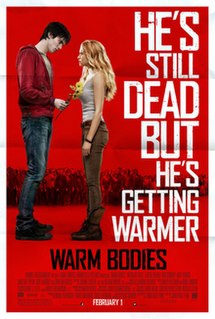
Warm Bodies is a different take on a zombie movie-- a romance told from the eyes of a zombie mixed with a little twist of parody. The story is narrated by the zombie "R" as he wanders around without real purpose, in search of, you guessed it, brains. It's set after the apocalypse, an event fuzzy in R's mind. All he knows is that most of the population are now mindless zombies, and there remain very few humans. The plot really begins when "R" spontaneously saves a human girl whose boyfriend he ate, and as he spends more time with her, he begins to warm up: he starts to turn back into a human. But the girl, Julie's, dad is the head of the human military force/ mayor? of the last human encampment, so can their love ever be?
I thought this movie was a cute summer flick. The story line was straightforward and pretty predictable, but R was relatable and you rooted for him. I didn't really like Julie's character, though. The movie was very obviously marketed to teens; R's inner dialogue speaks of angst and questioning purpose, individuality, feeling lost, etc. and he had complete hipster music tastes- I mean, he had a record player in his airplane compartment.
I enjoyed the movie ( I was half-passed out with heat exhaustion while watching it, so maybe I was less inclined to be critical) but there were some things that I thought could have been better. The main weakness, I felt, was that the movie had a lot of great ideas that the writers never really followed through on. In the beginning, the film is presented as a sort of mild parody of a zombie story- the lines sort of make fun of what's happening, and it has a little bit of a sarcastic edge that forces you to crack a smile. But I think the story got too involved as it went along, and lost a lot of the comedy. To be a parody, the narrative has to have a certain distance and sense of humor from the events in the story, which this lacked.
I was actually very interested in the way the whole zombiepocalypse was presented as a criticism about today's teens. (i.e. the main character and many of the zombies lived in an airport-- they were set up and in the position to go places and yet lacked the drive to. The zombies shuffle around with no purpose and lack communication skills. R is trying to define himself and remember who he is, but he can't quite.) R's journey is definitely one of self-discovery, but the commentary on teens began to fade as you got deeper into the story line, and towards the end it was really a stretch to relate what was happening to the original ideas.
It was only towards the end of the movie that I realized the love story of R and Julie was a nod to Romeo and Juliet ( I had this little epiphany only when I saw Julie perched on a balcony speaking down to R and I sarcastically remarked "Who are you, Juliet?" after which I quietly went "Oh." and then curled up in embarrassment.) I could understand this to an extent-- the zombies as the Montagues and the humans as the Capulets, Julie's overbearing father, etc. But I got a little too excited and jumped straight to thinking the whole story had understatedly been mimicking the events of Romeo and Juliet, which it didn't. I think that little detail was thrown in there simply for the cute factor, but I wished they had followed through with it more.
Overall, it was a light viewing and not memorable but didn't offend me in any way and was enjoyable to watch :)
"It's 1949. Two young Cuban musicians make their way up from Havana to the grand stage of New York. It is the era of the mambo, and the Castillo brothers, workers by day, become by night stars of the dance halls, where their orchestra plays the lush, sensuous, pulsing music that earns them the title of Mambo Kings. This is their moment of youth-- a golden time that thirty years later will be remembered with nostalgia and deep affection. In The Mambo Kings Play Songs of Love, Oscar Hijuelos has created a rich and enthralling novel about passion and loss and memory and desire."
This book was a vivid portrayal of a certain era in a certain place through a certain man's eyes. Oscar Hijuelos took the idea that in your last moments your life flashes before you to heart, and created a wildly detailed and beautifully illustrated trip down the memory lane of one Cesar Castillo, a Cuban musician living out his days in a New York City pulsing with mambo and life.
To be honest, this book took me quite awhile to get through. There isn't a driving plot line that makes you want to know what happens next; instead, each chapter presents an intricate vignette of actions, emotions, and thoughts, and the memories don't necessarily come in order. What I realized towards the end of the book, though, is why the scenes weren't shown chronologically. The book really only takes place in a couple hours of Cesar's life, as he's living out his last moments in a room in the Hotel Splendour, with a record player by his side spinning out the music of his youth. So when a song comes on, it's like opening a time capsule: everything this man experienced relating to that song comes rushing back as clearly as if it happened yesterday-- and the songs aren't chronological. It's a feeling I can personally relate to, as I think most people can.
What I liked a lot about the book was that, even though Cesar is remembering certain things, the author provides you with information that Cesar may not know. So these characters Cesar interacts with, you know their story and their thoughts, and they become a rounded person. In terms of that, I thought there was amazing character development in the story. Something I also found interesting was how no one character would be good or bad, since their intentions were all laid bare to the reader. The author was very blatant about how people used eachother, not necessarily malevolently, but simply because that's what people do. Cesar himself was an interesting man to consider. He drank a lot, he smoked, he was a complete womanizer, and though yet given these facts you would jump to the conclusion he was a bad man, or maybe emotionally closed off, as the stereotype is, Hijuelos gave him generosity, a love of family and music, redeeming qualities that in the end made him neither a good, nor a bad person-- because in real life, good and bad people don't exist. There are only good and bad qualities, and the balance therein.
The reason I picked this book up in the first place was that it was about the music scene in the mid- twentieth century, particularly the Cuban music. I love books that work in history and real settings, because you learn so much while reading them, and understand even more because you have context. Reading this book, I learned an amazing amount about New York, mambo, Cuban immigrants, and more, and while I had heard about Fidel Castro in Cuba, this book taught me about the effect it had on Cubans and the different views they had- something I would never learn in history books. I liked how real people and places were worked in- the main characters met the likes of Perez Prado, Paquito di Rivera, and Desi Arnaz, and integrating such real-life names gave the book a sense of reality as well; it was interesting to be listening to the exact songs mentioned while reading about them.
One of the few things I didn't necessarily enjoy about this book was how graphic it was. It made a point of questioning the difference/ boundary between lust and love, but I feel that it could have made that point with less imagery--I felt like it held up the story sometimes. However, it did round out that theme well in the end, giving no clear answer and leaving you questioning more than ever.
There was no doubt this book was well- written, and although it wasn't a page-turner I enjoyed my time reading it- Hijuelos is a master of imagery and his sentences are beautiful in their own right, rich in color and emotion. I would recommend this book to music-lovers and history buffs and anyone looking for a little romance.
There was a movie adaptation made of this book in 1992 that I'm looking forward to watching now that I finished the book. Review to come!
It's hard to believe that summer is almost halfway over- I've been so busy that the days have just flown past. For my birthday I went on a weekend trip to Quebec, which was amazing! I got in a little of practice with my French, and got to experience some foreign culture. It was basically my first time being out of the country, and it was such a weird feeling to walk down the street and realize that all of these people just assumed that I was Quebecois- it wasn't as if they all knew I was from America. On another note, the food was delicious, and I probably had way too much of it- basically everything came in maple flavor, every restaurant had poutine, and wild meats were the name of the game. I also developed a fascination with streets and stairways, and after awhile I was prohibited from taking any more pictures of the ground. (Click here to see some of my pictures from the trip) Anyways, I'm basically booked with regattas-- I just came back from one today and I'm diving into another tomorrow-- so I thought I would check in with some of the stuff that's caught my attention this summer.
MUSIC
Putamayo Presents French Cafe
Found this little treasure of a CD on a cabinet shelf and it ended up being one of those albums where there isn't one song I dislike.
Fibre de Verre
Mal o Mains
Si La Photo Est Bonne
Requiem For Annie by Parov Stelar
Teen Idle by Marina and the Diamonds
Twisted Nerve by Bernard Herman from Kill Bill
--WARNING!-- if you listen to this song you won't be able to get it out of your head for about two weeks.
I actually found this youtuber awhile ago but I literally cannot stop watching his videos. He's a dancer that does a dance style called "criming". I can't even describe it but it's addictive to watch- I'll admit I've marathonned his videos more than a couple of times. Plus he has amazing music taste- a lot of the songs above I found from watching his videos, and he also dances to a lot of Parov Stelar and Caravan Palace, which are my known favorites.
This video is definitely my new favorite- I think it's an interesting study in genders and the related dance styles/ what they enhance. When he's dancing as a girl he makes it look like he has curves just by the way he moves-- it's really well done. This video is good too but it won't display it so click here!
I actually can't even pick a favorite video. It's basically two brothers who talk to eachother over Youtube about whatever is on their minds, but it's all very interesting and they both have great personalities.
Hannibal is the latest creation of one of my favorite TV producers, Bryan Fuller. Now, I must admit I had my doubts about this show: could Bryan Fuller really pull off something as dark and intense as Hannibal Lecter? I mean, he had been known, at least in my mind, for adorable, bright-colored, quirky shows with light plots and pie-makers and talking inanimate objects. And besides, another police drama? *Groan* But after the fact, I can see how this show was perfect for Fuller. Although somewhat sugar-coated in all his shows, there is a theme of death and a certain amount of darkness--- I mean, Pushing Daisies is about a guy that can bring dead people back to life, but also kill them again. Take all the cute humor and primary-colored sets out of that and you have some pretty scary stuff. And don't Wonderfalls and Hannibal really address the same question; Am I going insane? Not to mention the interest in food shown in Pushing Daisies and well, obviously in Hannibal.
So, to get to my point, I was completely wrong to doubt that Fuller could pull off Hannibal. So, so wrong. To be honest, I had to warm up to it, but by mid-season I think that the show caught it's stride and started to develop its own personality and really set itself apart from the other crime dramas on air.
If you haven't watched the show, in which case I have no idea what you're doing with your life, it focuses on the time period before Thomas Harris's books, following police consultant Will Graham. Will Graham has the power of complete empathy under his control; he can assume the point of view of murderers and see from their eyes the murders unfolding, thus gaining clues and insight into how the crime was committed.
The problem with Will Graham is that this takes a toll on his psyche; he wakes up gasping from terrifying nightmares, and he starts losing his grasp on himself, slipping entirely into the minds of the killers. To help him cope, the police chief Jack Crawford brings in psychiatrist Hannibal Lecter, who watches Will's pursuit of the so-called "Chesapeake Ripper" with a bemused smile.
Bryan Fuller's Hannibal Lecter is played by the Danish actor Mads Mikkelsen, who most may know from his role as the villain in one of the recent James Bond movies. I haven't actually seen any of the Hannibal movies, but I do know that Mads Mikkelsen portrays a very different kind of Hannibal; more restrained, refined, and of course, with a Danish accent. I personally thought that Mikkelsen's character was genius.
From the start of the show, you know Hannibal is the murderer; the tension of the show isn't about figuring out who dun' it. But it's interesting how the show manipulates your feelings towards Hannibal. Yes, you know that he killed all these people, you know that's not pork he's serving up at his dinner table, and yet, you want to like him. You want to like him because he wears European suits and nice ties, he decorates with luxurious furniture, and his dinner parties are a work of art. You want to like him because he's a gentleman, and because of that, it's almost like the truth becomes tasteful. Because the show leads you through this train of thought, you can understand why no one suspects him, and everybody likes him. But as the season progresses, you start to turn on him. "Wait, Hannibal, why would you do that?" At the beginning, you didn't know him too well; you could project what you wanted him to be onto him; he was understanding, a good friend, even merciful, in your eyes. You wanted him to be a human. But then you see more of him, of who he is and what he does, and you find it harder and harder to connect to him, you start to feel hatred towards him. I think how you, as the viewer, were led through this really made you understand the points of view of those surrounding him; you, too, were given the power of empathy, just like Will and Hannibal.
I like that by the end of season one you still didn't really know too much about who Hannibal really was, only how people saw him. You never really saw through the "person-mask" he had on; only at the end did he let Will see his true self, when he smiled through the bars of the jail cell. It leaves you wanting more and keeps the interest on Hannibal, so there's always room to develop him as a character.
Something I truly enjoyed about the show was how stylized it was, from the sets to the script to the lighting and costumes. This wasn't just a show that focused on a plot, this was an all-around production, where everything, even down to the smallest detail, was a work of art- in the true fashion of Hannibal Lecter.
The show was directed by David Slade, whose work I recognized from his movie Hard Candy. He incorporated his trademark flashes of red among mostly stark colors, blacks and whites and grays. This lent the show a very interesting atmosphere- surgical at times, moody at others.
I loved the costume design in Hannibal. The outfit that Freddie Lounds (left) in the picture above has got to be one of my favorites in the whole show, but Hannibal himself was so impeccably dressed throughout the season. His signature was a three-piece plaid suit and a paisley tie; don't ask me how he pulled it off, but he did.
Something I didn't appreciate until after finishing the show was the cinematography, and the attention to detail that was put into it. I found a lot written by film students on the sets, colors, focus, and more, and realized that I hadn't really thought to look for those things while watching; I'd become so accustomed to watching shows that were plot-driven and didn't care to pay attention to those aspects of the production. But I love that this show did that- there's a layer beneath what is said that is created. Why are those colors saturated? Why is Will leaning towards Hannibal in this shot, but placed elsewhere in this one? Why is that curtain more open than in previous episodes? And answering all these questions gives you so much more understanding of the show.
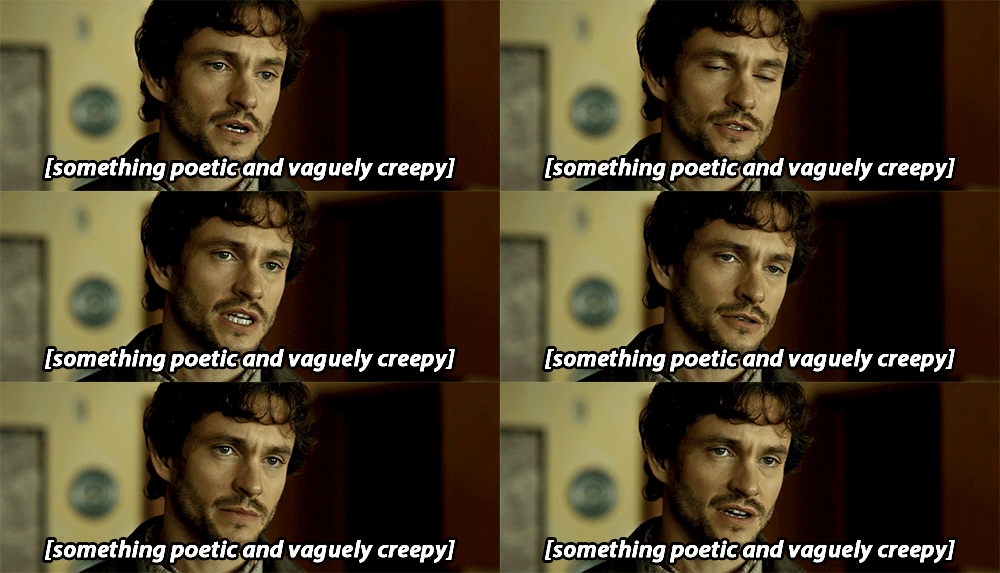
Actually, that caption sums up the script writing a little too well. The first couple episodes of the show I wasn't sure how I felt about the script; I thought maybe Fuller's style didn't apply too well in the context. But then I realized something; the script wasn't trying to be realistic. In fact, it was completely self-indulgent, as if it had been written by a poet. Yet once I realized that, I enjoyed it so much- listening to the characters' dialogue turned into one of my favorite parts of the show, and added even more to it's moody and artistic feel. When I think of it, the script made me understand that the show wasn't trying to be realistic in any way- it was surreal and psychological, and you had to embrace that style to really enjoy watching it.
The moment I truly committed to the script, though, was when Hannibal says,"Killing must feel good to God, too. He does it all the time, and are we not created in his image?" I feel like that was the moment the show hit it's stride, veered off the road of normal police dramas, and turned into something far darker and more beautiful.
I have to give a shout-out to Bryan Fuller for bringing back the actors and actresses from his other shows. It was interesting to see some familiar faces, but set in a different light. Fingers crossed that Lee Pace makes a cameo!
I thought the music was done very well. It was a mix of creepy vibrations and classical music, but it fit together very well; the classical was a nice touch and added to the style of Hannibal Lecter.
The. Number. Of. Puns. In. This. Show. And every time Hannibal says one you just expect him to turn and wink at the camera. But I think there's something interesting in them, too, apart from the humor. For one thing, you get a little glimpse into how Hannibal views people; he equates them to sheep and pigs-- animals. But also, it's almost as if he wants to get caught. He says things that could very easily give him away, and yet no one recognizes them; he seems almost disappointed in people. I don't think it's even that he wants to get caught, necessarily. It's just that he wants people to recognize his art. You could see a bit of this in the episode where the police were giving credit to someone else for Hannibal's work, and, for the only time in the season, Hannibal gets mad- shown in a slight facial twitch, but you can see it. The psyche of Hannibal Lecter, the psychiatrist, is something that you only see glimpses into, and I hope you see more in the upcoming seasons.
I'll be honest, right here and now, and state NBC's Hannibal has become my favorite show, right on top of Sherlock. I was indecisive as to how to review this show; I was tempted to go episode by episode simply because there's so much detail and so much to talk about in each. I think what makes this show successful is that it's such an interesting plot line, and it'll appease the people that simply want to watch a show for entertainment. But that could be any show. What then sets it apart as quality is that there's a level beneath that, a level of details and inferences, ideas, themes, things to think about- there's a beauty and intricacy to the show that sets it above others. It's one of those shows where you learn more every time you talk about it. So I think that there's something in it for everyone (just not the faint-hearted) and I would recommend it. 5/5 stars!


.jpg)
.JPG)