Showing posts with label Adrien Brody. Show all posts

Friday, March 28, 2014

The Grand Budapest Hotel (2014) dir. by Wes Anderson


Wes Anderson is one of the most prominent directors of our time: worshiped by hipsters everywhere, respected by film students and critics, inspiration for fashion bloggers, and a dream come true for soundtrack junkies. One is able to recognize a Wes Anderson movie after exactly thirty seconds: the stunning symmetry of his sets, slightly retro color palettes, Bill Murray, and an overarching sense of irony. I'll admit to being smitten by Wes and his quirky aesthetics: in particular I have a weakness for The Darjeeling Limited. And his new movie, The Grand Budapest Hotel, delivered everything an Anderson lover could want, and more. Maybe a little too much more.
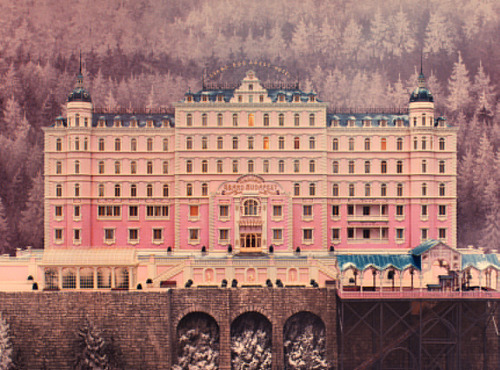

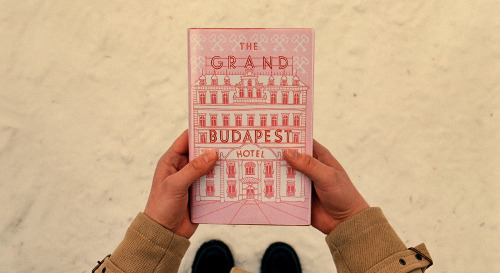
The film begins in a made-up location in Eastern Europe, with a slightly dweebish-looking girl. In a signature Anderson tracking shot, we follow her into a graveyard, past a huddle of old cronies clad in black, until she comes to a stop in front of a bust of a writer, at which point she hangs a pair of keys on the bust and sits down. She takes out a book, a pink hardcover entitled "The Grand Budapest Hotel". And so the story begins.

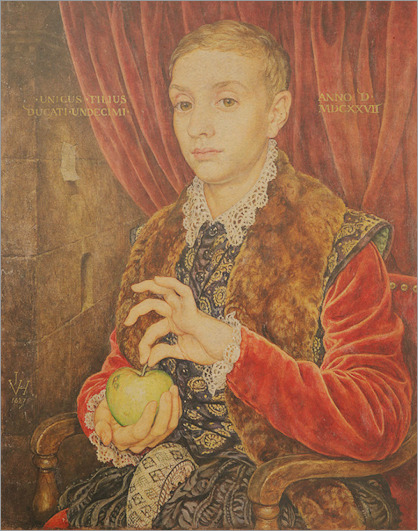
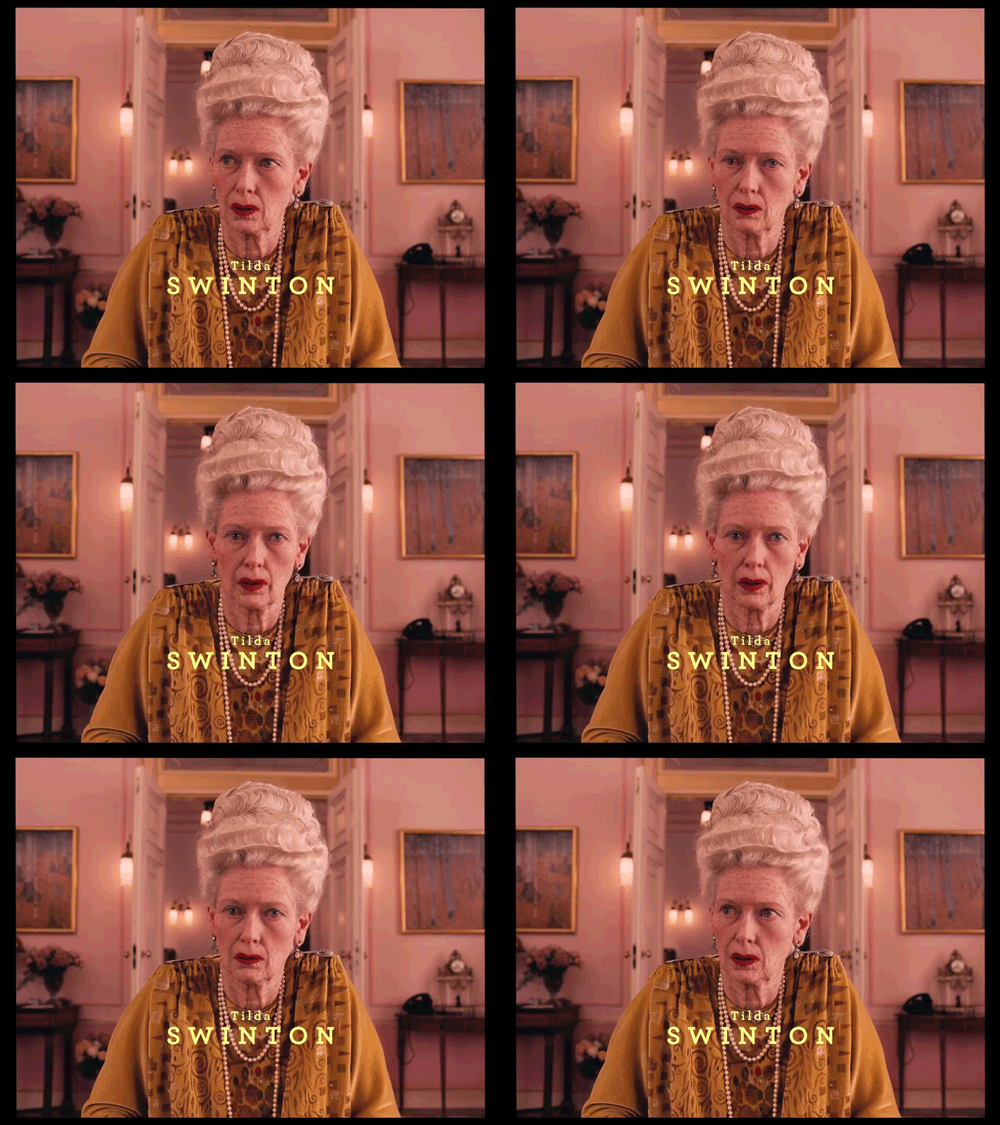
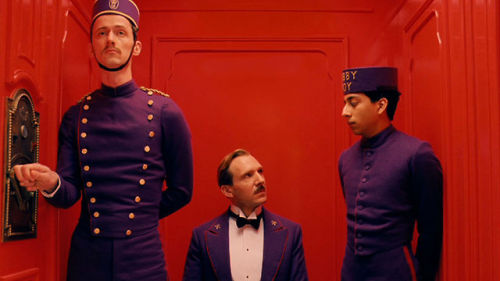
The writer *Hi Jude Law!* of the book speaks of his conversation with Zero Moustafa at the now-obsolete Grand Budapest Hotel, where he got the inspiration to write the book. He sits down with Moustafa for dinner, at which point the film descends into a third ring of story *so meta*, in which we meet the young Zero, lobby boy at the Grand Budapest Hotel, under the tutelage of Monsieur Gustave H. (Ralph Fiennes). Gustave is the main attraction to the hotel, especially for old, rich, blonde, lonely women. We soon learn that one of his elderly acquaintances, Madame D. (Tilda Swinton, with expert makeup may I add), has just been murdered, and in her will has left the priceless painting, Boy With Apple, to Gustave. Madame D.'s son Dmitri (Adrien Brody, avec twisted mustache and attitude problems) is enraged at this, and does everything he can to stop Gustave from getting it, after which ensues two hours of complete Wes Anderson visual indulgence.

The plot and setting of this movie was a bit of a departure for Wes Anderson. Granted, no two of his movies are the same: they range from an angsty prep school playwright to three brothers on a train ride across India  to an aquatic hunt for a leopard shark and back again, but this was the first time Anderson ventured into a historical setting, and even a political one at that. The movie took place in the 1930's as an oddly vague war was going on; Zero, the main character, had fled his own country because the "rebel militia" had killed his whole family, and you get a sense of the government presence when the train Gustave and Zero are on gets stopped by officials. Wes Anderson handles the setting well; he doesn't let it control his aesthetic and plot choices, and in fact it adds an extra dose of charm. 
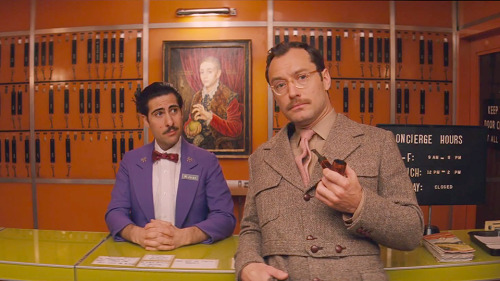

The cast of the movie was spot-on as usual. Ralph Fiennes completely stole the show as Gustave H.; he was groomed and charismatic and clever, and you got a little thrill whenever he came on screen. Tony Revelori was ...meh. Considering he was the main character, I wished his performance had been a little stronger: his character didn't leave much of anything to remember him by. I liked when he seemed sort of awkward and uncertain- I wish there was more of that. One of my problems with the film was that the only characters who were really developed at all, or even had any significant screen time, were Gustave and Zero. It seems strange even to me that I wish actors like Bill Murray, Jason Schwartzman, and Owen Wilson weren't in the movie; they're some of my favorite actors. But by having such memorable actors play such immemorable roles, the characters that should have just quietly passed out of the story stuck in my mind and crowded the film too much. However, there are some shout-outs due: Madame D. with her cloudy eye and old lady contoured lipstick was so incredibly well styled it brought me to tears. Adrien Brody as sour Dmitri was so perfect- the way one side of his mustache curled up slightly and his hair was tousled and he stormed everywhere. His character was so well-written and so very Wes Anderson.


Visually, the film was incredibly stunning. Every single shot was completely choreographed and designed down to the most minute details. The color palette didn't feel as fresh as some of Wes's other films: royal purple played prominently, as well as cherry red, but the light pink of the Mendl's boxes lightened things up a bit. The tracking shots were wonderful; the scene walking through Madame D,'s mansion was especially satisfying. Whenever Wes Anderson characters walk they walk with such purpose and turn at such sharp angles. There was wonderful symmetry and some more hints of that storybook feel Anderson films invariably have.
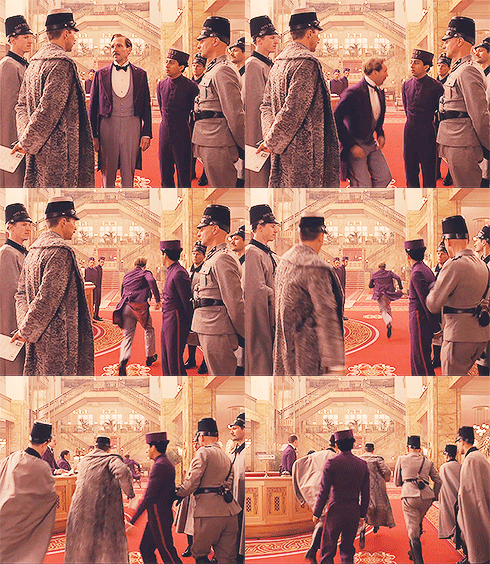

Here's my complaint: the movie was too Wes Anderson. Which I never thought I would say because the whole appeal of Wes Anderson films is that they're Wes Anderson films. I mean, the plots aren't necessarily anything groundbreaking; it's how they're carried out that makes you love them so much. The trademark symbols of his films inspire a sort of whimsical nostalgia, with their contrived cinematography and retro colors and forgotten sixties music and dopey characters and awkward pauses and ironic humor. But I feel with this film Wes counted on it being his film too much: it felt like he played too heavily into the fact that he's a hipster darling and his films are unconditionally loved. The whole film just screamed WES ANDERSON so much so that it became a little oppressive by the end: I didn't have room to breathe and absorb the plot between taking in all the style and design and witty dialogue. Also, the film lacked a certain sense of balance I connotate with Wes Anderson works. There's a feeling of equilibrium in his stories. The sadness and reality of the situations are tempered with ironic humor and child-like storytelling, and the joy and humor are tempered with sad irony and reminders of reality. Everything sort of cancels out and leaves the viewer with one steady emotion throughout the film. In this film, there was too much humor throughout: I wasn't able to savor it between flashes of sadness or dysfunction, because it was constantly there. At the end *no spoilers...maybe a little one?* it was just too sad. The end to the story finished what had been an action packed and humorous film on a surprisingly tragic note that I didn't appreciate. I have to say, despite how much I hate the belief that sad endings to books and movies make you think more than happy endings, the fact that this ending was so depressing did make me wonder why, and analyze some themes from the movie I wouldn't have payed attention to otherwise. I guess Wes Anderson was trying to make the statement that all things end and time moves forward, but it wasn't that novel of an idea or that well executed throughout the story that it warranted the kind of ending that was given.
  
I have a personal tendency to be opposed to all new creations and denounce them as inferior to everything old. So while I may have seemed to moan a lot about this film, the reality is that it's still Wes Anderson, and it's still amazing and beautiful and hilarious and inspiring. There are many people that say it's their favorite Wes Anderson: it does show his growth and change as a director, and I respect him for branching out and trying new ideas. I believe Wes Anderson is still on the rise, and his best is yet to come, which is promising considering how exceptional his existing body of work is. I also love that he is the star of his movies, rather than the actors. It's something you don't see too often but it's nice when a director gets the spotlight.


Wednesday, May 15, 2013

The Darjeeling Limited Directed by Wes Anderson


The Darjeeling Limited makes four out of six Wes Andersons that I have watched, and I've come to the conclusion that that man is actually incapable of making a bad movie. India was the perfect setting for his style, and he took full advantage of the saturated colors his setting provided, again playing up his iconic yellow and blue contrasting.


The movie began with, actually, a short movie, titled Hotel Chevalier. It was an interesting idea as a lead-in to the movie to supply some more depth to the back story, but personally I didn't like it. The short took place in the Hotel Chevalier in Paris, where the character Jack had been staying for quite some time. His ex-girlfriend(Natalie Portman) comes to visit him, and you get a look into their complicated relationship, her saying, "Whatever happens in the end, I don't want to lose you as a friend." and him replying, "I promise I will never be your friend. No matter what. Ever." I guess the reason I didn't like this short was that it wasn't deadpan enough for Wes Anderson. You get the kind of dysfunctional, aloofness of the character Jack, but Natalie Portman just isn't a Wes Anderson actress. She's too mainstream, too pretty, not strange enough. And her lines are too emotional. When they're conversing, you don't get the sense of sick amusement in their tragic, emotional dialogue. And also what sort of offended me was the nudity/graphic quality. Anderson just seems, I don't know, above that. It was a little bit of a shock to see it in the film.


As for what the real movie was about, it follows the journey of three semi-excommunicated brothers from an obviously semi-wealthy, dysfunctional family, on their train ride across India on what Francis, the oldest, calls a "spiritual journey". The train they ride on is called the Darjeeling Limited, hence the name of the movie. It turns out that Francis has planned on finding their mother, who you get the sense of as flighty, and who disappeared awhile back, not even coming to their father's funeral. They encounter numerous stops along the way, and the movie follows the typical "quest" format; Questers(the brothers) A place to go(India) a reason to go there(to find their mother) dangers along the way(stops, poisonous snakes, boy drowning) a princess (Indian stewardess) an enemy (the steward) and a real reason for the quest (self-discovery and rediscovering eachother as brothers)


What hit me first about this movie was how fast you knew which brothers were the youngest, middle, and oldest. Anderson really nailed that dynamic right on the head. Jack is youngest, the little one who craves attention and who struggles to keep up with the others. Francis is obviously the oldest, as is clearly displayed in the breakfast scene where he orders for everyone, telling them what they want, and then asking them to raise their hands for another item on the menu. You can also tell that he feels responsible, almost parent-like, for his little brothers, when he asks something like, "Did I not do a good job raising you?" in passing. Peter falls in the middle, having more of a muted personality, and not making a big deal of his personal problems. I also love how Peter and Jack would tell each other things, then say, "Don't tell Francis" obviously because Francis is the more parent-like figure that they have to own up to. But I like that Wes doesn't allow these secrets to become dramatic, and how they get out pretty quickly, and in a very nonchalant way. Jack finds out Peter told Francis he planned on leaving early, so Jack says very matter-of-factly and without any ado, "Peter's having a baby in nine weeks." And how they avoid conflict as well--my favorite was when Francis revealed he had taken Jack's passport, and Peter just walks away. Francis asks where he's going, and Peter is just like,"To uhh pray at a different thing" I can relate to so much of this since I am the youngest of three siblings, and realistic interactions made me wonder if Wes had siblings himself.


Wes Anderson definitely isn't trying to be subtle in his use of symbolism in this movie; I mean it takes place on a train, which basically screams moving through life. The train they are all on, the Darjeeling, is not a very good atmosphere. It is heavy with secretive parallels; the siblings are always telling each other not to tell each other things, and they have to keep such things as smoking and a poisonous snake secret from the steward. The steward himself represents the anger and hatred between the brothers, and the stewardess is the unhealthy relationship that Jack is in. Throughout the movie, the brothers are carrying around all this luggage/baggage *baggage*, and it's always kind of in the back of your head, annoying you, like, "why are they lugging this all around?!" and it's so refreshing when they are running to get on their new train, the healthier, more balanced one, they drop all their luggage.


Okay but I actually loved the casting for this movie (with the exception of Natalie Portman but that has already been addressed)  Something that is consistent in Wes Andersons is the use of actors that aren't quite attractive, instead having interesting and quirky faces, and that was shown again in this.

I absolutely loves Jason Schwartzman as Jack. His big mustache and haircut in the movie, in addition to his comparatively short stature and big dopey eyes, made him seem so little brother. I love that when he walked with his brothers he had to take twice as many steps to keep up; it was so cute and little duckling. He looked sort of mopey throughout the movie, but in that kind of immature little brother way, and it just fit the role so perfectly. I thought that it was hilarious when Francis kept saying "Jack agrees" and at a certain point Jack was just like


ADRIEN BRODY. I can't... I don't even know how to broach this. He was so great as the middle sibling who was just trying to figure out his life on his own in a quiet way, who wasn't so sure what to do with himself and kind of just went along with whatever was said. But I loved how you could tell through the whole film he really did love his brothers, and how he was kind of dealing with the idea of having a son when he knew how messed up his family was. And i love how he would always take his family's things; it showed in a subtle way ho attached he was to them. His character was a more subtle one, but I thought the most interesting in the movie.


Okay, so actually I'm pretty much done with Owen Wilson. He plays the same character every time! He played Francis, the oldest, in this, and he did an okay job, but I just can't see him as the character, I always see him as himself. Just meh.


I guess what was different about this movie was the emotional aspect of it. In the other Wes Andersons I've seen, there's always this sense of detachment, of cynicism and irony. It's like, whenever there's a sad situation there's ironic humour to balance it, and whenever there's a funny scene, there's tragedy to balance it, so the movie just goes in kind of this emotional flatline. And that's good, that's his style, and it's very distinct and interesting. This movie was a bit different from that; it let itself get more absorbed in the emotions and the scenes. When there was a sad moment, sometimes there wasn't the irony to bring you out of it. And I think that Wes Anderson executed this style brilliantly as well. The movie was a really great voyage through brotherhood; my favorite line was when jack asked, "Do you think we would have been friends in real life? Not as brothers, but as people." And I think that's the thing with families. You may not always like them, but you always always love them.

MUSIC SHOUT-OUT

This Time Tomorrow-The Kinks

Strangers-The Kinks

Champs Elysees-Joe Dassin

Search This Blog