Showing posts with label Film. Show all posts

Friday, May 9, 2014

The Devil's Violinist (2013) dir. by Bernard Rose


The Devil's Violinist directed by Bernard Rose and starring David Garrett, chronicles the life of the infamous violin maestro Niccolo Paganini. 


My impression of this film was that it was trying to be some knock-off of The Picture of Dorian Gray, which is an easy enough conclusion to come to if you see Niccolo Paganini as Dorian and Corbani as Lord Henry. There was even the *completely made up* innocent ingenue who acts to purify the sinful main character, although Lord Henry's daughter was a figment of the film version and not the book. I wish there had been more subtlety about the whole Faustian bargain; the scene at the beginning was a bit too literal with the expression of selling your soul to the devil. 

The movie was obviously catering to an audience: it completely overplayed the whole Satan theme, and the sex was just downright gratuitous. I mean, yes, that was something Paganini was known for but the whole movie centered around how Paganini was such a "seducer" and there is obviously SO much more to his life than that. All of the drama, action, emotion, and plot progress in the film ended up centering around Niccolo's conquests and the rumors about his love life, when more time should have been spent actually portraying his life and who he was as a person. The daddy problems vaguely hinted at in a couple scenes were a last-ditch effort to give some dimension to the main character, but it was so half-hearted and such a trope that it only warranted an eye-roll. Even after spending two hours with him, the viewer doesn't really know Paganini at all, and I refuse to accept that this was intentional on behalf of his little speech about how nobody knows him and he puts all he is into music. That's not an excuse for a lack of character development. Corbani came out of nowhere and left out of nowhere: he always seems to be there and yet remains a cardboard cutout of a character the whole time. What are his motives, really? I suppose money but really a man as clever as him could find a better and less dramatic way to make money. His role in the film was forced and only existed because the writers wanted to push the devil element so badly. Really I think I would have liked the story better without him. 

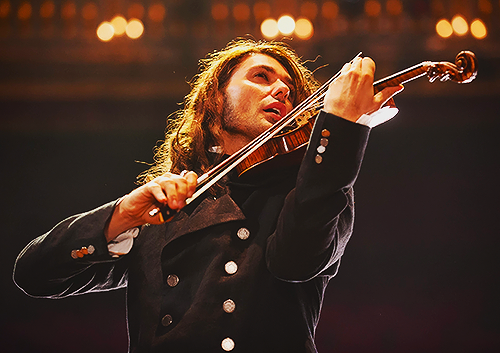
The one thing this movie did have going for it was David Garrett's beautiful beautiful face. The tan, the tousled hair, and hint of guyliner; it all came together to create something worth suffering through two hours of cheesy dialogue and non-existent plot for. I appreciate that a real violinist was found to play the part of Paganini: I only wish they could have found a violinist who could also act. David Garrett wasn't horrible, per se, but the fake Italian accent was pretty painful, and in the scenes where he couldn't get away with simply smoldering, his acting felt fake and distracted from whatever was happening. They at least tried to compensate for these flaws with many shots of exposed torso, so I appreciated that effort. 

Considering that the movie was about a musician, the music wasn't used to its full capacity. Just because the music was actually a plot point in the movie doesn't mean the scene always had to be of the performers when it was playing: the movie ended up with performance scenes that dragged on when I felt the music could have been used to better effect behind another scene, where it would have connected the story more and accentuated emotions and mood. I felt that the music scenes fell just short of the level of drama they really needed because they focused too greatly on the musicians performing and not on anything else going on in the plot. I did, however, like the mix of music: the pieces written by Paganini himself with (I believe) a piece written by David Garrett. 

Despite the torture of sitting through two hours of this movie, I did like the sentiment expressed at the end, when Paganini says, "I will live forever." and then nestles down amidst his sheet music. That's the beauty of art; you put everything you are into it and through doing so you become immortal. I was actually pretty heartbroken SPOILER about how things ended up with Niccolo and Charlotte, although being together after the whole affair seemed pretty impossible for them. However, when Niccolo writes to her and says there is some love between them, and again at the end when he is playing the violin part to the song he wrote and Charlotte is singing it, I think of a quote I like that goes something like, "If two people love the same thing,...then they must love each other, at least a little, even if they never say it." I forget where that's from, but it seems to encapsulate the relationship between the two musicians.

This movie wasn't all that I wanted it to be- I feel it sacrificed a lot to please the crowd, which is ironic in a way since that is the very sentiment that is shown in a negative light at the beginning of the movie. I wouldn't recommend it, but definitely look into Niccolo Paganini if you're interested in music history, and I know there are other movies that address his life on the Wikipedia page I linked above.


This is actually a very pretty song.

Sunday, January 19, 2014

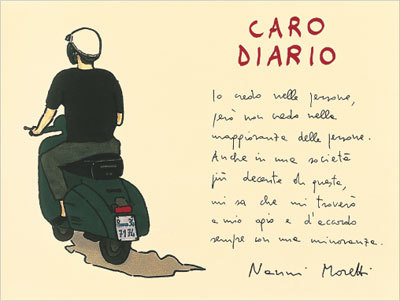
Caro Diario (1993) dir. by Nanni Moretti


Caro Diario is the three-part film memoir of Italian director and actor Nanni Moretti. In part one, Vespa, the camera follows Nanni around Rome on his Vespa, with panning shots of buildings and Nanni stopping to speak with random people on the street, including an encounter with Jennifer Beals. Part two, Isole, follows Nanni and his friend from island to island, trying to find the perfect spot to sit down and work. The film concludes with Medici, documenting Nanni as he gets diagnosed with cancer. 

From what I've heard, this is one of the films that Moretti is best known for. Called the Woody Allen of Italy, he definitely is a bit strange, but in my opinion not very appealing. The film had the opportunity to be very beautiful, but instead the colors were dingy and the places, especially the buildings, pretty rough on the eyes. I found the music to be annoying, except for this song, and there wasn't quite enough offbeat humor to make the whole thing worthwhile. I felt some Wes Anderson vibes from it, but it didn't have the strong aesthetic that Wes Anderson has. The first two parts felt sort of pointless, and the last was TMI. Overall I was mildly bored by the whole thing, and I don't really understand why this film has gotten so much praise. Perhaps I'm missing something. 
I do, however, like the idea of a sort of travelogue, inner-narration type thing. I was thinking of experimenting making one when I went to France this summer-- I like the idea of getting into filmmaking. Originally I thought Caro Diario would be sort of like the book Spotted In France, which follows a man around on his Vespa in the south of France with his Dalmatian, which was thoroughly enjoyable.

Wednesday, May 15, 2013

The Darjeeling Limited Directed by Wes Anderson


The Darjeeling Limited makes four out of six Wes Andersons that I have watched, and I've come to the conclusion that that man is actually incapable of making a bad movie. India was the perfect setting for his style, and he took full advantage of the saturated colors his setting provided, again playing up his iconic yellow and blue contrasting.


The movie began with, actually, a short movie, titled Hotel Chevalier. It was an interesting idea as a lead-in to the movie to supply some more depth to the back story, but personally I didn't like it. The short took place in the Hotel Chevalier in Paris, where the character Jack had been staying for quite some time. His ex-girlfriend(Natalie Portman) comes to visit him, and you get a look into their complicated relationship, her saying, "Whatever happens in the end, I don't want to lose you as a friend." and him replying, "I promise I will never be your friend. No matter what. Ever." I guess the reason I didn't like this short was that it wasn't deadpan enough for Wes Anderson. You get the kind of dysfunctional, aloofness of the character Jack, but Natalie Portman just isn't a Wes Anderson actress. She's too mainstream, too pretty, not strange enough. And her lines are too emotional. When they're conversing, you don't get the sense of sick amusement in their tragic, emotional dialogue. And also what sort of offended me was the nudity/graphic quality. Anderson just seems, I don't know, above that. It was a little bit of a shock to see it in the film.


As for what the real movie was about, it follows the journey of three semi-excommunicated brothers from an obviously semi-wealthy, dysfunctional family, on their train ride across India on what Francis, the oldest, calls a "spiritual journey". The train they ride on is called the Darjeeling Limited, hence the name of the movie. It turns out that Francis has planned on finding their mother, who you get the sense of as flighty, and who disappeared awhile back, not even coming to their father's funeral. They encounter numerous stops along the way, and the movie follows the typical "quest" format; Questers(the brothers) A place to go(India) a reason to go there(to find their mother) dangers along the way(stops, poisonous snakes, boy drowning) a princess (Indian stewardess) an enemy (the steward) and a real reason for the quest (self-discovery and rediscovering eachother as brothers)


What hit me first about this movie was how fast you knew which brothers were the youngest, middle, and oldest. Anderson really nailed that dynamic right on the head. Jack is youngest, the little one who craves attention and who struggles to keep up with the others. Francis is obviously the oldest, as is clearly displayed in the breakfast scene where he orders for everyone, telling them what they want, and then asking them to raise their hands for another item on the menu. You can also tell that he feels responsible, almost parent-like, for his little brothers, when he asks something like, "Did I not do a good job raising you?" in passing. Peter falls in the middle, having more of a muted personality, and not making a big deal of his personal problems. I also love how Peter and Jack would tell each other things, then say, "Don't tell Francis" obviously because Francis is the more parent-like figure that they have to own up to. But I like that Wes doesn't allow these secrets to become dramatic, and how they get out pretty quickly, and in a very nonchalant way. Jack finds out Peter told Francis he planned on leaving early, so Jack says very matter-of-factly and without any ado, "Peter's having a baby in nine weeks." And how they avoid conflict as well--my favorite was when Francis revealed he had taken Jack's passport, and Peter just walks away. Francis asks where he's going, and Peter is just like,"To uhh pray at a different thing" I can relate to so much of this since I am the youngest of three siblings, and realistic interactions made me wonder if Wes had siblings himself.


Wes Anderson definitely isn't trying to be subtle in his use of symbolism in this movie; I mean it takes place on a train, which basically screams moving through life. The train they are all on, the Darjeeling, is not a very good atmosphere. It is heavy with secretive parallels; the siblings are always telling each other not to tell each other things, and they have to keep such things as smoking and a poisonous snake secret from the steward. The steward himself represents the anger and hatred between the brothers, and the stewardess is the unhealthy relationship that Jack is in. Throughout the movie, the brothers are carrying around all this luggage/baggage *baggage*, and it's always kind of in the back of your head, annoying you, like, "why are they lugging this all around?!" and it's so refreshing when they are running to get on their new train, the healthier, more balanced one, they drop all their luggage.


Okay but I actually loved the casting for this movie (with the exception of Natalie Portman but that has already been addressed)  Something that is consistent in Wes Andersons is the use of actors that aren't quite attractive, instead having interesting and quirky faces, and that was shown again in this.

I absolutely loves Jason Schwartzman as Jack. His big mustache and haircut in the movie, in addition to his comparatively short stature and big dopey eyes, made him seem so little brother. I love that when he walked with his brothers he had to take twice as many steps to keep up; it was so cute and little duckling. He looked sort of mopey throughout the movie, but in that kind of immature little brother way, and it just fit the role so perfectly. I thought that it was hilarious when Francis kept saying "Jack agrees" and at a certain point Jack was just like


ADRIEN BRODY. I can't... I don't even know how to broach this. He was so great as the middle sibling who was just trying to figure out his life on his own in a quiet way, who wasn't so sure what to do with himself and kind of just went along with whatever was said. But I loved how you could tell through the whole film he really did love his brothers, and how he was kind of dealing with the idea of having a son when he knew how messed up his family was. And i love how he would always take his family's things; it showed in a subtle way ho attached he was to them. His character was a more subtle one, but I thought the most interesting in the movie.


Okay, so actually I'm pretty much done with Owen Wilson. He plays the same character every time! He played Francis, the oldest, in this, and he did an okay job, but I just can't see him as the character, I always see him as himself. Just meh.


I guess what was different about this movie was the emotional aspect of it. In the other Wes Andersons I've seen, there's always this sense of detachment, of cynicism and irony. It's like, whenever there's a sad situation there's ironic humour to balance it, and whenever there's a funny scene, there's tragedy to balance it, so the movie just goes in kind of this emotional flatline. And that's good, that's his style, and it's very distinct and interesting. This movie was a bit different from that; it let itself get more absorbed in the emotions and the scenes. When there was a sad moment, sometimes there wasn't the irony to bring you out of it. And I think that Wes Anderson executed this style brilliantly as well. The movie was a really great voyage through brotherhood; my favorite line was when jack asked, "Do you think we would have been friends in real life? Not as brothers, but as people." And I think that's the thing with families. You may not always like them, but you always always love them.

MUSIC SHOUT-OUT

This Time Tomorrow-The Kinks

Strangers-The Kinks

Champs Elysees-Joe Dassin

Search This Blog