Showing posts with label movie. Show all posts

Friday, May 9, 2014

The Devil's Violinist (2013) dir. by Bernard Rose


The Devil's Violinist directed by Bernard Rose and starring David Garrett, chronicles the life of the infamous violin maestro Niccolo Paganini. 


My impression of this film was that it was trying to be some knock-off of The Picture of Dorian Gray, which is an easy enough conclusion to come to if you see Niccolo Paganini as Dorian and Corbani as Lord Henry. There was even the *completely made up* innocent ingenue who acts to purify the sinful main character, although Lord Henry's daughter was a figment of the film version and not the book. I wish there had been more subtlety about the whole Faustian bargain; the scene at the beginning was a bit too literal with the expression of selling your soul to the devil. 

The movie was obviously catering to an audience: it completely overplayed the whole Satan theme, and the sex was just downright gratuitous. I mean, yes, that was something Paganini was known for but the whole movie centered around how Paganini was such a "seducer" and there is obviously SO much more to his life than that. All of the drama, action, emotion, and plot progress in the film ended up centering around Niccolo's conquests and the rumors about his love life, when more time should have been spent actually portraying his life and who he was as a person. The daddy problems vaguely hinted at in a couple scenes were a last-ditch effort to give some dimension to the main character, but it was so half-hearted and such a trope that it only warranted an eye-roll. Even after spending two hours with him, the viewer doesn't really know Paganini at all, and I refuse to accept that this was intentional on behalf of his little speech about how nobody knows him and he puts all he is into music. That's not an excuse for a lack of character development. Corbani came out of nowhere and left out of nowhere: he always seems to be there and yet remains a cardboard cutout of a character the whole time. What are his motives, really? I suppose money but really a man as clever as him could find a better and less dramatic way to make money. His role in the film was forced and only existed because the writers wanted to push the devil element so badly. Really I think I would have liked the story better without him. 

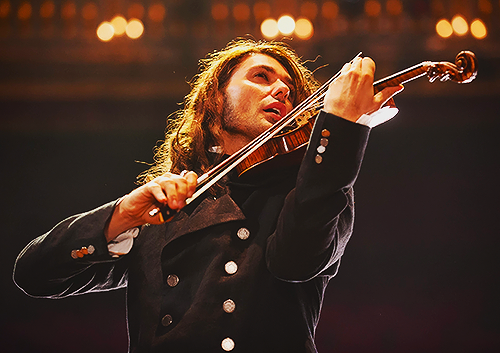
The one thing this movie did have going for it was David Garrett's beautiful beautiful face. The tan, the tousled hair, and hint of guyliner; it all came together to create something worth suffering through two hours of cheesy dialogue and non-existent plot for. I appreciate that a real violinist was found to play the part of Paganini: I only wish they could have found a violinist who could also act. David Garrett wasn't horrible, per se, but the fake Italian accent was pretty painful, and in the scenes where he couldn't get away with simply smoldering, his acting felt fake and distracted from whatever was happening. They at least tried to compensate for these flaws with many shots of exposed torso, so I appreciated that effort. 

Considering that the movie was about a musician, the music wasn't used to its full capacity. Just because the music was actually a plot point in the movie doesn't mean the scene always had to be of the performers when it was playing: the movie ended up with performance scenes that dragged on when I felt the music could have been used to better effect behind another scene, where it would have connected the story more and accentuated emotions and mood. I felt that the music scenes fell just short of the level of drama they really needed because they focused too greatly on the musicians performing and not on anything else going on in the plot. I did, however, like the mix of music: the pieces written by Paganini himself with (I believe) a piece written by David Garrett. 

Despite the torture of sitting through two hours of this movie, I did like the sentiment expressed at the end, when Paganini says, "I will live forever." and then nestles down amidst his sheet music. That's the beauty of art; you put everything you are into it and through doing so you become immortal. I was actually pretty heartbroken SPOILER about how things ended up with Niccolo and Charlotte, although being together after the whole affair seemed pretty impossible for them. However, when Niccolo writes to her and says there is some love between them, and again at the end when he is playing the violin part to the song he wrote and Charlotte is singing it, I think of a quote I like that goes something like, "If two people love the same thing,...then they must love each other, at least a little, even if they never say it." I forget where that's from, but it seems to encapsulate the relationship between the two musicians.

This movie wasn't all that I wanted it to be- I feel it sacrificed a lot to please the crowd, which is ironic in a way since that is the very sentiment that is shown in a negative light at the beginning of the movie. I wouldn't recommend it, but definitely look into Niccolo Paganini if you're interested in music history, and I know there are other movies that address his life on the Wikipedia page I linked above.


This is actually a very pretty song.

Wednesday, January 22, 2014

Ginger and Rosa (2013) dir. by Sally Potter


London, 1962. Two teenage girls – Ginger and Rosa - are inseparable; they play truant together, discuss religion, politics and hairstyles, and dream of lives bigger than their mothers’ frustrated domesticity.
But, as the Cold War meets the sexual revolution, and the threat of nuclear holocaust escalates, the lifelong friendship of the two girls is shattered - by the clash of desire and the determination to survive.
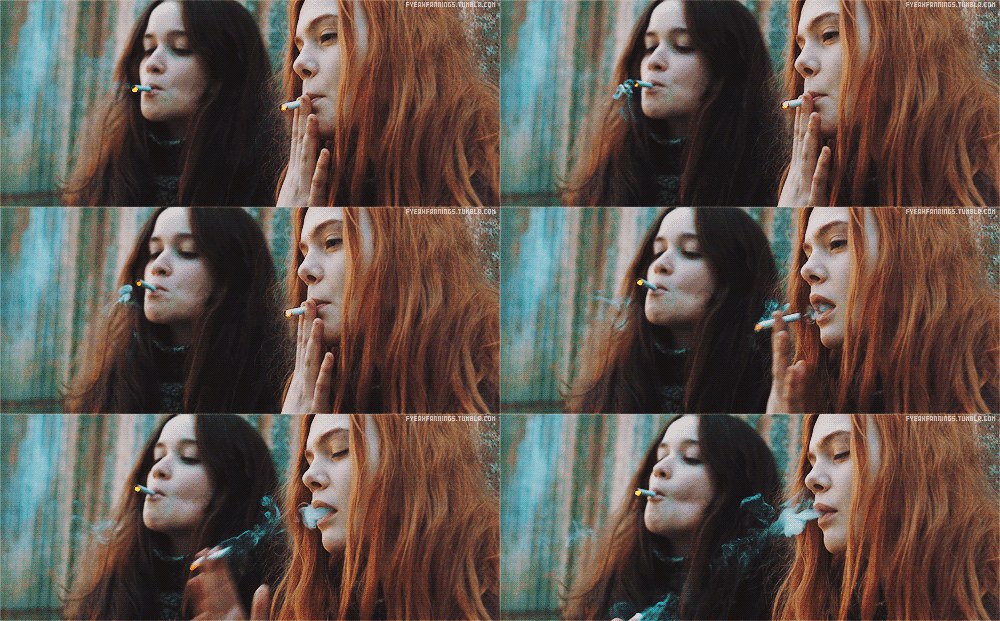
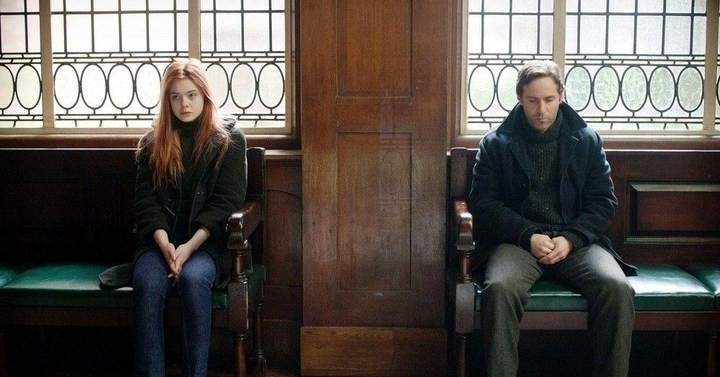
Ginger & Rosa, directed by Sally Potter, stars Elle Fanning, Alessandro Nivola, Christina Hendricks, Timothy Spall, Jodhi May, Annette Bening and Alice Englert. The film premiered at Toronto Film Festival and was also shown at the 56th BFI London Film Festival.

Ginger and Rosa is the kind of film that leaves you completely sapped -mentally and emotionally- after watching, all in the most beautiful way. The lasting message of the film is in fact a very positive one, but delivering that message and making it stick is a painful affair. 

This was my first time seeing one of Sally Potter's films, but what was immediately apparent was how well she understood the emotions and thoughts of a teenage girl. The character of Ginger was so real, from her stringy hair to her random bursts of laughter with her best friend. I have a feeling Sally Potter wrote a little of herself- at least her seventeen year-old self- into the main character. I've completely fallen for Elle Fanning as an actress- her face is just strange enough that you're completely mesmerized by all it's expressions, and she emotes so well that when she feels uncomfortable or sad or listless or frustrated, you can feel it too, twisting your stomach in every which way. The interactions between characters were given to extended bouts of silence, sometimes comfortable, sometimes because the characters didn't know what to say, but when people did speak, it felt so entirely natural. There are some scripts that feel like scripts- the characters know how to respond right away, and they know what to say. But in Potter's film, it felt like you were right there in the conversations, and the silences gave you time to think about what was being said, and if the case was, not being said. 
All of the characters, supporting or main, were brought to life in the movie. No matter how much time you were given with them, you somehow were able to understand their struggles, and why they were the way they were. The way that Ginger and Rosa played off each other developed their characters that much better. I found myself identifying with Ginger so easily, but being able to understand Rosa too. Ginger seemed very childish sometimes, not in that she was necessarily immature, but just that she saw the world in such a bright and new light. She was hopeful and wanted to change things on a grand scale, philosophical in that dizzying way that only young people can be, soaking everything in. Rosa was struggling to be an adult, and only really wanted to help one person-- Ginger's dad. 

The most appealing aspect of this film for me was how it approached the idea of depth in a person. It's hard to really define depth, or nail down who has it and who doesn't. It's strange, because I've always considered myself to have a measure of depth-- I read, I write, I take things in and think about them. And then I found out people who hadn't gotten to know me, or even who had, considered me to be pretty shallow. Not in a negative way, but still, it made me wonder what makes someone deep or shallow? How can we know from the self they show to the outside world? Ginger was the poet. She read, she wrote, she talked about ideas such as autonomy of thought and went to activist meetings. Rosa was the realist. She wanted to appeal to guys and spent her time reading what to do to get them to like her. She didn't really care about Ginger's causes. But while one would automatically jump to define Ginger as deep and Rosa as shallow, Sally Potter makes you wait and reconsider. It seems almost as though Ginger has all these ideas and truths that she knows about but doesn't understand, and desperately wants to understand, while at the same time her life is light, she's still a child and has the luxury of thinking of these things because she doesn't have her own problems to deal with. She protests and gets involved in these movements as a way to avoid dealing with the issues she sees around her- it's just a way to distance herself. Rosa is aware of all her own problems, and she seems to understand the things that Ginger wants to understand, but she herself doesn't want to understand them, which is why she tries to think and live on a shallower level. She wants to save Ginger's dad because she wants to save herself, and she sees herself in him. I visualize it as if she's inside a big semi-transparent orb, desperately wanting to live on the outside of it, while Ginger is on the outside trying to get in. *That doesn't make sense sorry but this is a really hard concept for me to try to explain* Really if you just watch the scene where Ginger and Rosa are in the cafe and Ginger asks if Rosa even cares about the future anymore, you'll get what Sally Potter is pointing out.


Ginger's dad is a quite clear example of Potter's focus on depth and immaturity. Roland has never let him call her Dad- he says because it sounds like a bourgeoisie trap and looks like slippers by the fire. He's been separated from Ginger's mom multiple times, and it's insinuated that he has had multiple affairs. But there's something about his attitude of free thought and autonomy and philosophy that draws you in, and you find yourself justifying him through his own reasoning. Only later in the film, when you start to see the repercussions of his lifestyle do you realize how truly immature he is. He hides this in the disguise of radical thought and the refusal to conform, but it's just how he avoids facing his own problems. Rosa's not wrong when she says he's wounded, but at a certain point you lose sympathy for him, because, well, he's a grown man and he thinks just because he's a philosopher he can hurt as many people as he wants. What I actually really appreciated was how Sally Potter addressed his relationship with Rosa. No one really berated him for how young Rosa was- the word pedophile was never said, or even inferred, because with that we have our own moral definitions and ideas of what kinds of person that is. Potter wanted the audience to see the relationship for what it was, not as a preconceived idea in our minds. 


I was like "Hey, it's Joan!" when I saw the Mad Men actress playing the mother. She was so good in the role, and you felt bad for her while at the same time feeling the same frustration Ginger felt towards her- why didn't she paint anymore, why didn't she care about anything going on in the world?? It's easy for an idealistic daughter with nothing pinning her down to ask, and I myself have said the same things as Ginger to my mother countless times. Nat serves to mark the other end of the spectrum from Roland. She had to grow up too fast, and because there is so much to deal with in her own life, so many real problems, she doesn't have the luxury of being "deep". 

What Potter seems to be saying through her characters is that there's a direct link between maturity and the ability to be deep and idealistic. Both sides are unhealthy, and the key is finding a balance in the middle- the right amount of mature and deep.

I loved the little support crew- Mark, Mark 2, and Bella. They were like the controls in an experiment- the calibrated ones that showed what the right balance was, so you could compare the test subjects--like Roland and Nat-- to something. I especially loved Bella's voice for some reason. It was immediately calming.


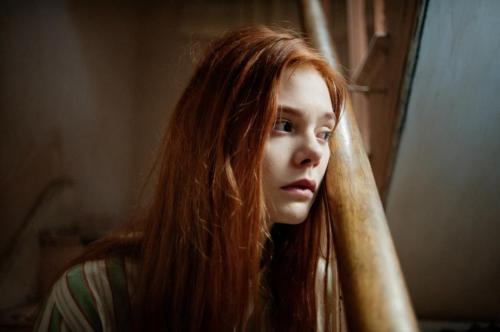
The cinematography in the movie was really beautiful at times. My favorite moments were when Elle Fanning's profile was outlined in light, and the rest of her face was dark, which was done a few times. But the lighting was so beautiful and clear throughout the movie, and the way especially the characters were shot drew out the beauty in them. The settings were all atmospheric and reminiscent of the time period- it was very believable that it was set in London in the sixties, and some places, like the father's apartment, I really wished I lived in.

Through the movie, Ginger had the habit of listening to music when she was upset, which drew attention to a wonderful soundtrack of jazz standards, with appearances from Django, Count Basie, Thelonius, and many other great names. For me, this really matched the feel of the movie. Jazz is a very atmospheric genre, but I find that it never tends to be so sad or so happy-- a lot of the time it stands apart from emotions, being more abstract and falling in the realm of thought. Having jazz was a pleasant background to the happenings in the movie, playing off them so well because they were already saturated in emotion. 


Overall, the film was pretty taxing but extremely enjoyable to watch, and I know it's good because I want to keep talking about it but don't even know what to say. I think the all you really have to listen to is Ginger's poem, though.

"Despite the horror and the sorrow,
 I love our world. 
I want us all to live. 
What really matters is to live
 and if we live,
 there will be nothing to forgive."


Saturday, December 28, 2013

Bottle Rocket(1996)


Bottle Rocket was Wes Anderson's debut film, and considering how much I love his work I've always been curious to see it. I got it as a Christmas present and watched it that night. The film stars the Wilson brothers, along with Robert Musgrave, and it was co-written by Owen Wilson. Luke plays Anthony, fresh out of the asylum and re-united with his vivacious friend Dignan(Owen). Dignan has got the idea that they should be criminals, rob stores and be on the run until they can join back up with Mr. Henry, the area's crime lord slash landscaping contractor. They bring their friend Bob along as a getaway driver, and consider themselves a gang.

It was definitely very interesting to see how Anderson got his start- although I didn't think the movie was very good, it's easy to see where much of his trademark style came from. The Wilson brothers fit perfectly with his writing- quirky looking actors, Luke with his big puppy eyes and Owen with his twice-broke nose. I didn't really understand Musgrave's acting, or his character for that matter. He played the bullied younger brother, unsure of himself, awkward, with some kind of exclusion complex. But the whole movie I was just sort of waiting for him to disappear, like his character was only making a cameo and the real third character would appear shortly. Bob just seemed superfluous; the movie could have been solely about Anthony and Dignan. I like to see how Wes found what fit for Luke Wilson- the deadpan, depressed, somewhat ironic romantic. I loved his line:
"One morning, over at Elizabeth’s beach house, she asked me if I’d rather go water-skiing or lay out. And I realized that not only did I not want to answer THAT question, but I never wanted to answer another water-sports question, or see any of these people again for the rest of my life."
It was one of the lines that really felt like Wes Anderson in the script. However, I just didn't believe that his character was a bit crazy, or that he was really under any kind of mental duress at all. It wasn't shown all that well.

The romance between Inez and Anthony was one of the high points of the movie, when it really felt like it was going somewhere. It was very sweet and awkward and reminded me quite a bit of the romance between the youngest brother in The Darjeeling Limited and the train stewardess. I liked the way their relationship moved along; not anything wildly romantic, but cute and sort of realistic. 

The pacing for the rest of the movie didn't quite work. The whole time I was waiting for the plot to actually begin. There never felt like there was a real conflict, and there wasn't enough up and down to make the movie really go anywhere. 

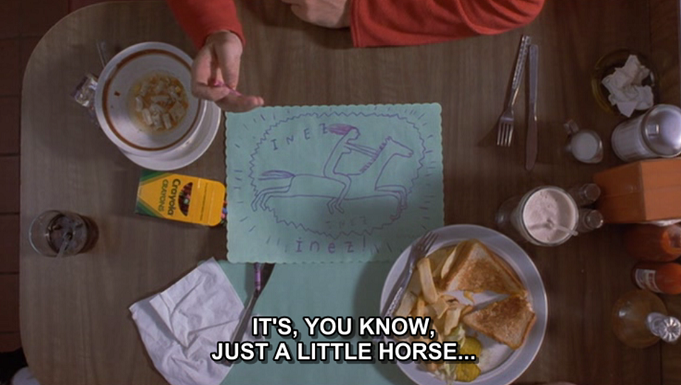
Above all I felt like this was a learning experience for Anderson. Judging from his later works, he figured out what he liked in this and then refined it and played with it to get the desired effect. The yellow of the jumpsuits is seen in the yellow tent of The Royal Tenenbaums and Moonrise Kingdom. The up-close shots of writing and drawings and plans are recurrent, as well as the shots looking straight down at a surface with objects arranged on it. The zoom shots of faces are also a common feature. 


What most apparently lacked in this movie was the sense of inescapable irony Wes lends to his films. Whenever something is funny, there's a sad irony to the humor that keeps you from laughing too hard, and when something is said there's a humorous irony to lighten the mood. I don't think Anderson had quite perfected that balance yet, so the movie isn't emotional but doesn't have the irony to keep it interesting.

Although I didn't like the movie and probably would not watch it again, there's a comfort in knowing that even a director as great as Wes Anderson was not perfect from the beginning but obviously learned quite a bit from his mistakes and came out with something better because of them.

Now I have to see Rushmore and I'll have seen his whole filmography!

Sunday, March 31, 2013

A Studio Ghibli Update- "From Up On Poppy Hill"


It's no secret that I am a devoted fan of Studio Ghibli and all the wonderful movies it puts out. So when I heard about From Up On Poppy Hill, I was excited to give it a try. I can't really do a review of this movie, though, because I could only get about forty-five minutes into it-I really didn't enjoy it! The first turn-off was definitely the music; Joe Hisaishi composes the music for all the Studio Ghibli films that I like, and his music is incredible- it's such a strong component and adds such depth and beauty to the films. The music in this wasn't written by Hisaishi though, and from the beginning I could tell that the music wasn't as good. It didn't really lend anything to the scenes and it sounded very gimmicky and done. Unoriginal. 

I would include a summary of the movie, but I didn't even really understand what it was about: there wasn't any clear conflict or catalyst for the plot. It was just following this Japanese highschooler named Umi, who lived at a hotel or something, and her budding romance with this other highschool dude. Likeeeeeee, so what? There wasn't really any depth or dynamic to the characters; nothing that made me care about them at all. And it just kind of lowered the bar for the movie to make it about a romance; that alone can't really constitute a plot. Don't get me wrong, because if you consider it basically all of the Hayao Miyazaki movies I've seen are romances, but it's not obvious; it's not about a romance. The plots are about something bigger, and the romance is even more of a friendship, which takes place on a deeper level than a romance. I didn't feel like this movie really stood for anything, even though it seemed to be about the changes in Japan after WW2. That was too obvious, not enough of an idea and more of an observation, whereas in other Studio Ghibli movies they bring up many ideas and points of view on things: they can be dissected, you can discuss them. 

I also didn't get the sense of a world in this movie. The great thing about Miyazaki movies is that they create these interesting, fantastical worlds, even the ones that are supposed to be realistic. They feel different, like a parallel universe that has just a touch of magic in it. That's really what it comes down to. This film was missing the magic of Studio Ghibli movies. It didn't entrance me, it didn't make me want to watch it again and again because every single scene was so beautiful and poignant. It makes me sad, I guess, because I love Miyazakis so much, and yet it seems that the more recent movies have lost some of their originality and genius; they're more mass market and less personal. I think I need to go watch Porco Rosso now just to restore my faith in Studio Ghibli.


PS-- I didn't make it through the whole movie, so maybe some of it picked up later on, but I think that it says something if I don't want to watch the whole thing.

Search This Blog