Showing posts with label film review. Show all posts

Friday, May 9, 2014

The Devil's Violinist (2013) dir. by Bernard Rose


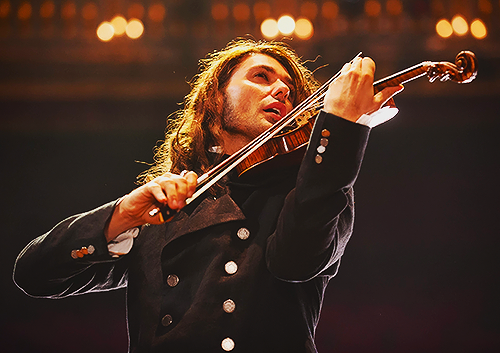
The Devil's Violinist directed by Bernard Rose and starring David Garrett, chronicles the life of the infamous violin maestro Niccolo Paganini. 


My impression of this film was that it was trying to be some knock-off of The Picture of Dorian Gray, which is an easy enough conclusion to come to if you see Niccolo Paganini as Dorian and Corbani as Lord Henry. There was even the *completely made up* innocent ingenue who acts to purify the sinful main character, although Lord Henry's daughter was a figment of the film version and not the book. I wish there had been more subtlety about the whole Faustian bargain; the scene at the beginning was a bit too literal with the expression of selling your soul to the devil. 

The movie was obviously catering to an audience: it completely overplayed the whole Satan theme, and the sex was just downright gratuitous. I mean, yes, that was something Paganini was known for but the whole movie centered around how Paganini was such a "seducer" and there is obviously SO much more to his life than that. All of the drama, action, emotion, and plot progress in the film ended up centering around Niccolo's conquests and the rumors about his love life, when more time should have been spent actually portraying his life and who he was as a person. The daddy problems vaguely hinted at in a couple scenes were a last-ditch effort to give some dimension to the main character, but it was so half-hearted and such a trope that it only warranted an eye-roll. Even after spending two hours with him, the viewer doesn't really know Paganini at all, and I refuse to accept that this was intentional on behalf of his little speech about how nobody knows him and he puts all he is into music. That's not an excuse for a lack of character development. Corbani came out of nowhere and left out of nowhere: he always seems to be there and yet remains a cardboard cutout of a character the whole time. What are his motives, really? I suppose money but really a man as clever as him could find a better and less dramatic way to make money. His role in the film was forced and only existed because the writers wanted to push the devil element so badly. Really I think I would have liked the story better without him. 

The one thing this movie did have going for it was David Garrett's beautiful beautiful face. The tan, the tousled hair, and hint of guyliner; it all came together to create something worth suffering through two hours of cheesy dialogue and non-existent plot for. I appreciate that a real violinist was found to play the part of Paganini: I only wish they could have found a violinist who could also act. David Garrett wasn't horrible, per se, but the fake Italian accent was pretty painful, and in the scenes where he couldn't get away with simply smoldering, his acting felt fake and distracted from whatever was happening. They at least tried to compensate for these flaws with many shots of exposed torso, so I appreciated that effort. 

Considering that the movie was about a musician, the music wasn't used to its full capacity. Just because the music was actually a plot point in the movie doesn't mean the scene always had to be of the performers when it was playing: the movie ended up with performance scenes that dragged on when I felt the music could have been used to better effect behind another scene, where it would have connected the story more and accentuated emotions and mood. I felt that the music scenes fell just short of the level of drama they really needed because they focused too greatly on the musicians performing and not on anything else going on in the plot. I did, however, like the mix of music: the pieces written by Paganini himself with (I believe) a piece written by David Garrett. 

Despite the torture of sitting through two hours of this movie, I did like the sentiment expressed at the end, when Paganini says, "I will live forever." and then nestles down amidst his sheet music. That's the beauty of art; you put everything you are into it and through doing so you become immortal. I was actually pretty heartbroken SPOILER about how things ended up with Niccolo and Charlotte, although being together after the whole affair seemed pretty impossible for them. However, when Niccolo writes to her and says there is some love between them, and again at the end when he is playing the violin part to the song he wrote and Charlotte is singing it, I think of a quote I like that goes something like, "If two people love the same thing,...then they must love each other, at least a little, even if they never say it." I forget where that's from, but it seems to encapsulate the relationship between the two musicians.

This movie wasn't all that I wanted it to be- I feel it sacrificed a lot to please the crowd, which is ironic in a way since that is the very sentiment that is shown in a negative light at the beginning of the movie. I wouldn't recommend it, but definitely look into Niccolo Paganini if you're interested in music history, and I know there are other movies that address his life on the Wikipedia page I linked above.


This is actually a very pretty song.

Friday, March 28, 2014

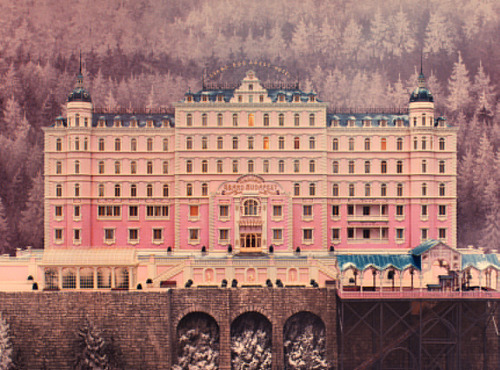
The Grand Budapest Hotel (2014) dir. by Wes Anderson


Wes Anderson is one of the most prominent directors of our time: worshiped by hipsters everywhere, respected by film students and critics, inspiration for fashion bloggers, and a dream come true for soundtrack junkies. One is able to recognize a Wes Anderson movie after exactly thirty seconds: the stunning symmetry of his sets, slightly retro color palettes, Bill Murray, and an overarching sense of irony. I'll admit to being smitten by Wes and his quirky aesthetics: in particular I have a weakness for The Darjeeling Limited. And his new movie, The Grand Budapest Hotel, delivered everything an Anderson lover could want, and more. Maybe a little too much more.


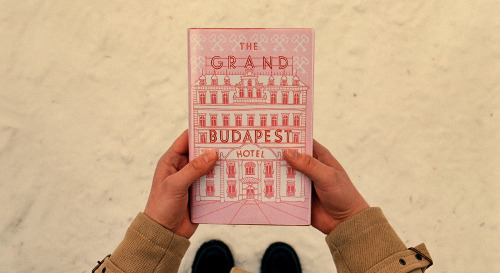
The film begins in a made-up location in Eastern Europe, with a slightly dweebish-looking girl. In a signature Anderson tracking shot, we follow her into a graveyard, past a huddle of old cronies clad in black, until she comes to a stop in front of a bust of a writer, at which point she hangs a pair of keys on the bust and sits down. She takes out a book, a pink hardcover entitled "The Grand Budapest Hotel". And so the story begins.

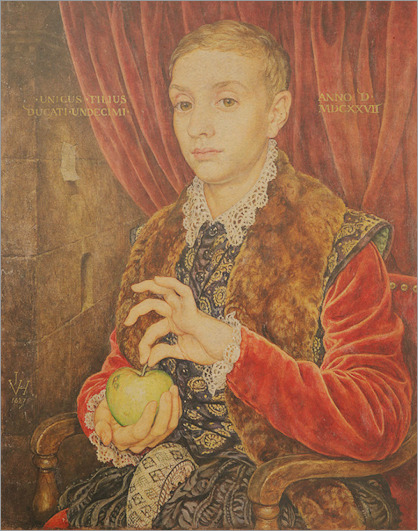
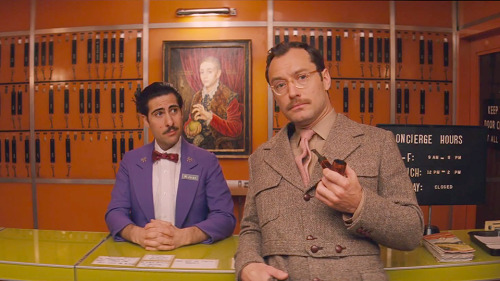
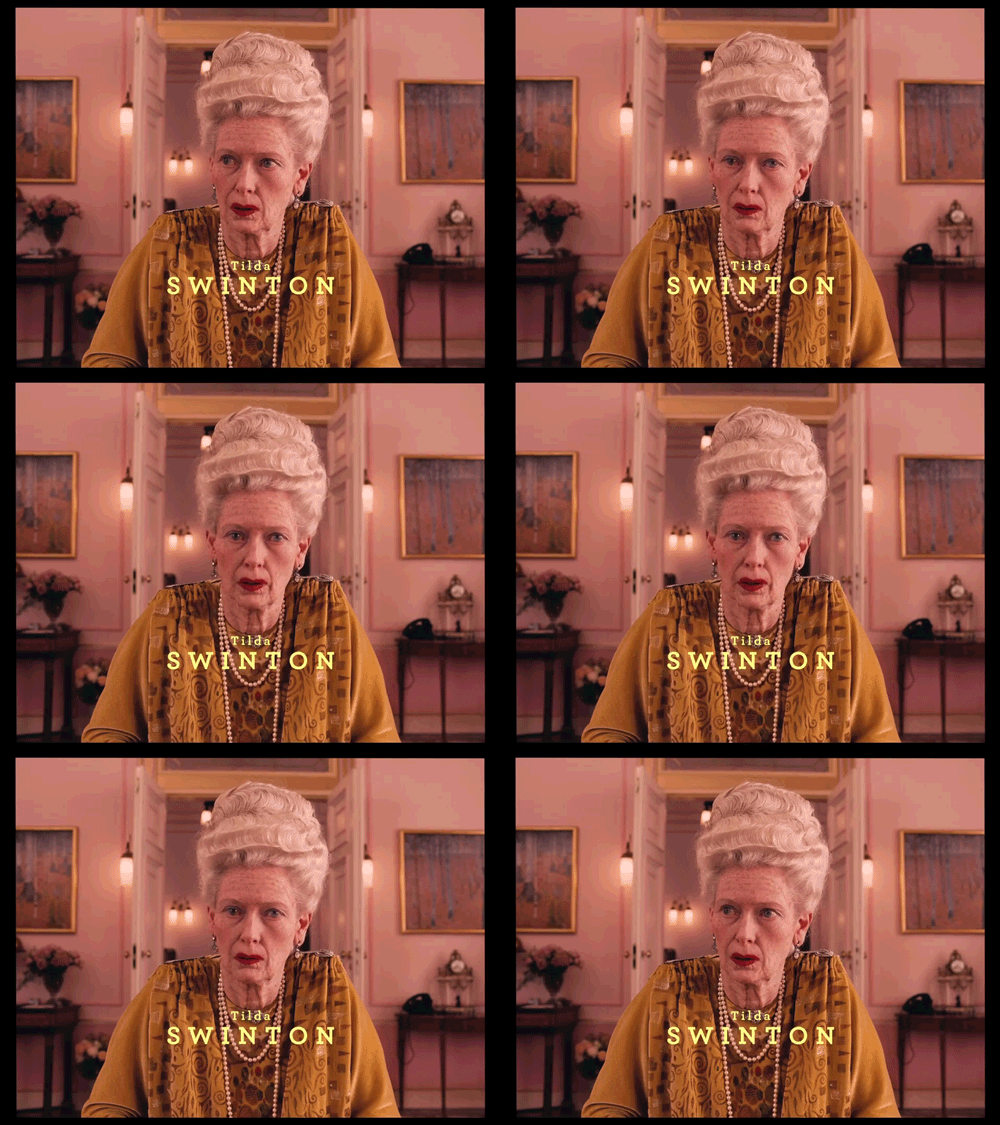
The writer *Hi Jude Law!* of the book speaks of his conversation with Zero Moustafa at the now-obsolete Grand Budapest Hotel, where he got the inspiration to write the book. He sits down with Moustafa for dinner, at which point the film descends into a third ring of story *so meta*, in which we meet the young Zero, lobby boy at the Grand Budapest Hotel, under the tutelage of Monsieur Gustave H. (Ralph Fiennes). Gustave is the main attraction to the hotel, especially for old, rich, blonde, lonely women. We soon learn that one of his elderly acquaintances, Madame D. (Tilda Swinton, with expert makeup may I add), has just been murdered, and in her will has left the priceless painting, Boy With Apple, to Gustave. Madame D.'s son Dmitri (Adrien Brody, avec twisted mustache and attitude problems) is enraged at this, and does everything he can to stop Gustave from getting it, after which ensues two hours of complete Wes Anderson visual indulgence.


The plot and setting of this movie was a bit of a departure for Wes Anderson. Granted, no two of his movies are the same: they range from an angsty prep school playwright to three brothers on a train ride across India  to an aquatic hunt for a leopard shark and back again, but this was the first time Anderson ventured into a historical setting, and even a political one at that. The movie took place in the 1930's as an oddly vague war was going on; Zero, the main character, had fled his own country because the "rebel militia" had killed his whole family, and you get a sense of the government presence when the train Gustave and Zero are on gets stopped by officials. Wes Anderson handles the setting well; he doesn't let it control his aesthetic and plot choices, and in fact it adds an extra dose of charm. 


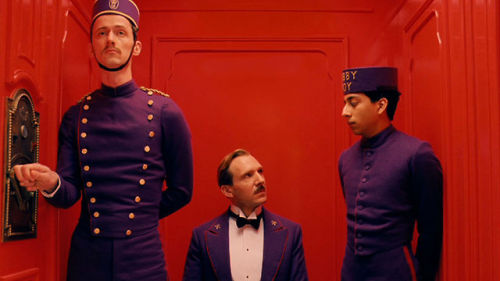
The cast of the movie was spot-on as usual. Ralph Fiennes completely stole the show as Gustave H.; he was groomed and charismatic and clever, and you got a little thrill whenever he came on screen. Tony Revelori was ...meh. Considering he was the main character, I wished his performance had been a little stronger: his character didn't leave much of anything to remember him by. I liked when he seemed sort of awkward and uncertain- I wish there was more of that. One of my problems with the film was that the only characters who were really developed at all, or even had any significant screen time, were Gustave and Zero. It seems strange even to me that I wish actors like Bill Murray, Jason Schwartzman, and Owen Wilson weren't in the movie; they're some of my favorite actors. But by having such memorable actors play such immemorable roles, the characters that should have just quietly passed out of the story stuck in my mind and crowded the film too much. However, there are some shout-outs due: Madame D. with her cloudy eye and old lady contoured lipstick was so incredibly well styled it brought me to tears. Adrien Brody as sour Dmitri was so perfect- the way one side of his mustache curled up slightly and his hair was tousled and he stormed everywhere. His character was so well-written and so very Wes Anderson.


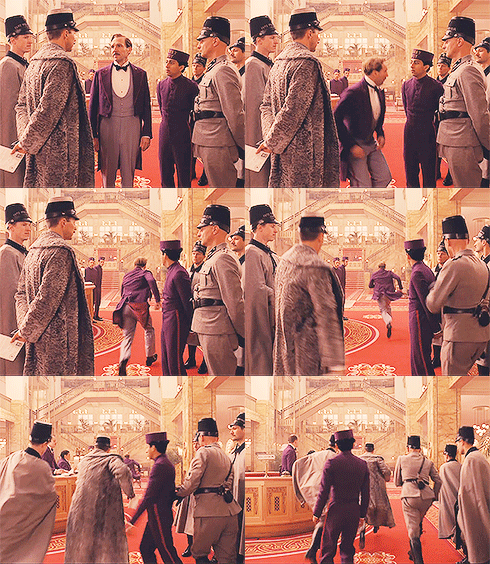
Visually, the film was incredibly stunning. Every single shot was completely choreographed and designed down to the most minute details. The color palette didn't feel as fresh as some of Wes's other films: royal purple played prominently, as well as cherry red, but the light pink of the Mendl's boxes lightened things up a bit. The tracking shots were wonderful; the scene walking through Madame D,'s mansion was especially satisfying. Whenever Wes Anderson characters walk they walk with such purpose and turn at such sharp angles. There was wonderful symmetry and some more hints of that storybook feel Anderson films invariably have.


Here's my complaint: the movie was too Wes Anderson. Which I never thought I would say because the whole appeal of Wes Anderson films is that they're Wes Anderson films. I mean, the plots aren't necessarily anything groundbreaking; it's how they're carried out that makes you love them so much. The trademark symbols of his films inspire a sort of whimsical nostalgia, with their contrived cinematography and retro colors and forgotten sixties music and dopey characters and awkward pauses and ironic humor. But I feel with this film Wes counted on it being his film too much: it felt like he played too heavily into the fact that he's a hipster darling and his films are unconditionally loved. The whole film just screamed WES ANDERSON so much so that it became a little oppressive by the end: I didn't have room to breathe and absorb the plot between taking in all the style and design and witty dialogue. Also, the film lacked a certain sense of balance I connotate with Wes Anderson works. There's a feeling of equilibrium in his stories. The sadness and reality of the situations are tempered with ironic humor and child-like storytelling, and the joy and humor are tempered with sad irony and reminders of reality. Everything sort of cancels out and leaves the viewer with one steady emotion throughout the film. In this film, there was too much humor throughout: I wasn't able to savor it between flashes of sadness or dysfunction, because it was constantly there. At the end *no spoilers...maybe a little one?* it was just too sad. The end to the story finished what had been an action packed and humorous film on a surprisingly tragic note that I didn't appreciate. I have to say, despite how much I hate the belief that sad endings to books and movies make you think more than happy endings, the fact that this ending was so depressing did make me wonder why, and analyze some themes from the movie I wouldn't have payed attention to otherwise. I guess Wes Anderson was trying to make the statement that all things end and time moves forward, but it wasn't that novel of an idea or that well executed throughout the story that it warranted the kind of ending that was given.

  
I have a personal tendency to be opposed to all new creations and denounce them as inferior to everything old. So while I may have seemed to moan a lot about this film, the reality is that it's still Wes Anderson, and it's still amazing and beautiful and hilarious and inspiring. There are many people that say it's their favorite Wes Anderson: it does show his growth and change as a director, and I respect him for branching out and trying new ideas. I believe Wes Anderson is still on the rise, and his best is yet to come, which is promising considering how exceptional his existing body of work is. I also love that he is the star of his movies, rather than the actors. It's something you don't see too often but it's nice when a director gets the spotlight.


Monday, March 10, 2014

Adult World Dir. by Scott Coffey (2013)


I went home sick today, and so after a couple hours of laying in bed I decided to watch something. I have a longstanding tradition that when I'm sick I get to watch the movies I wouldn't otherwise watch- the chick flicks, the cheesy comedies, etc. So I decided to knock this one off my to-be-watched list. I was actually pleasantly surprised by the quality of this movie- it isn't a groundbreaker, but it knows what it's trying to do and, I thought, it does it well.


The plot is simple: Amy (Emma Roberts), a poetry major in college, is in search of a job when her parents cut her off after months of paying her student loans and other expenses. She gets rejected from all kinds of jobs before accidentally going into a porn shop and being hired. Here she meets the manager, Alex (Evan Peters), along with a drag queen named Rubia. During all this, she is striving for poetry fame and success, sending submissions to literary magazines all over the country and convincing herself her big break is just around the corner. She tracks down her favorite living poet, Rat Billings (John Cusack), and forces him to accept her as his protegee.

The whole movie was pretty straightforward, which I ended up liking about it. For taking place half the time in a porn shop, it was surprisingly PG, and the setting actually allowed the story more flexibility because it faced the whole sexual tension thing that can mire down so many story lines head-on and conquered it. It was, simultaneously, dramatic and achingly realistic; Emma Roberts' character can be a bit psycho and unrelatable at times, but the emotions she feels and her struggles as an artist- that was more realistic than was maybe comfortable. And though I don't think Roberts' acting was outstanding, I did identify with Amy; being a poet is hard, and it's so easy to be torn down by other people so you have to believe in yourself sooo much to make up for that, because people's opinions of what is quality are so entirely subjective. The minute you stop winning awards, stop being told you're special by your teachers, everything starts crumbling. Amy was simply fighting against this. And she was childish, but like the quote says, "Artists are the children that survive." Why is being childish a bad thing? It allows you to see the world with brilliance, not just in the gray tones of adulthood and monotony. I liked Cusack's character as well- he was what Amy was heading towards being; a success at a young age, and then spending the rest of his life feeling as though he had peaked. He had this great sense of candid humor, which really brought something to the movie. And Alex...awwwww. He really pulled through as a character in the end. The whole movie he spent being sort of wishy-washy, but when you realized he was this quiet artist, that didn't need to flaunt his skill, you ended up really liking him. It was great in the end, because Amy had been looking for this mentor, this inspiration, and in reality Alex was the one that could introduce her to another kind of life with interesting things and interesting people, and they ended up with this great relationship where they could inspire one another. This movie was inspiring, really. It accomplished that without a ton of frill but with a good dose of humor and quirk. Great for a laid-back day!


Saturday, February 1, 2014

Cinema Paradiso (1988) dir. by Giuseppe Tornatore


I've found that some of the most genuine and inspiring art is about art itself. When an artist creates something about what they love the most in the world, that love is conveyed to the viewer. Cinema Paradiso was a love story about a boy and film. And it was a love that lasted his lifetime.

We meet Salvatore as a middle-aged man, living in a nice apartment with a beautiful woman. He receives a phone call from his mother, telling him someone named Alfredo has just died. This spurs a series of Salvatore's childhood memories, from when he lived in the small Sicilian town of Giancaldo with his mother and little sister. He was called Toto, and he was a cunning and vivacious boy. He would love to sneak into the town's cinema and visit the projectionist, Alfredo. From Alfredo Toto learned the craft of film, and as he grew up spent much of his time with Alfredo at the cinema. After Alfredo is caught in a fire at the cinema and is blinded, Salvatore had to take over the role of projectionist. He falls in love, joins the army, and comes back to Giancaldo, but Alfredo, seeing that Toto will meet a dead end in the small town, tells him he must go and never return. Thus Toto leaves the town and the film returns to the present, when Toto finally comes home to attend Alfredo's funeral.


For me, this movie seemed like the epitome of an Italian movie. A small village, an aging man reflecting on his youth, first love, a town crazy, a few stray dogs and a herd of sheep, some offbeat if not a little risque humor, a bed of genuine emotion, and there you have an Oscar winning foreign film. Toto was an adorable and inspiring main character- he was sly and scrappy, but he also really loved the cinema and loved Alfredo. I appreciated the consistency of his character throughout; we see him in three incarnations (child, teen, man), and although in each he is more reserved, he remains the playful Toto we got to love in the first few minutes of the film. 


Of course, my favorite aspect of the film was the relationship between Toto and Alfredo. Alfredo was by far my favorite character in the film. He looked out for Toto and really wanted him to be something. Although not bitter, Alfredo wished he had done more with his life that sit in the projection room- he takes night school and he warns Toto against becoming a projectionist, saying Toto should not want to be like him. At the same time, he wants to nurture Toto's interest in film. Alfredo developed a lot after losing his sight: of course it's the old trope of the blind seeing more than the sighted, but it was done in such a sweet and subtle way in this movie. When Alfredo runs his hand over little Toto's face and suddenly we see Toto as a teenager, and realize that really Toto had been growing up but Alfredo had always seen him as a child, was when I committed to liking Alfredo's character. *Spoiler?* The ending was so heart wrenching when Alfredo told Toto that he needed to get out of the village and go somewhere to become successful and fulfill his potential, that Toto should not come back and if he did Alfredo would not let him in his house. It showed more than anything how much Alfredo loved him- that he would sacrifice being with him for Toto's future. 


Not a huge number of movies get to me emotionally, but this one really did a number on the feels. There's that bittersweet happiness in it that gets me every time, that wonderful and horrible statement of this is how things are, that's all that makes for the best movies and books. There's no real problem to solve, there's no hero that comes and saves the day because the day does not need saving, everyone is going on with their lives, and in each one's life is enough sentiment and drama and love and beauty to make a movie. Toto never really found love- his love was in films, as really, his life was. I was almost in tears by the end, and I think this is really a wonderful Italian classic that everyone should watch. 


(The soundtrack was great, if not a little repetitive)

Wednesday, January 29, 2014

Bianca Come Il Latte, Rossa Come il Sangue dir. by Giacomo Campiotti


I think writing a story about cancer, especially cancer in young adults, is one of the hardest endeavors for an author. Cancer is no doubt very prevalent in our world today, and most people know someone affected by it, but to adress it from an artistic viewpoint, as of an author or film maker, I don't think cancer can be the subject of the work. Sure, you can write a story about a kid who has cancer, but what's the point? Without some kind of underlying idea-which the movie is really about- it's just a very depressing "Ok, but so what?"

Having read John Green's acclaimed The Fault In Our Stars before watching this movie, I already had some ideas about what works in a cancer story and what doesn't, and I think being able to compare the two stories gave me a better understanding of how I felt about each. In my opinion, Bianca Come Il Latte, Rossa Come Il Sangue worked much better as a cancer love story that The Fault In Our Stars

Bianca Come Il Latte is an Italian movie directed by Giacomo Campiotti, starring Filippo Scicchitano as Leo, the free-spirited tenth grader that falls in love with the beautiful red-haired eleventh-grade Beatrice (Gaia Weiss). The movie was adapted from the book by the same name, written by Alessandro D'Avenia. Leo is a bit of a rebel, playing truant and biking around Turin, where the movie takes place. His best friends are Niko and Silvia, Silvia being the brains of the operation. At the beginning of the story, Leo is in the midst of an obsession with the eleventh-grader Beatrice, who moved from France. She's gorgeous, mysterious, and he's trying to work up the nerve to talk to her. The first time he says hello is in a movie theater he followed her to, where he trips over her bag in the isle and she smiles and says she'll see him at school. The problem is she doesn't come back to school. He finds out she has cancer, and that she's ended up in the hospital being treated with chemotherapy. If she doesn't get a bone marrow donor she'll die, but no one is compatible. When she comes home from the hospital Leo starts visiting her, and they form a friendship he hopes will turn into something more, while at the same time desperately wishing for her to get better.


I'm not quite sure why the way to go about addressing cancer is with a love story- it was the same in The Fault In Our Stars. I would imagine being sick is a very internal struggle- that if you knew you may die soon there would be a lot of deep thought going on inside, trying to sort out your beliefs before you don't have any time left. But considering that it was a love story, the relationship between Leo and Bea was written very charmingly but also in a touching and realistic way. 
Bea knows right from the start how Leo feels about her- he doesn't try to hide it. Although it feels like she perhaps doesn't reciprocate quite those same sentiments, she's very gentle and nice to Leo, and really values his friendship. He makes her smile when she's in a tough situation, and he wants to listen to her when she talks about her struggles and emotions. But even though Bea is the sick one, she actually helps Leo. In her he finds a passion for something, a will to do good, that he didn't really have before. He donates bone marrow even when he finds out she isn't a match, because he genuinely wants to help someone else out there. 
Silvia, Leo's best friend, has had a crush on him since eighth grade, and Bea knows this. Because she truly cares about Leo, she wants him to end up with the person he really loves, and she can sense that even though he is enamored of her, Silvia is the one who is really important to him. Bea isn't bitter- she helps sort things out between them. I liked that the author/director didn't use a love triangle as a source of drama in the story. Instead he dealt with it in a very caring and understanding way, where all the characters seemed to have a real sense of what was going on. I also appreciate that Leo was allowed to love someone other than the cancer patient. Their friendship was touching, but Bea having cancer didn't change how Leo felt about Silvia. I feel like this gave a certain amount of respect to Bea's character- having cancer was only a part of her character, and it didn't make Leo love her more than he already did.

I sort of had to roll my eyes at the teacher. It's become such an archetype by now; the language teacher that becomes a friend and inspiration(see: The Perks of Being a Wallflower, Dead Poet's Society) It wasn't really an original character, and I didn't think he had too much of an impact on the story. However, I did like that instead of talking to Leo about his problems he boxed with him- it was an acknowledgement to the fact that meaningful quotes and metaphors can't fix too many problems in real life- they're a luxury those without problems can afford.


It was a good move to tell the story from Leo's perspective. It worked to show how cancer affects everyone, both the patients and the people that they might not even know would be affected. In the end, a really positive message was able to be pulled from the story- live for today, love for today, because things like sickness strike without warning and you'll end up wishing you had acted on all the dreams you dreamt.

The movie definitely made more of an impact on me that TFIOS book did. It wasn't an incredibly artistic or creative movie, but it provided two hours of insight into the effects of the sickness of one girl and connected lives of those around her. I'm thinking of ordering the original book in Italian- although I'm only just learning to speak Italian, I'm sure with some work I could translate it.

Search This Blog