Showing posts with label Movie Review. Show all posts

Friday, May 9, 2014

The Devil's Violinist (2013) dir. by Bernard Rose


The Devil's Violinist directed by Bernard Rose and starring David Garrett, chronicles the life of the infamous violin maestro Niccolo Paganini. 


My impression of this film was that it was trying to be some knock-off of The Picture of Dorian Gray, which is an easy enough conclusion to come to if you see Niccolo Paganini as Dorian and Corbani as Lord Henry. There was even the *completely made up* innocent ingenue who acts to purify the sinful main character, although Lord Henry's daughter was a figment of the film version and not the book. I wish there had been more subtlety about the whole Faustian bargain; the scene at the beginning was a bit too literal with the expression of selling your soul to the devil. 

The movie was obviously catering to an audience: it completely overplayed the whole Satan theme, and the sex was just downright gratuitous. I mean, yes, that was something Paganini was known for but the whole movie centered around how Paganini was such a "seducer" and there is obviously SO much more to his life than that. All of the drama, action, emotion, and plot progress in the film ended up centering around Niccolo's conquests and the rumors about his love life, when more time should have been spent actually portraying his life and who he was as a person. The daddy problems vaguely hinted at in a couple scenes were a last-ditch effort to give some dimension to the main character, but it was so half-hearted and such a trope that it only warranted an eye-roll. Even after spending two hours with him, the viewer doesn't really know Paganini at all, and I refuse to accept that this was intentional on behalf of his little speech about how nobody knows him and he puts all he is into music. That's not an excuse for a lack of character development. Corbani came out of nowhere and left out of nowhere: he always seems to be there and yet remains a cardboard cutout of a character the whole time. What are his motives, really? I suppose money but really a man as clever as him could find a better and less dramatic way to make money. His role in the film was forced and only existed because the writers wanted to push the devil element so badly. Really I think I would have liked the story better without him. 

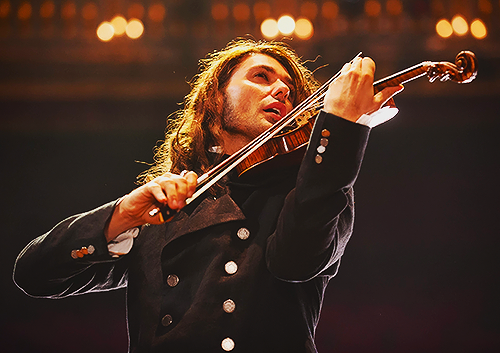
The one thing this movie did have going for it was David Garrett's beautiful beautiful face. The tan, the tousled hair, and hint of guyliner; it all came together to create something worth suffering through two hours of cheesy dialogue and non-existent plot for. I appreciate that a real violinist was found to play the part of Paganini: I only wish they could have found a violinist who could also act. David Garrett wasn't horrible, per se, but the fake Italian accent was pretty painful, and in the scenes where he couldn't get away with simply smoldering, his acting felt fake and distracted from whatever was happening. They at least tried to compensate for these flaws with many shots of exposed torso, so I appreciated that effort. 

Considering that the movie was about a musician, the music wasn't used to its full capacity. Just because the music was actually a plot point in the movie doesn't mean the scene always had to be of the performers when it was playing: the movie ended up with performance scenes that dragged on when I felt the music could have been used to better effect behind another scene, where it would have connected the story more and accentuated emotions and mood. I felt that the music scenes fell just short of the level of drama they really needed because they focused too greatly on the musicians performing and not on anything else going on in the plot. I did, however, like the mix of music: the pieces written by Paganini himself with (I believe) a piece written by David Garrett. 

Despite the torture of sitting through two hours of this movie, I did like the sentiment expressed at the end, when Paganini says, "I will live forever." and then nestles down amidst his sheet music. That's the beauty of art; you put everything you are into it and through doing so you become immortal. I was actually pretty heartbroken SPOILER about how things ended up with Niccolo and Charlotte, although being together after the whole affair seemed pretty impossible for them. However, when Niccolo writes to her and says there is some love between them, and again at the end when he is playing the violin part to the song he wrote and Charlotte is singing it, I think of a quote I like that goes something like, "If two people love the same thing,...then they must love each other, at least a little, even if they never say it." I forget where that's from, but it seems to encapsulate the relationship between the two musicians.

This movie wasn't all that I wanted it to be- I feel it sacrificed a lot to please the crowd, which is ironic in a way since that is the very sentiment that is shown in a negative light at the beginning of the movie. I wouldn't recommend it, but definitely look into Niccolo Paganini if you're interested in music history, and I know there are other movies that address his life on the Wikipedia page I linked above.


This is actually a very pretty song.

Friday, March 28, 2014

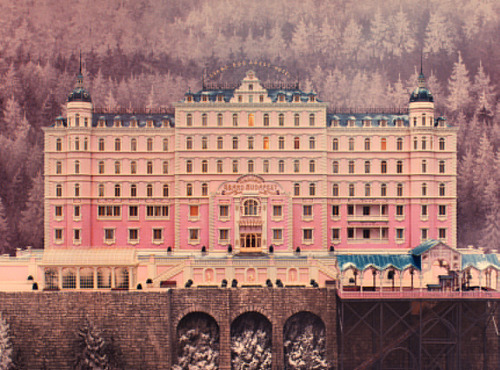
The Grand Budapest Hotel (2014) dir. by Wes Anderson


Wes Anderson is one of the most prominent directors of our time: worshiped by hipsters everywhere, respected by film students and critics, inspiration for fashion bloggers, and a dream come true for soundtrack junkies. One is able to recognize a Wes Anderson movie after exactly thirty seconds: the stunning symmetry of his sets, slightly retro color palettes, Bill Murray, and an overarching sense of irony. I'll admit to being smitten by Wes and his quirky aesthetics: in particular I have a weakness for The Darjeeling Limited. And his new movie, The Grand Budapest Hotel, delivered everything an Anderson lover could want, and more. Maybe a little too much more.


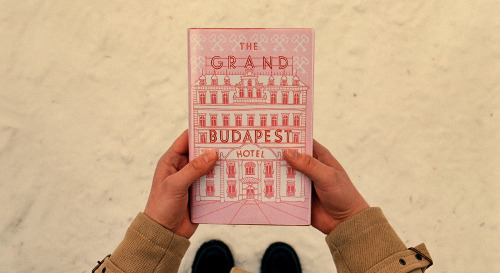
The film begins in a made-up location in Eastern Europe, with a slightly dweebish-looking girl. In a signature Anderson tracking shot, we follow her into a graveyard, past a huddle of old cronies clad in black, until she comes to a stop in front of a bust of a writer, at which point she hangs a pair of keys on the bust and sits down. She takes out a book, a pink hardcover entitled "The Grand Budapest Hotel". And so the story begins.

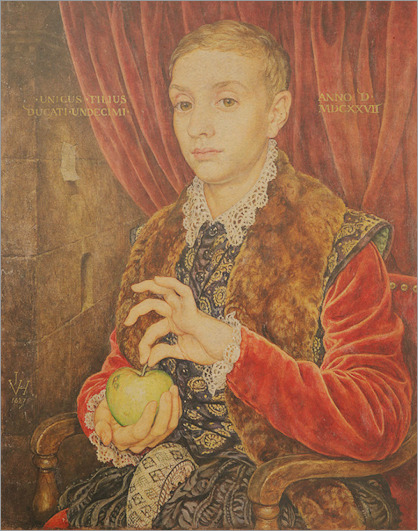
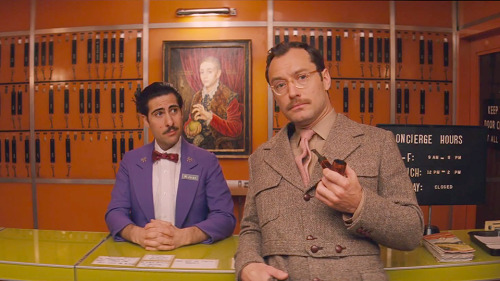
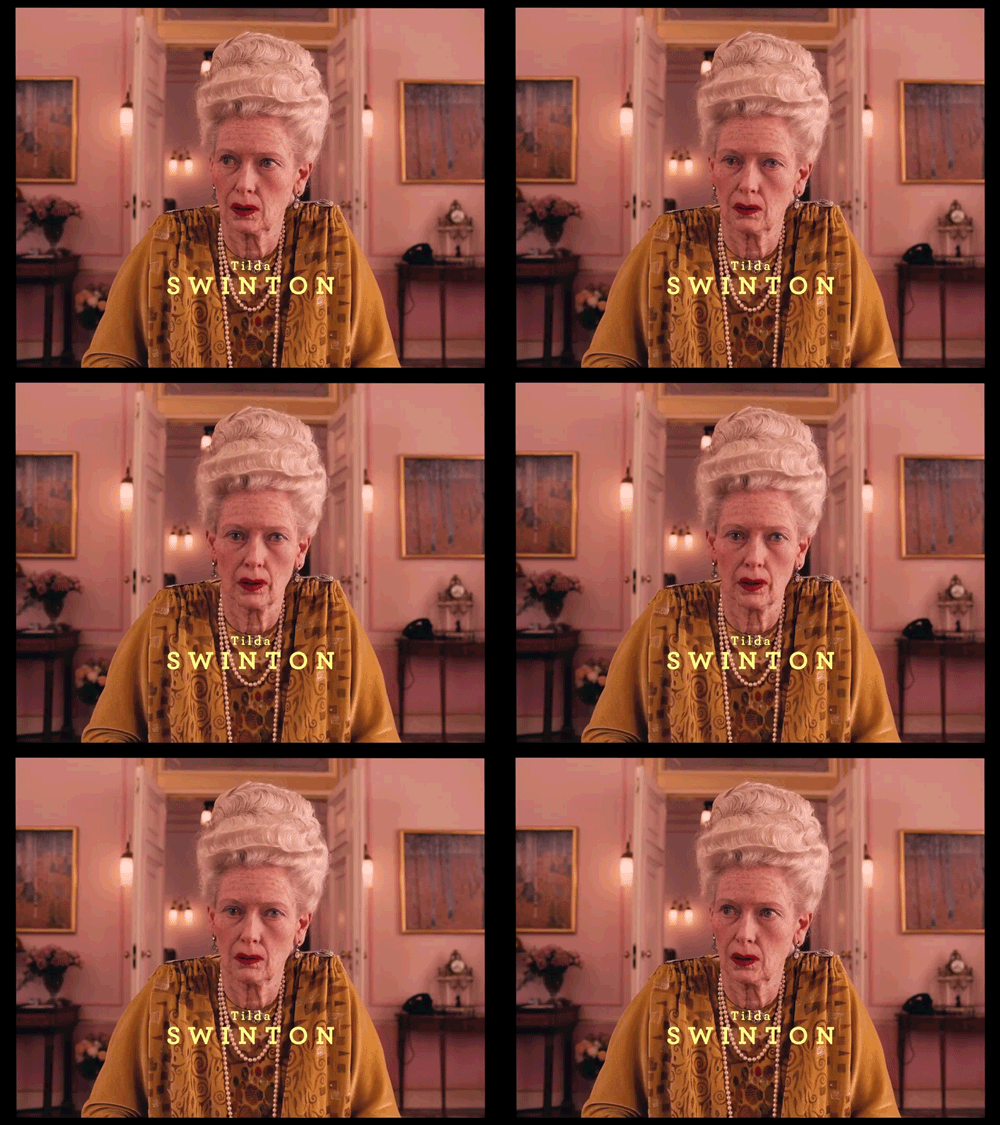
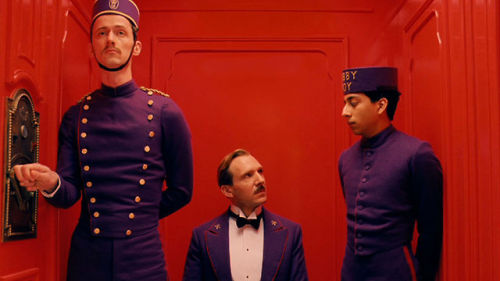
The writer *Hi Jude Law!* of the book speaks of his conversation with Zero Moustafa at the now-obsolete Grand Budapest Hotel, where he got the inspiration to write the book. He sits down with Moustafa for dinner, at which point the film descends into a third ring of story *so meta*, in which we meet the young Zero, lobby boy at the Grand Budapest Hotel, under the tutelage of Monsieur Gustave H. (Ralph Fiennes). Gustave is the main attraction to the hotel, especially for old, rich, blonde, lonely women. We soon learn that one of his elderly acquaintances, Madame D. (Tilda Swinton, with expert makeup may I add), has just been murdered, and in her will has left the priceless painting, Boy With Apple, to Gustave. Madame D.'s son Dmitri (Adrien Brody, avec twisted mustache and attitude problems) is enraged at this, and does everything he can to stop Gustave from getting it, after which ensues two hours of complete Wes Anderson visual indulgence.


The plot and setting of this movie was a bit of a departure for Wes Anderson. Granted, no two of his movies are the same: they range from an angsty prep school playwright to three brothers on a train ride across India  to an aquatic hunt for a leopard shark and back again, but this was the first time Anderson ventured into a historical setting, and even a political one at that. The movie took place in the 1930's as an oddly vague war was going on; Zero, the main character, had fled his own country because the "rebel militia" had killed his whole family, and you get a sense of the government presence when the train Gustave and Zero are on gets stopped by officials. Wes Anderson handles the setting well; he doesn't let it control his aesthetic and plot choices, and in fact it adds an extra dose of charm. 


The cast of the movie was spot-on as usual. Ralph Fiennes completely stole the show as Gustave H.; he was groomed and charismatic and clever, and you got a little thrill whenever he came on screen. Tony Revelori was ...meh. Considering he was the main character, I wished his performance had been a little stronger: his character didn't leave much of anything to remember him by. I liked when he seemed sort of awkward and uncertain- I wish there was more of that. One of my problems with the film was that the only characters who were really developed at all, or even had any significant screen time, were Gustave and Zero. It seems strange even to me that I wish actors like Bill Murray, Jason Schwartzman, and Owen Wilson weren't in the movie; they're some of my favorite actors. But by having such memorable actors play such immemorable roles, the characters that should have just quietly passed out of the story stuck in my mind and crowded the film too much. However, there are some shout-outs due: Madame D. with her cloudy eye and old lady contoured lipstick was so incredibly well styled it brought me to tears. Adrien Brody as sour Dmitri was so perfect- the way one side of his mustache curled up slightly and his hair was tousled and he stormed everywhere. His character was so well-written and so very Wes Anderson.


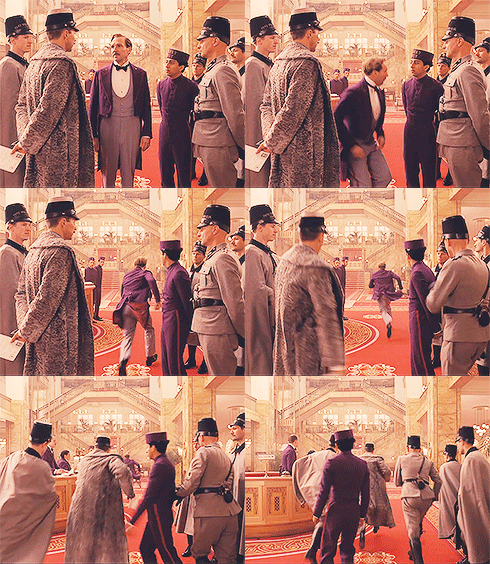
Visually, the film was incredibly stunning. Every single shot was completely choreographed and designed down to the most minute details. The color palette didn't feel as fresh as some of Wes's other films: royal purple played prominently, as well as cherry red, but the light pink of the Mendl's boxes lightened things up a bit. The tracking shots were wonderful; the scene walking through Madame D,'s mansion was especially satisfying. Whenever Wes Anderson characters walk they walk with such purpose and turn at such sharp angles. There was wonderful symmetry and some more hints of that storybook feel Anderson films invariably have.


Here's my complaint: the movie was too Wes Anderson. Which I never thought I would say because the whole appeal of Wes Anderson films is that they're Wes Anderson films. I mean, the plots aren't necessarily anything groundbreaking; it's how they're carried out that makes you love them so much. The trademark symbols of his films inspire a sort of whimsical nostalgia, with their contrived cinematography and retro colors and forgotten sixties music and dopey characters and awkward pauses and ironic humor. But I feel with this film Wes counted on it being his film too much: it felt like he played too heavily into the fact that he's a hipster darling and his films are unconditionally loved. The whole film just screamed WES ANDERSON so much so that it became a little oppressive by the end: I didn't have room to breathe and absorb the plot between taking in all the style and design and witty dialogue. Also, the film lacked a certain sense of balance I connotate with Wes Anderson works. There's a feeling of equilibrium in his stories. The sadness and reality of the situations are tempered with ironic humor and child-like storytelling, and the joy and humor are tempered with sad irony and reminders of reality. Everything sort of cancels out and leaves the viewer with one steady emotion throughout the film. In this film, there was too much humor throughout: I wasn't able to savor it between flashes of sadness or dysfunction, because it was constantly there. At the end *no spoilers...maybe a little one?* it was just too sad. The end to the story finished what had been an action packed and humorous film on a surprisingly tragic note that I didn't appreciate. I have to say, despite how much I hate the belief that sad endings to books and movies make you think more than happy endings, the fact that this ending was so depressing did make me wonder why, and analyze some themes from the movie I wouldn't have payed attention to otherwise. I guess Wes Anderson was trying to make the statement that all things end and time moves forward, but it wasn't that novel of an idea or that well executed throughout the story that it warranted the kind of ending that was given.

  
I have a personal tendency to be opposed to all new creations and denounce them as inferior to everything old. So while I may have seemed to moan a lot about this film, the reality is that it's still Wes Anderson, and it's still amazing and beautiful and hilarious and inspiring. There are many people that say it's their favorite Wes Anderson: it does show his growth and change as a director, and I respect him for branching out and trying new ideas. I believe Wes Anderson is still on the rise, and his best is yet to come, which is promising considering how exceptional his existing body of work is. I also love that he is the star of his movies, rather than the actors. It's something you don't see too often but it's nice when a director gets the spotlight.


Monday, March 10, 2014

Adult World Dir. by Scott Coffey (2013)


I went home sick today, and so after a couple hours of laying in bed I decided to watch something. I have a longstanding tradition that when I'm sick I get to watch the movies I wouldn't otherwise watch- the chick flicks, the cheesy comedies, etc. So I decided to knock this one off my to-be-watched list. I was actually pleasantly surprised by the quality of this movie- it isn't a groundbreaker, but it knows what it's trying to do and, I thought, it does it well.


The plot is simple: Amy (Emma Roberts), a poetry major in college, is in search of a job when her parents cut her off after months of paying her student loans and other expenses. She gets rejected from all kinds of jobs before accidentally going into a porn shop and being hired. Here she meets the manager, Alex (Evan Peters), along with a drag queen named Rubia. During all this, she is striving for poetry fame and success, sending submissions to literary magazines all over the country and convincing herself her big break is just around the corner. She tracks down her favorite living poet, Rat Billings (John Cusack), and forces him to accept her as his protegee.

The whole movie was pretty straightforward, which I ended up liking about it. For taking place half the time in a porn shop, it was surprisingly PG, and the setting actually allowed the story more flexibility because it faced the whole sexual tension thing that can mire down so many story lines head-on and conquered it. It was, simultaneously, dramatic and achingly realistic; Emma Roberts' character can be a bit psycho and unrelatable at times, but the emotions she feels and her struggles as an artist- that was more realistic than was maybe comfortable. And though I don't think Roberts' acting was outstanding, I did identify with Amy; being a poet is hard, and it's so easy to be torn down by other people so you have to believe in yourself sooo much to make up for that, because people's opinions of what is quality are so entirely subjective. The minute you stop winning awards, stop being told you're special by your teachers, everything starts crumbling. Amy was simply fighting against this. And she was childish, but like the quote says, "Artists are the children that survive." Why is being childish a bad thing? It allows you to see the world with brilliance, not just in the gray tones of adulthood and monotony. I liked Cusack's character as well- he was what Amy was heading towards being; a success at a young age, and then spending the rest of his life feeling as though he had peaked. He had this great sense of candid humor, which really brought something to the movie. And Alex...awwwww. He really pulled through as a character in the end. The whole movie he spent being sort of wishy-washy, but when you realized he was this quiet artist, that didn't need to flaunt his skill, you ended up really liking him. It was great in the end, because Amy had been looking for this mentor, this inspiration, and in reality Alex was the one that could introduce her to another kind of life with interesting things and interesting people, and they ended up with this great relationship where they could inspire one another. This movie was inspiring, really. It accomplished that without a ton of frill but with a good dose of humor and quirk. Great for a laid-back day!


Saturday, February 15, 2014

Cloud Atlas (2012) dir. by Tom Tykwer, Andy Wachowski


Me After Watching the the Trailer- "I have no idea what that was about but there was a Ben Whishaw"
Me After Watching Movie- "Well I have no idea what that was about but there was a Ben Whishaw"

Even just after watching the trailer, I figured this story would probably work out better as a book. And I think I was right.

Cloud Atlas follows six stories across hundreds of years and thousands of miles, and yet they are all connected. There's the lawyer on a voyage across the Pacific, a young genius pianist (hi Ben Whishaw) writing letters to his boyfriend, a seventies action plot starring Halle Berry, a quirky publisher locked up in an old folks home, a rebel Korean waitress, and a post-apocalyptic cannibalistic Hawaii with Tom Hanks smeared in dirt. And all this stuffed into two and a half hours of screen time.


This film was another case of a very interesting idea swallowed up by too much action (I'm looking at you, Surrogates) Some of the scenes and speeches were really quite lovely, and touched on some great thoughts, but everything was moving too fast to truly appreciate these moments, and it was hard to catch what the plots were about in between all the running and guns and Tom Hanks face shots. I haven't read the book, so maybe all this action really is a part of the story, but I feel like it may have been pumped up for audiences. I could see the movie working really well as a more quiet, contemplative piece with piano music and gentle soliloquies.

Out of all the plots, the only one I really liked was Robert Frobisher. Given the number of plots in the movie, each only got, what, like thirty minutes of screen time, and so it was hard to understand the plot and connect to the characters. The pianist one was the only one, in my mind, that really was able to connect and be powerful in the limited time it had. The Robert Frobisher plot was about a young gay (bi?) pianist who had been disinherited by his father and went to work with a sick composer to prove himself. The whole time, he is writing letters to his boyfriend Sixsmuth, and much of the story is narrated through these letters. I think this part of the movie worked so well because the character of Robert is immediately understandable- he's a great piano player, he wants to prove his father wrong for disinheriting him, he loves Sixsmuth. That's it there it is. Simple compared to why Tom Hanks is running around post-apocalyptic Hawaii with futuristic Halle Berry being chased by cannibals and speaking 1984 language. And the aesthetics were perfect- not overdone like some of the other plot lines. High-waisted trousers, pretty brick house, golden light, gentle narration. The whole movie should have been like that. Plus, that story was the one that had the true music, the Cloud Atlas, in it, and the music is the heart of the movie in my opinion. 

As for the other story lines- the lawyer on the boat was meh, although I did like the part with the slave and thought his rigging job was pretty cool (The sailor part of me is crazy jealous of his skills). The seventies provided a lot of clear parallels between the different parts of the movie but was pretty ridiculous, what with the nuclear power scheme and gun chases. The publisher, I still don't quite understand why he was even in the movie and I think his story was to provide some comic relief BUT I DIDN'T WANT COMIC RELIEF because whenever I was about to get into the story he shows up and it's just like *groan*. I thought the New Seoul part of the story was really interesting and I liked the outfits a ton, as well as some of the ideas about technology, but I thought the world building was far weaker than it should have been. I don't even want to talk about post-apocalyptic Hawaii. 


The music was so beautiful- I like that the Cloud Atlas piece showed up in different forms throughout the whole movie, to tie some things together. But I really wish there was a part of the movie that was basically silent save for the music- we really only got that at the end when Robert was narrating his last letter to Sixmith. The music was so powerful but I don't think it was focused on enough, or utilized well enough considering the movie was named after it. 
Travel To Edinburgh
Cloud Atlas Sextet for Orchestra

In conclusion, I think this movie bit off more than it could chew. The parallels and how the different plots fit together weren't clear enough, and I spent most of the time confused. I think the part with Sonmi 451 could have been its own movie, and I think the parts with Robert and the lawyer could have been made into a full movie themselves, considering they fit best aesthetically. I still have hope for the book, though, since I think the different parts would clash less in written form and everything would be much clearer. I like the ideas presented, of how everything is connected.

Favorite Scene-


This was the scene that stood out the most for me. The golden light, the beauty of the shots, the two lovers passing by each other, the gentle statements of "I watched my last sunrise. I smoked my last cigarette." I thought that this part really exemplified what the movie was about- how death is just opening another door, and how some things, like music, live on after us. I maybe cried a little. Ben Whishaw was too pretty to die.


Saturday, February 1, 2014

Cinema Paradiso (1988) dir. by Giuseppe Tornatore


I've found that some of the most genuine and inspiring art is about art itself. When an artist creates something about what they love the most in the world, that love is conveyed to the viewer. Cinema Paradiso was a love story about a boy and film. And it was a love that lasted his lifetime.

We meet Salvatore as a middle-aged man, living in a nice apartment with a beautiful woman. He receives a phone call from his mother, telling him someone named Alfredo has just died. This spurs a series of Salvatore's childhood memories, from when he lived in the small Sicilian town of Giancaldo with his mother and little sister. He was called Toto, and he was a cunning and vivacious boy. He would love to sneak into the town's cinema and visit the projectionist, Alfredo. From Alfredo Toto learned the craft of film, and as he grew up spent much of his time with Alfredo at the cinema. After Alfredo is caught in a fire at the cinema and is blinded, Salvatore had to take over the role of projectionist. He falls in love, joins the army, and comes back to Giancaldo, but Alfredo, seeing that Toto will meet a dead end in the small town, tells him he must go and never return. Thus Toto leaves the town and the film returns to the present, when Toto finally comes home to attend Alfredo's funeral.


For me, this movie seemed like the epitome of an Italian movie. A small village, an aging man reflecting on his youth, first love, a town crazy, a few stray dogs and a herd of sheep, some offbeat if not a little risque humor, a bed of genuine emotion, and there you have an Oscar winning foreign film. Toto was an adorable and inspiring main character- he was sly and scrappy, but he also really loved the cinema and loved Alfredo. I appreciated the consistency of his character throughout; we see him in three incarnations (child, teen, man), and although in each he is more reserved, he remains the playful Toto we got to love in the first few minutes of the film. 


Of course, my favorite aspect of the film was the relationship between Toto and Alfredo. Alfredo was by far my favorite character in the film. He looked out for Toto and really wanted him to be something. Although not bitter, Alfredo wished he had done more with his life that sit in the projection room- he takes night school and he warns Toto against becoming a projectionist, saying Toto should not want to be like him. At the same time, he wants to nurture Toto's interest in film. Alfredo developed a lot after losing his sight: of course it's the old trope of the blind seeing more than the sighted, but it was done in such a sweet and subtle way in this movie. When Alfredo runs his hand over little Toto's face and suddenly we see Toto as a teenager, and realize that really Toto had been growing up but Alfredo had always seen him as a child, was when I committed to liking Alfredo's character. *Spoiler?* The ending was so heart wrenching when Alfredo told Toto that he needed to get out of the village and go somewhere to become successful and fulfill his potential, that Toto should not come back and if he did Alfredo would not let him in his house. It showed more than anything how much Alfredo loved him- that he would sacrifice being with him for Toto's future. 


Not a huge number of movies get to me emotionally, but this one really did a number on the feels. There's that bittersweet happiness in it that gets me every time, that wonderful and horrible statement of this is how things are, that's all that makes for the best movies and books. There's no real problem to solve, there's no hero that comes and saves the day because the day does not need saving, everyone is going on with their lives, and in each one's life is enough sentiment and drama and love and beauty to make a movie. Toto never really found love- his love was in films, as really, his life was. I was almost in tears by the end, and I think this is really a wonderful Italian classic that everyone should watch. 


(The soundtrack was great, if not a little repetitive)

Wednesday, January 22, 2014

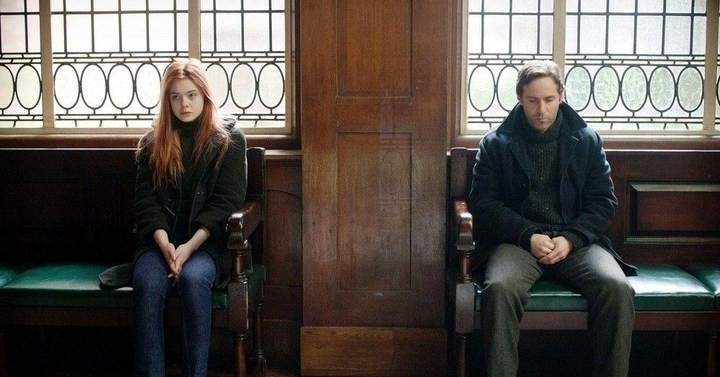
Ginger and Rosa (2013) dir. by Sally Potter


London, 1962. Two teenage girls – Ginger and Rosa - are inseparable; they play truant together, discuss religion, politics and hairstyles, and dream of lives bigger than their mothers’ frustrated domesticity.
But, as the Cold War meets the sexual revolution, and the threat of nuclear holocaust escalates, the lifelong friendship of the two girls is shattered - by the clash of desire and the determination to survive.
Ginger & Rosa, directed by Sally Potter, stars Elle Fanning, Alessandro Nivola, Christina Hendricks, Timothy Spall, Jodhi May, Annette Bening and Alice Englert. The film premiered at Toronto Film Festival and was also shown at the 56th BFI London Film Festival.

Ginger and Rosa is the kind of film that leaves you completely sapped -mentally and emotionally- after watching, all in the most beautiful way. The lasting message of the film is in fact a very positive one, but delivering that message and making it stick is a painful affair. 

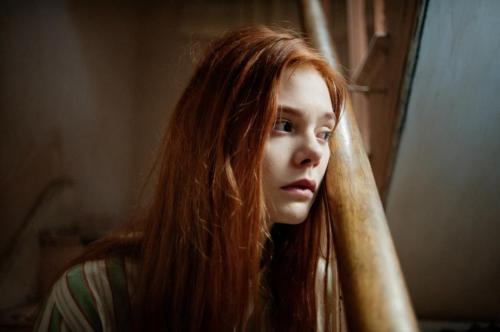
This was my first time seeing one of Sally Potter's films, but what was immediately apparent was how well she understood the emotions and thoughts of a teenage girl. The character of Ginger was so real, from her stringy hair to her random bursts of laughter with her best friend. I have a feeling Sally Potter wrote a little of herself- at least her seventeen year-old self- into the main character. I've completely fallen for Elle Fanning as an actress- her face is just strange enough that you're completely mesmerized by all it's expressions, and she emotes so well that when she feels uncomfortable or sad or listless or frustrated, you can feel it too, twisting your stomach in every which way. The interactions between characters were given to extended bouts of silence, sometimes comfortable, sometimes because the characters didn't know what to say, but when people did speak, it felt so entirely natural. There are some scripts that feel like scripts- the characters know how to respond right away, and they know what to say. But in Potter's film, it felt like you were right there in the conversations, and the silences gave you time to think about what was being said, and if the case was, not being said. 
All of the characters, supporting or main, were brought to life in the movie. No matter how much time you were given with them, you somehow were able to understand their struggles, and why they were the way they were. The way that Ginger and Rosa played off each other developed their characters that much better. I found myself identifying with Ginger so easily, but being able to understand Rosa too. Ginger seemed very childish sometimes, not in that she was necessarily immature, but just that she saw the world in such a bright and new light. She was hopeful and wanted to change things on a grand scale, philosophical in that dizzying way that only young people can be, soaking everything in. Rosa was struggling to be an adult, and only really wanted to help one person-- Ginger's dad. 

The most appealing aspect of this film for me was how it approached the idea of depth in a person. It's hard to really define depth, or nail down who has it and who doesn't. It's strange, because I've always considered myself to have a measure of depth-- I read, I write, I take things in and think about them. And then I found out people who hadn't gotten to know me, or even who had, considered me to be pretty shallow. Not in a negative way, but still, it made me wonder what makes someone deep or shallow? How can we know from the self they show to the outside world? Ginger was the poet. She read, she wrote, she talked about ideas such as autonomy of thought and went to activist meetings. Rosa was the realist. She wanted to appeal to guys and spent her time reading what to do to get them to like her. She didn't really care about Ginger's causes. But while one would automatically jump to define Ginger as deep and Rosa as shallow, Sally Potter makes you wait and reconsider. It seems almost as though Ginger has all these ideas and truths that she knows about but doesn't understand, and desperately wants to understand, while at the same time her life is light, she's still a child and has the luxury of thinking of these things because she doesn't have her own problems to deal with. She protests and gets involved in these movements as a way to avoid dealing with the issues she sees around her- it's just a way to distance herself. Rosa is aware of all her own problems, and she seems to understand the things that Ginger wants to understand, but she herself doesn't want to understand them, which is why she tries to think and live on a shallower level. She wants to save Ginger's dad because she wants to save herself, and she sees herself in him. I visualize it as if she's inside a big semi-transparent orb, desperately wanting to live on the outside of it, while Ginger is on the outside trying to get in. *That doesn't make sense sorry but this is a really hard concept for me to try to explain* Really if you just watch the scene where Ginger and Rosa are in the cafe and Ginger asks if Rosa even cares about the future anymore, you'll get what Sally Potter is pointing out.


Ginger's dad is a quite clear example of Potter's focus on depth and immaturity. Roland has never let him call her Dad- he says because it sounds like a bourgeoisie trap and looks like slippers by the fire. He's been separated from Ginger's mom multiple times, and it's insinuated that he has had multiple affairs. But there's something about his attitude of free thought and autonomy and philosophy that draws you in, and you find yourself justifying him through his own reasoning. Only later in the film, when you start to see the repercussions of his lifestyle do you realize how truly immature he is. He hides this in the disguise of radical thought and the refusal to conform, but it's just how he avoids facing his own problems. Rosa's not wrong when she says he's wounded, but at a certain point you lose sympathy for him, because, well, he's a grown man and he thinks just because he's a philosopher he can hurt as many people as he wants. What I actually really appreciated was how Sally Potter addressed his relationship with Rosa. No one really berated him for how young Rosa was- the word pedophile was never said, or even inferred, because with that we have our own moral definitions and ideas of what kinds of person that is. Potter wanted the audience to see the relationship for what it was, not as a preconceived idea in our minds. 


I was like "Hey, it's Joan!" when I saw the Mad Men actress playing the mother. She was so good in the role, and you felt bad for her while at the same time feeling the same frustration Ginger felt towards her- why didn't she paint anymore, why didn't she care about anything going on in the world?? It's easy for an idealistic daughter with nothing pinning her down to ask, and I myself have said the same things as Ginger to my mother countless times. Nat serves to mark the other end of the spectrum from Roland. She had to grow up too fast, and because there is so much to deal with in her own life, so many real problems, she doesn't have the luxury of being "deep". 

What Potter seems to be saying through her characters is that there's a direct link between maturity and the ability to be deep and idealistic. Both sides are unhealthy, and the key is finding a balance in the middle- the right amount of mature and deep.

I loved the little support crew- Mark, Mark 2, and Bella. They were like the controls in an experiment- the calibrated ones that showed what the right balance was, so you could compare the test subjects--like Roland and Nat-- to something. I especially loved Bella's voice for some reason. It was immediately calming.


The cinematography in the movie was really beautiful at times. My favorite moments were when Elle Fanning's profile was outlined in light, and the rest of her face was dark, which was done a few times. But the lighting was so beautiful and clear throughout the movie, and the way especially the characters were shot drew out the beauty in them. The settings were all atmospheric and reminiscent of the time period- it was very believable that it was set in London in the sixties, and some places, like the father's apartment, I really wished I lived in.

Through the movie, Ginger had the habit of listening to music when she was upset, which drew attention to a wonderful soundtrack of jazz standards, with appearances from Django, Count Basie, Thelonius, and many other great names. For me, this really matched the feel of the movie. Jazz is a very atmospheric genre, but I find that it never tends to be so sad or so happy-- a lot of the time it stands apart from emotions, being more abstract and falling in the realm of thought. Having jazz was a pleasant background to the happenings in the movie, playing off them so well because they were already saturated in emotion. 


Overall, the film was pretty taxing but extremely enjoyable to watch, and I know it's good because I want to keep talking about it but don't even know what to say. I think the all you really have to listen to is Ginger's poem, though.

"Despite the horror and the sorrow,
 I love our world. 
I want us all to live. 
What really matters is to live
 and if we live,
 there will be nothing to forgive."


Sunday, January 19, 2014

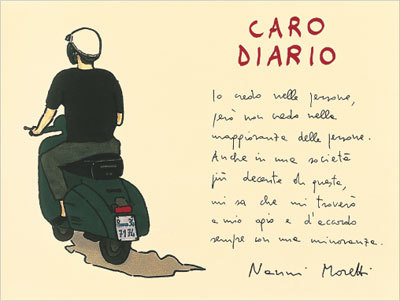
Caro Diario (1993) dir. by Nanni Moretti


Caro Diario is the three-part film memoir of Italian director and actor Nanni Moretti. In part one, Vespa, the camera follows Nanni around Rome on his Vespa, with panning shots of buildings and Nanni stopping to speak with random people on the street, including an encounter with Jennifer Beals. Part two, Isole, follows Nanni and his friend from island to island, trying to find the perfect spot to sit down and work. The film concludes with Medici, documenting Nanni as he gets diagnosed with cancer. 

From what I've heard, this is one of the films that Moretti is best known for. Called the Woody Allen of Italy, he definitely is a bit strange, but in my opinion not very appealing. The film had the opportunity to be very beautiful, but instead the colors were dingy and the places, especially the buildings, pretty rough on the eyes. I found the music to be annoying, except for this song, and there wasn't quite enough offbeat humor to make the whole thing worthwhile. I felt some Wes Anderson vibes from it, but it didn't have the strong aesthetic that Wes Anderson has. The first two parts felt sort of pointless, and the last was TMI. Overall I was mildly bored by the whole thing, and I don't really understand why this film has gotten so much praise. Perhaps I'm missing something. 
I do, however, like the idea of a sort of travelogue, inner-narration type thing. I was thinking of experimenting making one when I went to France this summer-- I like the idea of getting into filmmaking. Originally I thought Caro Diario would be sort of like the book Spotted In France, which follows a man around on his Vespa in the south of France with his Dalmatian, which was thoroughly enjoyable.

Sunday, January 5, 2014

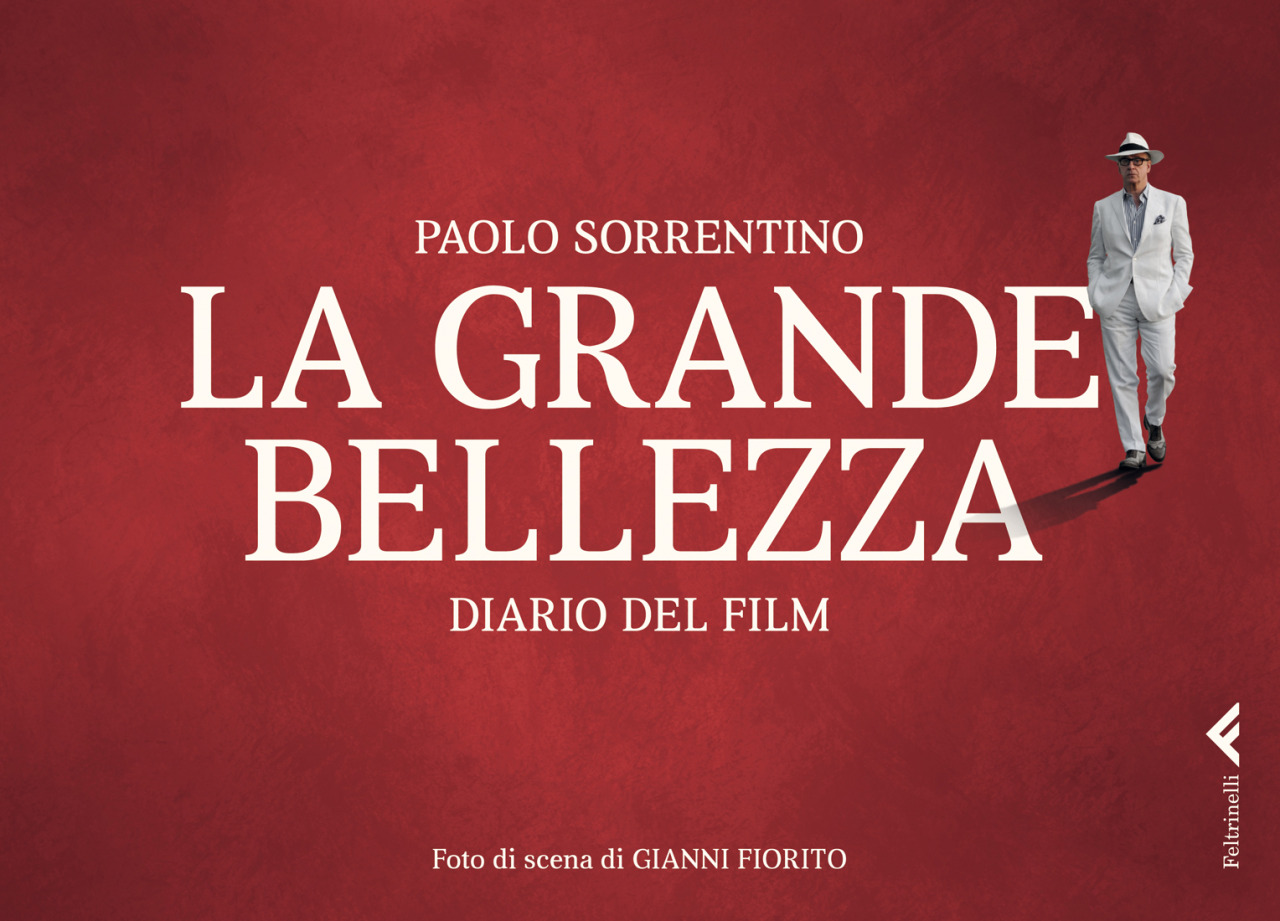
La Grande Bellezza (2013) Directed by Paolo Sorrentino


*Disclaimer*
This review is likely to be extremely biased considering that:
1.) It is Italian.
2.)I am Italian.


In La Grande Bellezza, director Paolo Sorrentino returns to Italy to tell the story of the aging king of Roman high-society, Jep Gambardella. We are introduced to Jep on his 65th birthday, a huge, Gatsby-style bash on a rooftop overlooking Rome, with people of all ages shimmying to synthetic club beats. (I'd just like to say, Jep's entrance to the movie is perfection, as seen below)


Jep is a renowned journalist and one-time author. He wrote The Human Apparatus in his youth, which received much acclaim, but never wrote another novel. He's spent the rest of his life searching for "la grande bellezza", or a great beauty, that would inspire him to write another work, but he has never found it.

Sorrentino tells his story in a very non-linear fashion. The scenes jump from place to place and time to time without much context or explanation, and it's up to the audience to figure out what's happening, so that in some places I got a little lost. But the juxtaposition between scenes is so well done: a booming, electrifying party scene will cut to a slow, quiet, beautifully shot scene like that, without any kind of transition, but it works, and it highlights the pace of Jep's life.

The aspect that was so striking about this movie were the moments of such pure beauty that would appear unexpectedly, and disappear just as fast. In Jep's words, "The haggard, inconsistent splashes of beauty." These were moments of the great beauty that Jep was looking for, and yet he could not see them as he lived them, only we, the audience, the tourists of the movie, would notice them. 


Part of the charm of the movie for me was the Italian personality it had. There was just an atmosphere to it that was incredibly different than American movies. The pace was so relaxed, the scenes not contrived, the humor, the characters, it felt so foreign, but good. There was something about reading the subtitles but having the Italian voices behind them; Italians speak with such passion and rhythm and expression, it really enhanced the lines. The actor, Toni Servillo, who played Jep, was genius. His face, all lined and old but still so expressive, it was really disarming. He was almost like a philosophical Italian Bill Murray. 

The soundtrack to this movie is still stuck in my head; it oscillates between heavy dance beats and ethereal violin and choral pieces, again reflecting the tone of the movie. My favorite tracks:


To be honest, I'm finding it so hard to review this movie because 1.) I loved it so much and I can't quite put why into words, and 2.) I didn't really understand it. It's not the sort of movie you really get the first time through, because it's so purely about life, and in the same vein, not really about anything. The whole package just creates this ineffable feel to the movie, of beauty and relaxation and pulsing life everywhere you look, of timelessness. It was my favorite movie of the year, and I plan on watching it many more times. All I can say is that if you have patience and an open mind, this movie is something you NEED to watch. I couldn't even stop watching during the credits, when the camera simulated a boat ride down the Tiber river as violin music played and names scrolled past. It was beautiful in every aspect of the word, and abstract at the same time. 


Saturday, December 28, 2013

Bottle Rocket(1996)


Bottle Rocket was Wes Anderson's debut film, and considering how much I love his work I've always been curious to see it. I got it as a Christmas present and watched it that night. The film stars the Wilson brothers, along with Robert Musgrave, and it was co-written by Owen Wilson. Luke plays Anthony, fresh out of the asylum and re-united with his vivacious friend Dignan(Owen). Dignan has got the idea that they should be criminals, rob stores and be on the run until they can join back up with Mr. Henry, the area's crime lord slash landscaping contractor. They bring their friend Bob along as a getaway driver, and consider themselves a gang.

It was definitely very interesting to see how Anderson got his start- although I didn't think the movie was very good, it's easy to see where much of his trademark style came from. The Wilson brothers fit perfectly with his writing- quirky looking actors, Luke with his big puppy eyes and Owen with his twice-broke nose. I didn't really understand Musgrave's acting, or his character for that matter. He played the bullied younger brother, unsure of himself, awkward, with some kind of exclusion complex. But the whole movie I was just sort of waiting for him to disappear, like his character was only making a cameo and the real third character would appear shortly. Bob just seemed superfluous; the movie could have been solely about Anthony and Dignan. I like to see how Wes found what fit for Luke Wilson- the deadpan, depressed, somewhat ironic romantic. I loved his line:
"One morning, over at Elizabeth’s beach house, she asked me if I’d rather go water-skiing or lay out. And I realized that not only did I not want to answer THAT question, but I never wanted to answer another water-sports question, or see any of these people again for the rest of my life."
It was one of the lines that really felt like Wes Anderson in the script. However, I just didn't believe that his character was a bit crazy, or that he was really under any kind of mental duress at all. It wasn't shown all that well.

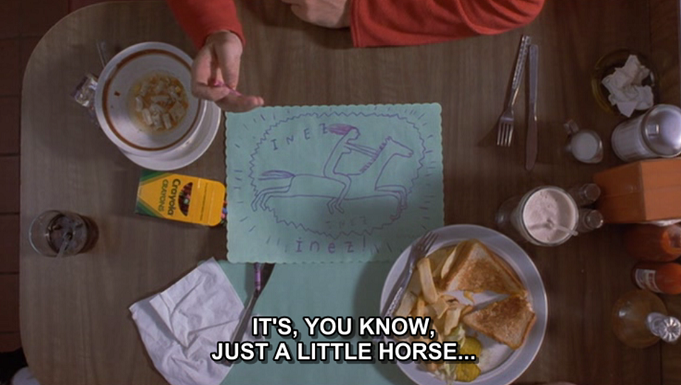
The romance between Inez and Anthony was one of the high points of the movie, when it really felt like it was going somewhere. It was very sweet and awkward and reminded me quite a bit of the romance between the youngest brother in The Darjeeling Limited and the train stewardess. I liked the way their relationship moved along; not anything wildly romantic, but cute and sort of realistic. 

The pacing for the rest of the movie didn't quite work. The whole time I was waiting for the plot to actually begin. There never felt like there was a real conflict, and there wasn't enough up and down to make the movie really go anywhere. 

Above all I felt like this was a learning experience for Anderson. Judging from his later works, he figured out what he liked in this and then refined it and played with it to get the desired effect. The yellow of the jumpsuits is seen in the yellow tent of The Royal Tenenbaums and Moonrise Kingdom. The up-close shots of writing and drawings and plans are recurrent, as well as the shots looking straight down at a surface with objects arranged on it. The zoom shots of faces are also a common feature. 


What most apparently lacked in this movie was the sense of inescapable irony Wes lends to his films. Whenever something is funny, there's a sad irony to the humor that keeps you from laughing too hard, and when something is said there's a humorous irony to lighten the mood. I don't think Anderson had quite perfected that balance yet, so the movie isn't emotional but doesn't have the irony to keep it interesting.

Although I didn't like the movie and probably would not watch it again, there's a comfort in knowing that even a director as great as Wes Anderson was not perfect from the beginning but obviously learned quite a bit from his mistakes and came out with something better because of them.

Now I have to see Rushmore and I'll have seen his whole filmography!

Friday, December 27, 2013

Surrogates(2009)


Surrogates came out in 2009, directed by Jonathan Maslow and starring Bruce Willis.The story is based in the future, when the invention of humanoid robots, or "surrogates", has completely changed the everyday way of life. People don't go outside anymore; instead they experience the world through their surrogate, which they control from a chair in the comfort of their own home. The surrogates are all twenty-something, attractive, thin, and users can live out their every whim without fearing any sort of harm.

However, there is a countermovement against the widespread use of surrogates- groups of people in every city that refuse to conform, that choose to live in their human bodies and their human bodies only. They have special zones where no surrogates are allowed to enter, and their leader is called "The Prophet". They think the use of surrogates is unnatural and should be stopped.

The movie begins with the FBI discovering there is a weapon that can kill the actual users of the surrogates through killing their surrogates- an idea that goes against the very idea of the robots. Bruce Willis plays the FBI agent Tom Greer, who is determined to solve the case, and this leads him through a series of car/helicopter chases and gunfights. Eventually his surrogate body is destroyed, and he experiences the city in his human form, seeing the negative effects of surrogate culture.

My bone to pick with this movie was that it has really great ideas as far as presenting a dystopian culture, but it didn't do justice to these ideas because of what it was trying to be. Many parallels could be drawn between our present day online personas and the surrogates- oftentimes we edit our digital selves to portray us in the best possible light, or someone else entirely. We're striving as a society for youth and beauty and perfection, while simultaneously drifting farther and farther away from what it really means to be human. But to develop these thoughts would take time and subtlety, both of which the movie did not allow for. It jumped from action scene to action scene to revelation to Bruce Willis's blood and grime-covered face and back without a moment to spare for actual thought. 

What I did think was interesting, until the very end, was that you weren't sure who you were rooting for. There wasn't a bad guy, and the main character wasn't necessarily a good guy. You were caught between your desire for such a beautiful, perfect society, and your gut feeling of wrongness. I guess you could say it was almost an emotional "uncanny valley". It seems right, but there's something just a little off and not quite human that makes you shy away. 

As far as character development goes...rudimentary. It was introduced at the very beginning that Tom Greer's son has died, and there are some underlying issues existing between him and his wife that she tries to hide with her use of the surrogate. But it just seemed like an easy way out for the writers. A child's death at some vague moment before the story happened is a surefire way to illicit sympathy without having to go too deep. I found myself not really caring. 

The movie was fine, but sort of a shame. I wish it had focused more on the subtleties and culture of the setting rather than the number of explosions could be fit into two hours. Im sure there have been other movies and novels about this idea, but Surrogates just left me feeling unsatisfied.


P.S. Merry Christmas! I hope everyone had a wonderful holiday! I'm planning on posting a lot more soon- I got lots of great books and movies from my family.


Saturday, November 23, 2013

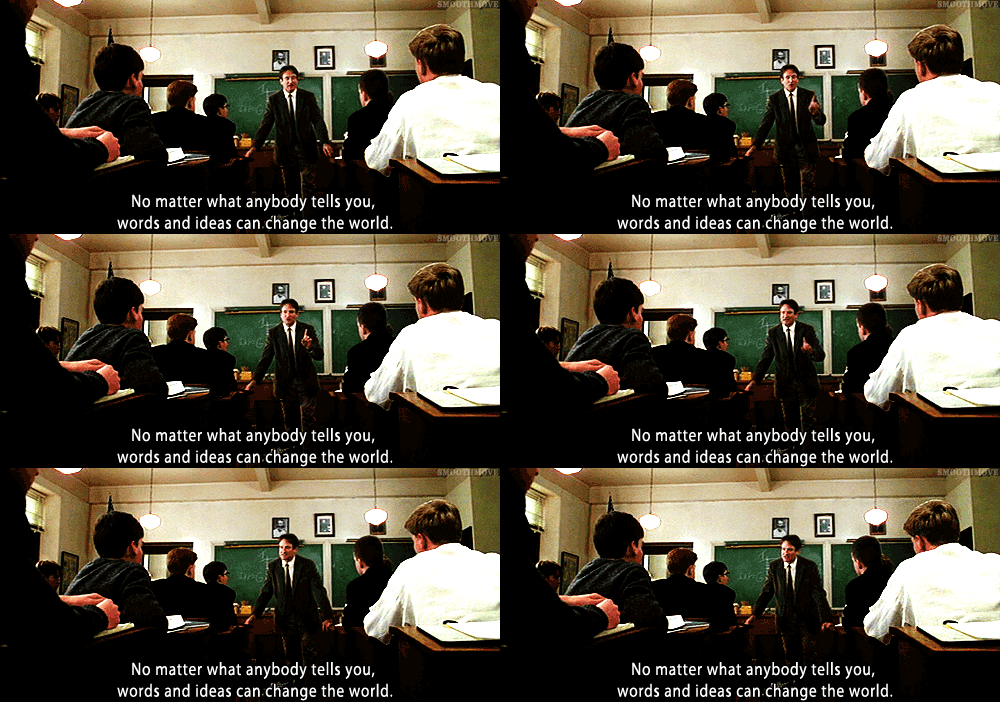
Dead Poets Society (1989)


Painfully shy Todd Anderson has been sent to the school where his popular older brother was valedictorian. His room-mate, Neil, although exceedingly bright and popular, is very much under the thumb of his overbearing father. The two, along with their other friends, meet Professor Keating, their new English teacher, who tells them of the Dead Poets Society, and encourages them to go against the status quo. Each, in their own way, does this, and are changed for life.
(Liz Jordan)

The impression I got from this film was in one word: romance. Not the sort of romance in cheap novels or sappy movies; no, the sort of romance one gets with ideas and dreams. The setting is one that I'm known to have a weakness for: prep school. The film was a profusion of plaids and cable-knits, old wood and white-washed walls. There wasn't much to be said for the cinematography or style of the movie- it was more centered around the plot, but the plot was compelling. It was so inspiring to see a teacher come in and inspire students, to see them want to read poetry and actually be passionate about things and speak seriously about their ideas. It made me yearn for a "dead poet's society" at my school, for people with whom I could recite poetry and discuss ideas, be passionate about beliefs with, because there is a large part inside of me that wants to do that. I suspect there is a large part like that in many people, yet the problem is that none of us show it, preoccupied as we are with maintaining the superficiality that keeps everything passively pleasant in our social lives. I'll say that the ending of the film came as a bit of a shock to me: I won't give spoilers but the ending kept the film from being too cheesy and inspirational. I don't have too much to say- although some of the ideas were inspiring in the movie, there wasn't too much I really connected with, or that made the movie stand out. I feel like this idea has been done in the past, and has been done again- teaching the younger generation that there is rebellion in free thought. Watching Dead Poets Society brought to mind the movie Les Choristes, which follows the same sort of storyline, except with a music teacher and set in France. I much preferred Les Choristes to this: it was much more atmospheric and the soundtrack lent an air of beauty that wasn't there in this movie. 

2.5/5 stars


As a last note, something I was sort of annoyed by was how the ideas were just outright stated by the characters rather than illustrated in the story- it almost seemed like cheating to me. It's my belief that in movies the ideas should be shown rather than told; it makes them that much more potent. It just seems lazy to have a character say everything.

If you liked this movie you should watch Les Choristes.


Wednesday, May 15, 2013

The Darjeeling Limited Directed by Wes Anderson


The Darjeeling Limited makes four out of six Wes Andersons that I have watched, and I've come to the conclusion that that man is actually incapable of making a bad movie. India was the perfect setting for his style, and he took full advantage of the saturated colors his setting provided, again playing up his iconic yellow and blue contrasting.


The movie began with, actually, a short movie, titled Hotel Chevalier. It was an interesting idea as a lead-in to the movie to supply some more depth to the back story, but personally I didn't like it. The short took place in the Hotel Chevalier in Paris, where the character Jack had been staying for quite some time. His ex-girlfriend(Natalie Portman) comes to visit him, and you get a look into their complicated relationship, her saying, "Whatever happens in the end, I don't want to lose you as a friend." and him replying, "I promise I will never be your friend. No matter what. Ever." I guess the reason I didn't like this short was that it wasn't deadpan enough for Wes Anderson. You get the kind of dysfunctional, aloofness of the character Jack, but Natalie Portman just isn't a Wes Anderson actress. She's too mainstream, too pretty, not strange enough. And her lines are too emotional. When they're conversing, you don't get the sense of sick amusement in their tragic, emotional dialogue. And also what sort of offended me was the nudity/graphic quality. Anderson just seems, I don't know, above that. It was a little bit of a shock to see it in the film.


As for what the real movie was about, it follows the journey of three semi-excommunicated brothers from an obviously semi-wealthy, dysfunctional family, on their train ride across India on what Francis, the oldest, calls a "spiritual journey". The train they ride on is called the Darjeeling Limited, hence the name of the movie. It turns out that Francis has planned on finding their mother, who you get the sense of as flighty, and who disappeared awhile back, not even coming to their father's funeral. They encounter numerous stops along the way, and the movie follows the typical "quest" format; Questers(the brothers) A place to go(India) a reason to go there(to find their mother) dangers along the way(stops, poisonous snakes, boy drowning) a princess (Indian stewardess) an enemy (the steward) and a real reason for the quest (self-discovery and rediscovering eachother as brothers)


What hit me first about this movie was how fast you knew which brothers were the youngest, middle, and oldest. Anderson really nailed that dynamic right on the head. Jack is youngest, the little one who craves attention and who struggles to keep up with the others. Francis is obviously the oldest, as is clearly displayed in the breakfast scene where he orders for everyone, telling them what they want, and then asking them to raise their hands for another item on the menu. You can also tell that he feels responsible, almost parent-like, for his little brothers, when he asks something like, "Did I not do a good job raising you?" in passing. Peter falls in the middle, having more of a muted personality, and not making a big deal of his personal problems. I also love how Peter and Jack would tell each other things, then say, "Don't tell Francis" obviously because Francis is the more parent-like figure that they have to own up to. But I like that Wes doesn't allow these secrets to become dramatic, and how they get out pretty quickly, and in a very nonchalant way. Jack finds out Peter told Francis he planned on leaving early, so Jack says very matter-of-factly and without any ado, "Peter's having a baby in nine weeks." And how they avoid conflict as well--my favorite was when Francis revealed he had taken Jack's passport, and Peter just walks away. Francis asks where he's going, and Peter is just like,"To uhh pray at a different thing" I can relate to so much of this since I am the youngest of three siblings, and realistic interactions made me wonder if Wes had siblings himself.


Wes Anderson definitely isn't trying to be subtle in his use of symbolism in this movie; I mean it takes place on a train, which basically screams moving through life. The train they are all on, the Darjeeling, is not a very good atmosphere. It is heavy with secretive parallels; the siblings are always telling each other not to tell each other things, and they have to keep such things as smoking and a poisonous snake secret from the steward. The steward himself represents the anger and hatred between the brothers, and the stewardess is the unhealthy relationship that Jack is in. Throughout the movie, the brothers are carrying around all this luggage/baggage *baggage*, and it's always kind of in the back of your head, annoying you, like, "why are they lugging this all around?!" and it's so refreshing when they are running to get on their new train, the healthier, more balanced one, they drop all their luggage.


Okay but I actually loved the casting for this movie (with the exception of Natalie Portman but that has already been addressed)  Something that is consistent in Wes Andersons is the use of actors that aren't quite attractive, instead having interesting and quirky faces, and that was shown again in this.

I absolutely loves Jason Schwartzman as Jack. His big mustache and haircut in the movie, in addition to his comparatively short stature and big dopey eyes, made him seem so little brother. I love that when he walked with his brothers he had to take twice as many steps to keep up; it was so cute and little duckling. He looked sort of mopey throughout the movie, but in that kind of immature little brother way, and it just fit the role so perfectly. I thought that it was hilarious when Francis kept saying "Jack agrees" and at a certain point Jack was just like


ADRIEN BRODY. I can't... I don't even know how to broach this. He was so great as the middle sibling who was just trying to figure out his life on his own in a quiet way, who wasn't so sure what to do with himself and kind of just went along with whatever was said. But I loved how you could tell through the whole film he really did love his brothers, and how he was kind of dealing with the idea of having a son when he knew how messed up his family was. And i love how he would always take his family's things; it showed in a subtle way ho attached he was to them. His character was a more subtle one, but I thought the most interesting in the movie.


Okay, so actually I'm pretty much done with Owen Wilson. He plays the same character every time! He played Francis, the oldest, in this, and he did an okay job, but I just can't see him as the character, I always see him as himself. Just meh.


I guess what was different about this movie was the emotional aspect of it. In the other Wes Andersons I've seen, there's always this sense of detachment, of cynicism and irony. It's like, whenever there's a sad situation there's ironic humour to balance it, and whenever there's a funny scene, there's tragedy to balance it, so the movie just goes in kind of this emotional flatline. And that's good, that's his style, and it's very distinct and interesting. This movie was a bit different from that; it let itself get more absorbed in the emotions and the scenes. When there was a sad moment, sometimes there wasn't the irony to bring you out of it. And I think that Wes Anderson executed this style brilliantly as well. The movie was a really great voyage through brotherhood; my favorite line was when jack asked, "Do you think we would have been friends in real life? Not as brothers, but as people." And I think that's the thing with families. You may not always like them, but you always always love them.

MUSIC SHOUT-OUT

This Time Tomorrow-The Kinks

Strangers-The Kinks

Champs Elysees-Joe Dassin

Search This Blog